
Mistakes Pertaining to "Aqidah" in Some Thai Translations of the Meaning of the Glorious Qur'an: An Analytic Study
Abstract
This research is aimed at submitting the fallacies found in the Qur'anic translatlion into Thai language. The researcher used the investigation method in order to bring out the findings. The research is divided into introduction, three chapters of discussion and conclusion. First chapter is a brief discussion on the dealing process of the Qur'anic translation into Thai language. Second chapter deals with examples of fallacies in translations. And the third chapter attempts to analyze the fallacies and the mistakes. The outcomes drawn from the research are as follows: 1. The active movement of the Qur'anic translation in Thai language has been begun in the forties in a form of fragmented translation, emphasizing only on certain chapters of the Qur'an. The first valuable piece of translation is the translation conducted by al-Islah Association, Bangkok Noi, and it was distributed in 1931. 2. The complete translation ( 30 Juz') is the version that has been conducted by al-Marhum Haji Ismail bin Yahya, (Tuan Suwannasart) Shaykh al-Islam [Chula Rajmontri; Thai]. It was printed at the expense of His Majesty the King of Thailand, and distributed in the year 1968. Then, in 1969, it was followed by the translation of Qur'an Majid by Ibrahim Quraishi (Direk Kullasirisawat). In 1981, Shaykh Murwan (Winai) Sama-on, had devotedly rendered his own version; and in 1989 appeared another version conducted by the Association of Arab Universities Alumni. It is worth mentioning here that this version--according to the researcher—is the appropriate translation ever existed in Thai language. Thus, King Fahd Holy Qur'an Printing Complex, al-Madinah al-Munawarah had exclusively singled it out and got it printed after being neatly revised. 3. The fallacies found in the translations of Tuan Suwannasart, Ibrahim Quraishi, Marwan Sama-on and Zainul Abidin Fendi involve the Divine Attributes [Sifat Ilahiyah]. The vital fallacies on the prophecy verses [ayat nubuwah] about Isa al-Masih 'alaihi al-salam and his mother Mariam, also the mircles, karamat, jinni and shayatin are explicitly found in Bayan Qur'an and Qur'an Majid of Ibrahim Quraishi. The verses on the Hereafter [ma'aad], the Heaven and Hell have no exeption. The above mentioned fallacies are discovered in Bayan Qu'an and Quran Majid by Ibrahim Quraishi, known as Direck Kullasirisawat. 4. The fallacies observed in the translations are due to the notions and methods of the Khalaf Mutakallimun. The sources of the fallacies in the translations about the prophecy and ma'aad are taken from the concept of Muhammad Ali al-Lahori, the head of Jama'ah al-Muhammadiyah [Qadyaniah) at Lahor. The fallacies occurred here, because the translator, Ibrahim Quraishi used the two books namely: Bayanul Qur'an and Qur'an Majid by Muhammad Ali al Lahori, as the guidline references in rendering and interpreting his version, This, in fact, has been clearly confirmed by Ibrahim Quraishi himself in his "Introduction and also during conducting his works.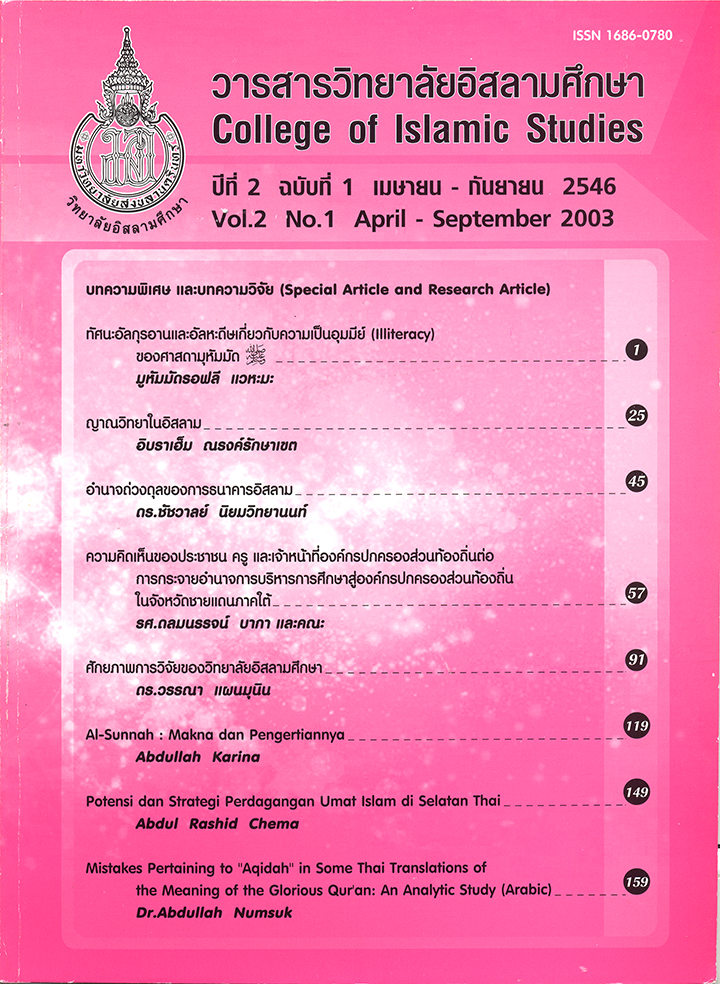
Downloads
Published
30-09-2003
How to Cite
Numsuk, A. (2003). Mistakes Pertaining to "Aqidah" in Some Thai Translations of the Meaning of the Glorious Qur’an: An Analytic Study. Journal of Islamic Studies, Prince of Songkla University, 2(1), 159–200. Retrieved from https://so03.tci-thaijo.org/index.php/JOIS/article/view/307112
Issue
Section
Academic Articles
License
All articles Published in The Journal of Islamic Studies are author’s opinions, and not the responsibility of the Faculty of Islamic Sciences nor the editorial board. However any citation should be referred to the journal.