
Al-Sunnah: Its Meaning and Definition
Abstract
Al-Sunnah is a system that was done and practiced by Rasulullah (peace be upon him) during his life time. It contains the best models and excellent examples to be followed in all aspects. Al-Sunnah consists of Prophet's words, deeds, and acknowledgment. This includes also the deeds of khulafa' rasyidin. Some muslim scholars consider al-Sunnah as the opposite to al-Bid'ah, an invention that does not have evidences to prove. However, the unconformity of the scholars in certain cases confines itself only on the external parts, and it is due to the different opinions in construting Islamic precepts derived from al-Sunnah. There are two types of al-Sunnah: general characteristic and specific one. The Sunnah bearing general characteristic phenomenon covers the teachings of al Qur'an and al-Hadith, also the companiaons' deeds. Whereas the specific characters focuses only for RasululLahe deeds not on others. The Sunnah as such is understood by al-Salaf al-Salih and incorporated in their lives. According to Ahl al-Sunnah, it is obligatory for RasululLah and Muslim community (Ummah) to obey and follow the general characteristic Sunnah. Whenever the special characteristic Sunnah is only for RasululLah, not compulsory for Ummah to obey or follow whether they know the secrets which are hidden inside the contents of al-Sunnah or not. So do, al-Sunnah which contains obligatory laws or commendable laws, because it is impossible that the Prophet would order his Ummah to do things that they have no ability to do and that are not suitable or fitting their ways of lives. Furthermore, the Prophet's way is moderate and up to each person's ability.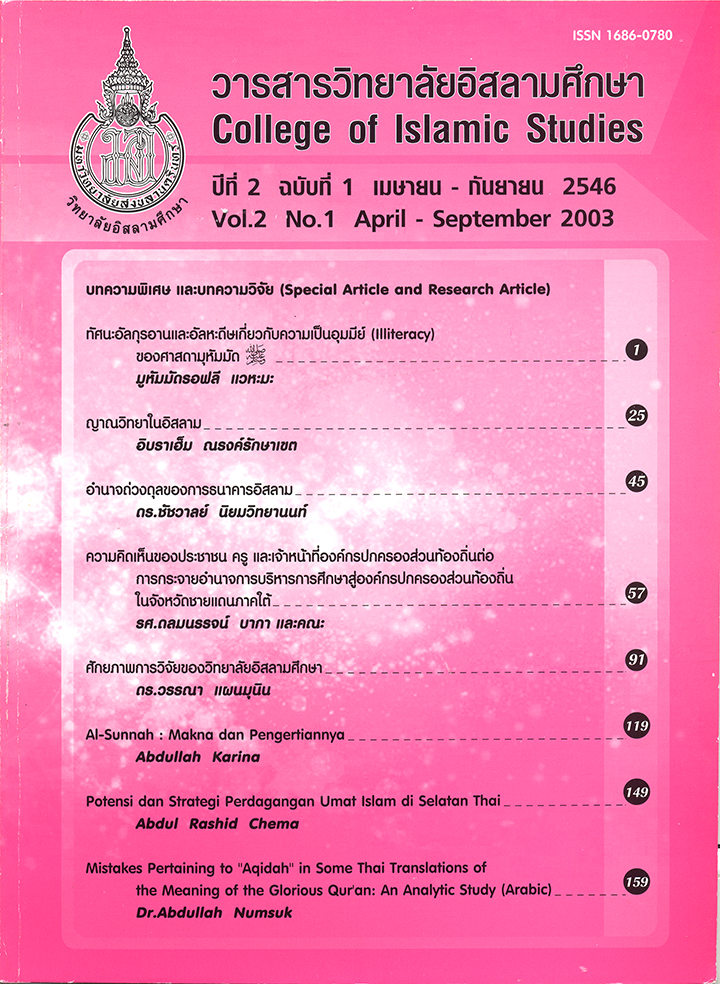
Downloads
Published
30-09-2003
How to Cite
Karina, A. (2003). Al-Sunnah: Its Meaning and Definition. Journal of Islamic Studies, Prince of Songkla University, 2(1), 119–148. Retrieved from https://so03.tci-thaijo.org/index.php/JOIS/article/view/307111
Issue
Section
Academic Articles
License
All articles Published in The Journal of Islamic Studies are author’s opinions, and not the responsibility of the Faculty of Islamic Sciences nor the editorial board. However any citation should be referred to the journal.