
Cognitive Behavioral Therapy (CBT) with Internet Gaming Disorder
Article Sidebar
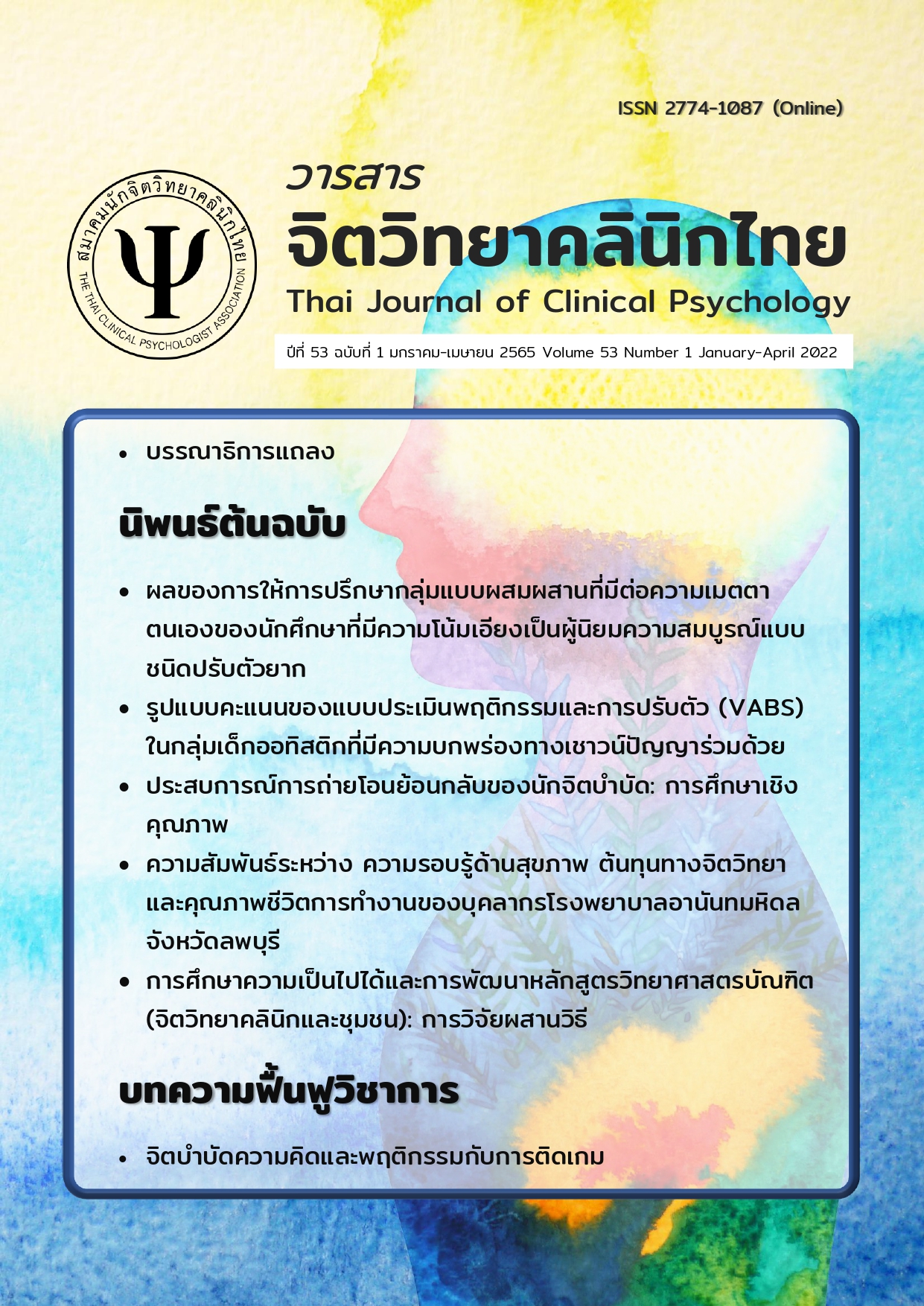
Main Article Content
Abstract
This article aims to review the literature about Cognitive Behavioral Therapy (CBT) and game/internet addiction. The author reviews academic articles, research, and textbooks available on Thailis, PubMed, Google Scholar and ScienceDirect, presenting principles of Cognitive Behavioral Therapy (CBT) and its implementation. The literature shows that Cognitive Behavioral Therapy (CBT) yields the most effective outcomes on game/internet addiction among other therapy techniques. In addition, the literature also presents specific interventions such as selfmonitoring, cognitive restructuring, behavior modification, etc. The author hopes that this article works as a primary resource for mental health professionals who work in the area of game/internet addiction. However, further study is needed for more evidence on effectiveness and therapy program.
Article Details

This work is licensed under a Creative Commons Attribution-NonCommercial-NoDerivatives 4.0 International License.
เรื่องที่ลงตีพิมพ์ในวารสารจิตวิทยาคลินิกแล้วถือเป็นลิขสิทธิ์การเผยแพร่โดยวารสารจิตวิทยาคลินิกแต่เพียงผู้เดียว การตีพิมพ์หรือเผยแพร่ซ้ำในที่อื่นต้องได้รับอนุญาตจากกองบรรณาธิการวารสารฯ
References
American Psychiatric Association (2013). Diagnostic and statistical manual of mental disorders (Fifth ed.). American Psychiatric Publishing. pp. 795-797.
Beck, A. T., Rush, A. J., Shaw, B. F., & Emery, G. (1979). Cognitive therapy of depression. New York: Guilford Press.
Bass, P. F. (2015). Gaming addiction: When going online goes off-kilter. Contemporary Pediatrics. 32(11), 16–23.
Dong, G., & Potenza, M. N. (2014). A cognitive-behavioral model of Internet gaming disorder: theoretical underpinnings and clinical implications. Journal of psychiatric research, 58, 7-11.
Freeman, C. B. (2008). Internet gaming addiction. The Journal for Nurse Practitioners, 4(1), 42–47.
Han, J., Seo, Y., Hwang, H., Kim, S.M. & Han, D.H. (2019). Efficacy of cognitive behavioural therapy for internet gaming disorder. Clinical Psychology and Psychotherapy. 27(2), 203-213 https://doi.org/10.1002/cpp.2419.
Kabat-Zinn, J. (1994). Wherever you go, there you are: Mindfulness meditation for everyday life. Piatkus Books.
King, D.L., Delfabbro, P.H. Wu, A.M.S. Doh, Y.Y., Kuss, D.J., Pallesen, S., Mentzoni, R., Carragher, N., and Sakuma, H. (2017). Treatment of Internet gaming disorder: An international systematic review and CONSORT evaluation. Clinical Psychology Review. 54,123-133.
Lemos, I. L., Abreu, C. N. D., & Sougey, E. B. (2014). Internet and video game addictions: A cognitive behavioral approach. Archives of Clinical Psychiatry (São Paulo), 41(3), 82-88.
Lee, E. J. (2011). A case study of internet game addiction. Journal of Addictions Nursing. 22(4), 208–213. https://doi:10.310 9/10884602.2011.616609.
Li, H., & Wang, S. (2013). The role of cognitive distortion in online game addiction among Chinese adolescents. Children and Youth Services Review, 35(9), 1468–1475.
Petry, N.M., & Steinberg, K.L., Women's Problem Gambling Research. (2005). Childhood maltreatment in male and female treatment-seeking pathological gamblers. Psychology of addictive behaviors. Psychology of Addictive Behaviors; 19: 226–229.
Potenza, M. N., Hong, K. I., Lacadie, C. M., Fulbright, R. K., Tuit, K. L., & Sinha, R. (2012). Neural correlates of stress-induced and cue-induced drug craving: influences of sex and cocaine dependence. The American journal of psychiatry, 169(4), 406–414. https://doi.org/10.1176/appi.ajp.2011.11020289
Rush, A. J., Beck, A. T., Kovacs, M., & Hollon, S. (1977). Comparative efficacy of cognitive therapy and pharmacotherapy in the treatment of depressed outpatients. Cognitive Therapy and Research, 1(1), 17-37.
Vasiliu, O. & Vasile, D. (2017). Cognitive-behavioral therapy for internet gaming disorder and alcohol use disorder- A case report. International Journal of Psychiatry and Psychotherapy. 2, 34-38.
Young, K. S. (2013). Treatment outcomes using CBT-IA with Internet-addicted patients. J. Behav. Addict. 2, 209–215. https://doi: 10.1556/JBA.2.2013.4.3
Young, K.S. & Brand, M. (2017). Merging theoretical models and therapy approaches in the context of internet gaming disorder: A personal perspective. Front. Psychol. 8: 1-12. https:// doi:10.3389/fpsyg.2017.01853
