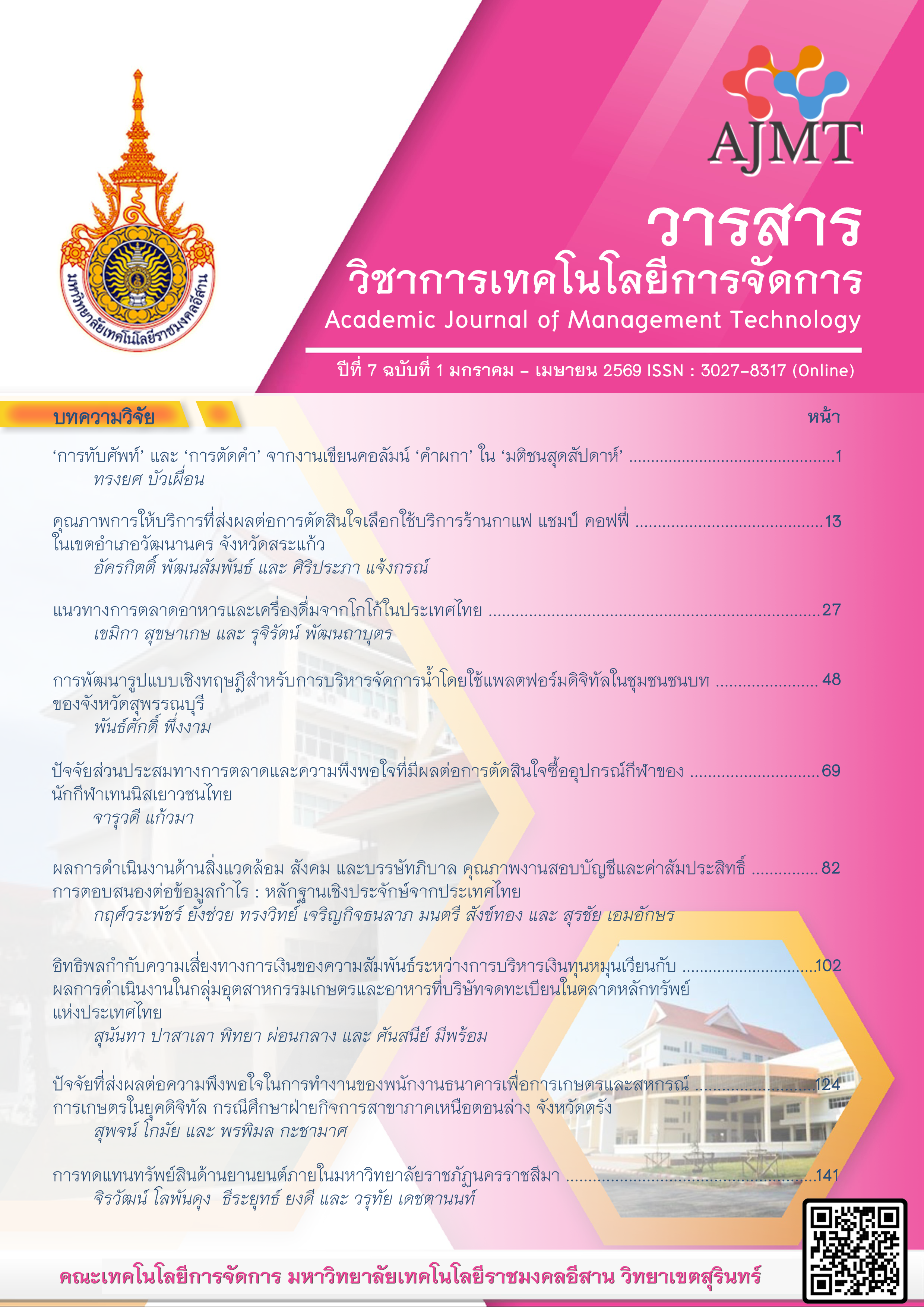
The Moderating Role of Financial Leverage in the Relationship between Working Capital Management and Financial Performance of the Agro & Food Industry on the Stock Exchange of Thailand
DOI:
https://doi.org/10.14456/ajmt.2026.7Keywords:
Working Capital Management, Agro & Food Industry, Financial Leverage, Firm PerformanceAbstract
This study examines the relationship between working capital management and financial performance, with financial leverage serving as a moderating variable. The sample comprises 51 companies listed in the Agro & Food Industry sector on the Stock Exchange of Thailand, covering the period 2020–2024 and yielding a total of 233 firm-year observations. Data were analyzed using multiple regression analysis and moderation analysis via the PROCESS MACRO. The findings indicate that the current ratio has a significant effect on return on assets; however, no significant effect on return on equity was observed. Meanwhile, inventory turnover period, accounts receivable turnover period, and accounts payable turnover period showed no significant relationship with either return on equity or return on assets. Regarding the moderating role of financial leverage, the results demonstrate that financial leverage significantly moderates the relationships between the current ratio and inventory turnover period and return on assets, with the moderating effect becoming pronounced at moderate and high leverage levels. Financial leverage was also found to moderate the relationship with return on equity. These findings suggest that highly leveraged firms are better positioned to utilize working capital management, especially effective inventory control, to convert debt obligations into opportunities for generating superior returns on equity, compared with compared with low-leverage firms.
References
Akartwipart, A. (2023). Influence of Working Capital Management on Profitability of Companies Listed on the Stock Exchange of Thailand in the Real Estate Industry. Humanity and Social Science Journal, Ubon Ratchathani University, 14(2), 261–290.
Aldubhani, M. A., Wang, J., Gong, T., & Maudhah, R. A. (2022). Impact of Working Capital Management on Profitability: Evidence from Listed Companies in Qatar. Journal of Money and Business, 2(1), 70–81.
Almomani, T. M., Almomani, M. A., & Obeidat, M. I. (2021). The Relationship Between Working Capital Management and Financial Performance: Evidence from Jordan. The Journal of Asian Finance, Economics and Business, 8(6), 713-720.
Alsulayhim, N. (2019). The Relationship between Working Capital Management and Profitability. International Business Research, 12(8), 142-152.
Dalci, I., & Ozyapici, H. (2018). Working Capital Management Policy in Health Care: The Effect of Leverage. Health Policy, 122(11), 1266–1272.
Deloof, M. (2003). Does Working Capital Management Affect Profitability of Belgian Firms?. Journal of Business Finance & Accounting, 30(3‐4), 573-588.
Efinancethai. (2025). Insight into Thai Stocks after Q3/2025: Which Stocks Have Soaring Profits and Which are Slowing Down? (In Thai). https://www.efinancethai.com/recommended-for-you/thai-stock-q3-2025-winners-losers
Hair, J. F., Black, W. C., Babin, B. J., & Anderson, R. E. (2010). Multivariate Data Analysis: A Global Perspective (7th ed.). Pearson Education.
Habib, A. M. (2022). Does the Efficiency of Working Capital Management and Environmental, Social, and Governance Performance Affect a Firm’s Value? Evidence From the United States. Financial Markets, Institutions and Risks, 6(3), 18–25.
Hayes, A. F. (2022). Introduction to Mediation, Moderation, and Conditional Process Analysis: A Regression-Based Approach (3rd ed.). The Guilford Press.
Intara, P., & Wanganusorn, B. (2023). The Relationship between Working Capital Management Efficiency and Financial Performance: The Case of Listed Companies in Agro and Food Industry in Thailand. Economics and Business Administration Journal Thaksin University, 15(4), 73–92.
Jia, H., Mohammed, M., & Elizabeth, S. A. (2020). The Impact of Working Capital and Debt Financing on the Profitability of Licensed Banks in Ghana. International Journal of Trend in Scientific Research and Development, 5(1), 90–102.
Kanjanalai, P., Davivongs, K., & Limsombunchai, V. (2024). Working Capital Management and Profitability of Agro and Food Business in the Stock Exchange of Thailand During Pre and Post COVID-19. Journal of Humanities and Social Sciences Thonburi University, 18(1), 48–59.
Kiymaz, H., Haque, S., & Choudhury, A. A. (2024). Working Capital Management and Firm Performance: A Comparative Analysis of Developed and Emerging Economies. Borsa Istanbul Review, 24(3), 634–642.
Krissadee, P., Thebpanya, S., & Rungseriruch, G. (2023). The Impact of Working Capital Management on the Profitability of Listed Food Companies in Thailand. Executive Journal, 43(2), 22–36.
Kulvijit, T., & Yangklan, P. (2024). Factors of Capital Structure and Working Capital Management that Affect Profitability of Companies in the Property and Construction Industry Listed in the Stock Exchange of Thailand. Academic Journal of Management Technology, 5(2), 1–14.
Lefebvre, V. (2022). Performance, Working Capital Management, and the Liability of Smallness: A Question of Opportunity Costs?. Journal of Small Business Management, 60(3), 704–733.
Mahmood, F., Han, D., Ali, N., Mubeen, R., & Shahzad, U. (2019). Moderating Effects of Firm Size and Leverage on the Working Capital Finance–Profitability Relationship: Evidence from China. Sustainability, 11(7), Article 2029. https://doi.org/10.3390/su11072029
Mitaliani, R., & Rasyid, R. (2023). The Impact of Working Capital Management on Profitability with Leverage as a Moderating Variable in Basic Industrial and Chemical Sectors. In Proceedings of the Ninth Padang International Conference on Economics Education, Economics, Business and Management, Accounting and Entrepreneurship (PICEEBA 2022) (pp. 586–594). Springer. https://doi.org/10.2991/978-94-6463-158-6_51
Modigliani, F., & Miller, M. H. (1958). The Cost of Capital, Corporate Finance and the Theory of Investment. American Economic Review, 48(3), 261–296.
Modigliani, F., & Miller, M. H. (1963). Corporate Income Taxes and the Cost of Capital: A Correction. The American Economic Review, 53(3), 433–443.
Osei, A., Osei Agyemang, A., Amoah, J. O., & Sulemana, I. (2023). Empirical Study on the Impact of Working Capital Management on Going Concern of Manufacturing Firms in Ghana. Cogent Business & Management, 10(2), 2218177. http://doi.org/10.1080/23311975.2023.2218177
Phuribiboon, P. (2019). Relationship Between Working Capital Management and Operating Results of Companies in the SET50 Group, The Stock Exchange of Thailand. Academic Journal University of the Thai Chamber of Commerce Humanities and Social Sciences, 41(1), 163–180.
Sakaew, J., & Chotkunakitti, P. (2024). Relationship between Working Capital Management and Profitability of Companies Listed on the Stock Exchange of Thailand: Before and During the COVID-19 Pandemic. Business Administration and Economics Review, 20(1), 36–49.
Settrade. (2025). Livestock Feed Business Trends (Updated). https://www.settrade.com/th/news-and-articles/articles/628-krungthai-compass-animal-feed-agro-update
Shaik, A. R., Ali, A., & Alanazi, I. D. (2023). Working Capital and Financial Performance in the Energy Sector of Saudi Arabia: Moderating Role of Leverage. International Journal of Energy Economics and Policy, 13(3), 158–163.
Stevens, P. (1992). Applied Multivariate Statistics for the Social Sciences. Lawrence Erlbaum Associates.
Suwannaphak, S., Tewongsa, A., Chancharat, S., & Chancharat, N. (2018). The Relationship Between Working Capital Management and Profitability: The Case of Listed Companies in Argo and Food Industry in Thailand. NIDA Business Journal, 23, 92–113.
Downloads
Published
How to Cite
Issue
Section
License
Copyright (c) 2026 Faculty of Management Technology, Rajamangala University of Technology Isan Surin Campus

This work is licensed under a Creative Commons Attribution-NonCommercial-NoDerivatives 4.0 International License.
บทความที่ได้รับการตีพิมพ์เป็นลิขสิทธิ์ของคณะเทคโนโลยีการจัดการ มหาวิทยาลัยเทคโนโลยีราชมงคลอีสาน วิทยาเขตสุรินทร์
ข้อความที่ปรากฏในบทความแต่ละเรื่องในวารสารวิชาการเล่มนี้ เป็นความคิดเห็นส่วนตัวของผู้เขียนแต่ละท่านไม่เกี่ยวข้องกับคณะเทคโนโลยีการจัดการ มหาวิทยาลัยเทคโนโลยีราชมงคลอีสาน วิทยาเขตสุรินทร์ และคณาจารย์ท่านอื่นๆในมหาวิทยาลัยฯ แต่อย่างใด ความรับผิดชอบองค์ประกอบทั้งหมดของบทความแต่ละเรื่องเป็นของผู้เขียนแต่ละท่าน หากมีความผิดพลาดใดๆ ผู้เขียนแต่ละท่านจะรับผิดชอบบทความของตนเองแต่ผู้เดียว