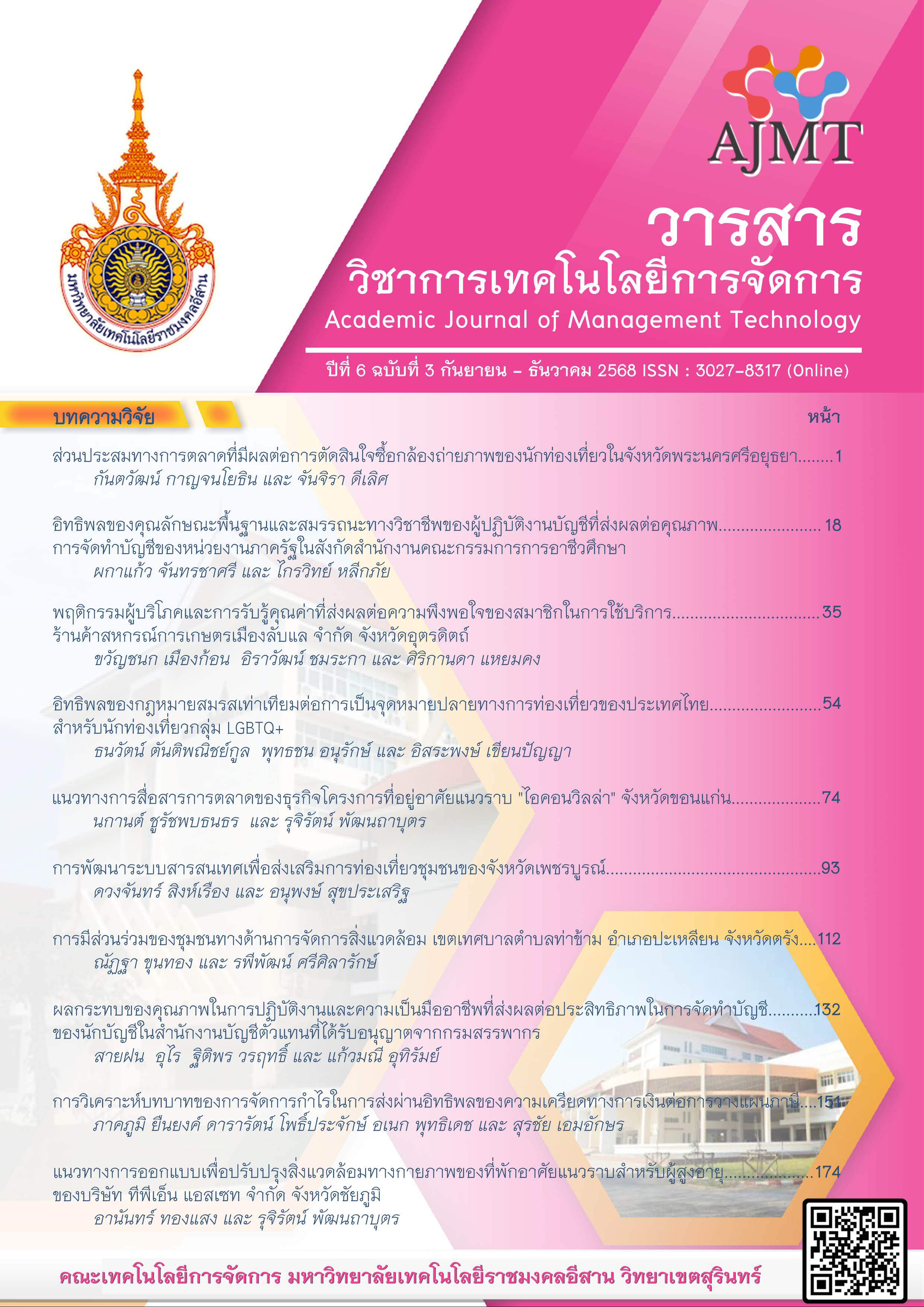
Influence of the Marriage Equality Law on Thailand as a Tourism Destination for LGBTQ+ Tourists
DOI:
https://doi.org/10.14456/ajmt.2025.21Keywords:
LGBTQ+ Tourism, Marriage Equality Law, Travel Intention, Theory of Planned BehaviorAbstract
This study aims to examine the effects of the Marriage Equality Law (MEL) on attitudes (ATT), subjective norms (SN), and perceived behavioral control (PBC) of LGBTQ+ tourists, as well as to analyze the influence of these variables on travel intention (INT) to visit Thailand. The participants were 400 self-identified LGBTQ+ individuals who had never traveled to Thailand, and data were gathered via an online questionnaire distributed among LGBTQ+ online communities. A 5-point Likert scale questionnaire was employed, and data were analyzed using multiple regression analysis. The findings reveal that MEL has a positive and statistically significant effect on ATT, SN, and PBC, explaining a substantial proportion of their variance (48–53%). Moreover, ATT and PBC were found to have positive and significant effects on INT, whereas SN showed a positive direction but without statistical significance. Overall, the research model explained 59.9% of the variance in travel intention. These results confirm that the Marriage Equality Law not only promotes equal rights but also contributes significantly to developing positive attitudes and building confidence among LGBTQ+ tourists, thereby enhancing Thailand’s image as a friendly and safe travel destination. The study contributes theoretically by extending the application of the Theory of Planned Behavior (TPB) within the context of law and tourism. In practical terms, it enables tourism operators to design services that respond effectively to LGBTQ+ travelers. From a policy perspective, the findings highlight that marriage equality can be strategically leveraged to strengthen Thailand's position as an LGBTQ+-Friendly Destination with strong potential in the global tourism market.
References
Ajzen, I. (1991). The Theory of Planned Behavior. Organizational Behavior and Human Decision Processes, 50(2), 179–211. https://doi.org/10.1016/0749-5978(91)90020-T
Badgett, M. V. L. (2014). The Economic Impact of Extending Marriage to Same-Sex Couples: Evidence from the United States. The Williams Institute, UCLA School of Law.
Bangkok Post. (2024, September 24). Marriage Equality Bill Becomes Law. Author. https://www.bangkokpost.com/thailand/general/2871458/marriage-equality-bill-becomes-law
Binnie, J., & Klesse, C. (2013). The Politics of Age, Temporality and Intergenerationality in Transnational Lesbian, Gay, Bisexual, Transgender and Queer Politics. Sociology, 47(3), 580-595. https://doi.org/10.1177/0038038512453795
CBI Ministry of Foreign Affairs. (2024). The European Market Potential for LGBTQ+ Tourism. CBI. https://www.cbi.eu/market-information/tourism/lgbtq-tourism/market-potential
Chayut, S., & Panarat, T. (2024). Thailand Becomes First Southeast Asian Country to Legalise Same-Sex Marriage. The Guardian. https://www.theguardian.com/world/2024/jun/18/thailand-same-sex-marriage
Cochran, W. G. (1977). Sampling Techniques (3rd ed.). John Wiley & Sons.
Field, A. (2018). Discovering Statistics Using IBM SPSS Statistics (5th ed.). Sage Publications.
Floyd, F. J., & Bakeman, R. (2006). Coming-Out Across the Life Course: Implications of Age and Historical Context. Archives of Sexual Behavior, 35(3), 287-296. https://doi.org/10.1007/s10508-006-9022-x
Hair, J. F., Black, W. C., Babin, B. J., & Anderson, R. E. (2019). Multivariate Data Analysis (8th ed.). Cengage Learning.
Hughes, H. L. (2002). Gay Men's Holiday Destination Choice: A Case of Risk and Avoidance. International Journal of Tourism Research, 4(4), 299–312. https://doi.org/10.1002/jtr.383
Hughes, H. L., Monterrubio, C., & Miller, A. (2010). “Gay Tourism” in the UK: Dimensions of Sexual Orientation Tourism. Tourism Management, 31(1), 1-12. https://doi.org/10.1016/j.tourman.2009.01.012
Jensen-Campbell, C. (2004). The Gay/Lesbian Travel Marketplace [White Paper]. USDM.net.
Johnston, L. (2005). Queer Cosmopolitanism and the Politics of Pride. Antipode, 37(4), 875-899. https://doi.org/10.1111/j.0066-4812.2005.00524.x
Kiatkamolsri, P., & Thayansin, K. L.-I. (2020). Factors Influencing LGBT Tourists' Loyalty in Pattaya, Chonburi Province. In Proceedings of the 15th Graduate Research Conference, Academic Year 2020 (pp. 1070-1084). Graduate School, Rangsit University. https://rsujournals.rsu.ac.th/index.php/rgrc/article/download/1919/1500/
Kobkitpanichpol, B., & Keawthip, P. (2022). The Analysis of LGBTQ+ Tourists Behavior in Chiang Mai Province. Journal of Management Science, Chiang Rai Rajabhat University, 17(2), 89–110.
Lam, T., & Hsu, C. H. C. (2006). Predicting Behavioral Intention of Choosing a Travel Destination. Tourism Management, 27(4), 589–599. https://doi.org/10.1016/j.tourman.2005.02.003
McNeil, O. (2021). I Do (or Don’t): The Impact of Same-Sex Marriage Laws on International Tourism (Honors thesis). University of California, Berkeley. https://www.econ.berkeley.edu/sites/default/files/McNeil_Oliver_HonorsThesis_2021.pdf
MCOT NEWS. (2025). TAT Pull LGBTQ to travel to Thailand after spending more than 73,000 baht per trip (in Thai). [Facebook post]. Facebook. https://www.facebook.com/share/p/1Ahgun17Nt/
Monterrubio, C. (2020). Sexual Minorities, Tourism and Spaces of Tolerance: The Case of Mexico. Annals of Tourism Research, 80, 102828. https://doi.org/10.1016/j.annals.2019.102828
Monterrubio, C., & Hughes, H. (2019). Gay Tourism: New Perspectives. Journal of Policy Research in Tourism, Leisure and Events, 11(3), 273-279. https://doi.org/10.1080/19407963.2019.1575952
Nunnally, J. C., & Bernstein, I. H. (1994). Psychometric Theory (3rd ed.). McGraw-Hill.
Penñaloza, L. (1996). We're Here, We're Queer, and We're Going Shopping! a Critical Perspective on the Accommodation of Gays and Lesbians in the U.S. Marketplace. Journal of Homosexuality, 31(1-2), 9-41. https://doi.org/10.1300/J082v31n01_02
Pornsuksawat, S., Kheokao, J., Wilainuch, P., & Phovijit, P. (2021). Exposure to Media and Information on Travel to Thailand and Lifestyle Segmentation of LGBT Tourists. Journal of the International Academy for Case Studies, 27(1), 1-8. https://www.abacademies.org/articles/exposure-to-media-and-information-on-travel-to-thailand-and-lifestyle-segmentation-of-lgbt-tourists.pdf
Pritchard, A., Morgan, N. J., & Sedgley, D. (2002). In Search of Lesbian Space? The Experience of Manchester’s Gay Village. Leisure Studies, 21(2), 105–123. https://doi.org/10.1080/02614360210139865
Pritchard, A., Morgan, N., Sedgely, D., & Jenkins, A. (1998). Reaching Out to the Gay Tourist: Opportunities and Threats in an Emerging Market Segment. Tourism Management, 19(3), https://doi.org/10.1016/S0261-5177(98)80016-2
Pritchard, A., Morgan, N., Sedgley, D., & Jenkins, A. (2000). Sexuality and Holiday Choices: Conversations with Gay and Lesbian Tourists. Leisure Studies, 19(4), 267–282. https://doi.org/10.1080/026143600750022283
Quintal, V. A., Lee, J. A., & Soutar, G. N. (2010). Risk, Uncertainty and the Theory of Planned Behavior: A Tourism Example. Tourism Management, 31(6), 797–805. https://doi.org/10.1016/j.tourman.2009.08.006
Reuters. (2024). Thailand Passes Landmark Bill Recognising Marriage Equality. Reuters. https://www.reuters.com/world/asia-pacific/thailand-passes-landmark-bill-recognising-marriage-equality-2024-06-18/
Russell, P. (2001). The World Gay Travel Market. Travel and Tourism Analyst, 2, 37-58.
Surajai, S. (2022). Behaviors and Expectations of LGBT Thai Tourists Traveling in Koh Samet, Rayong [Master’s thesis, Dhurakij Pundit University]. DPU Learning Library. https://libdoc.dpu.ac.th/thesis/Sunisa.Sura.pdf
Tongterm, T. (2025). Designing Recreational Spaces and Activities for Gender Diversity: Lessonsfrom Countries with Marriage Equality Laws. Journal of Education and Human Development. Sisaket Rajabhat University, 5(1), 62-80
UNWTO. (2012). Global Report on LGBT Tourism. World Tourism Organization.
UNWTO. (2017). Second Global Report on LGBT Tourism. World Tourism Organization. https://www.e-unwto.org
Veilleux, A. (2021). LGBTQ Tourism in Thailand in the Light of Glocalization : Capitalism, Local Policies, and Impacts on the Thai LGBTQ Community. FrancoAngeli. https://library.oapen.org/handle/20.500.12657/53224
Waitt, G., & Markwell, K. (2006). Gay Tourism: Culture and Context. Haworth Hospitality Press.
Wisartsakul, W., Panyakamphon, C., Hiransalee, S., & Sindhuras, T. (2021). A Study of Tourism Supply Promptness in Welcoming LGBT Tourists: A Case Study of Gay Tourists. Journal of International and Thai Tourism, 17(1), 140-163.
Wongwichit, N., Nadee, M., Panthong, K., Thawiphrom, R., Sungsunchat, C., Khumtong, P., Ngammoh, N., Boonraum, K., & Kiatprasert, P. (2023). Marketing Strategies Affecting Decisionsto ChooseEcotourism Destinations of Generation Z Tourists in Thailand. Academic Journal of Management Technology, 4(1), 29-40. DOI: https://doi.org/10.14456/ajmt.2023.3
Downloads
Published
How to Cite
Issue
Section
License
Copyright (c) 2025 Faculty of Management Technology, Rajamangala University of Technology Isan Surin Campus

This work is licensed under a Creative Commons Attribution-NonCommercial-NoDerivatives 4.0 International License.
บทความที่ได้รับการตีพิมพ์เป็นลิขสิทธิ์ของคณะเทคโนโลยีการจัดการ มหาวิทยาลัยเทคโนโลยีราชมงคลอีสาน วิทยาเขตสุรินทร์
ข้อความที่ปรากฏในบทความแต่ละเรื่องในวารสารวิชาการเล่มนี้ เป็นความคิดเห็นส่วนตัวของผู้เขียนแต่ละท่านไม่เกี่ยวข้องกับคณะเทคโนโลยีการจัดการ มหาวิทยาลัยเทคโนโลยีราชมงคลอีสาน วิทยาเขตสุรินทร์ และคณาจารย์ท่านอื่นๆในมหาวิทยาลัยฯ แต่อย่างใด ความรับผิดชอบองค์ประกอบทั้งหมดของบทความแต่ละเรื่องเป็นของผู้เขียนแต่ละท่าน หากมีความผิดพลาดใดๆ ผู้เขียนแต่ละท่านจะรับผิดชอบบทความของตนเองแต่ผู้เดียว