
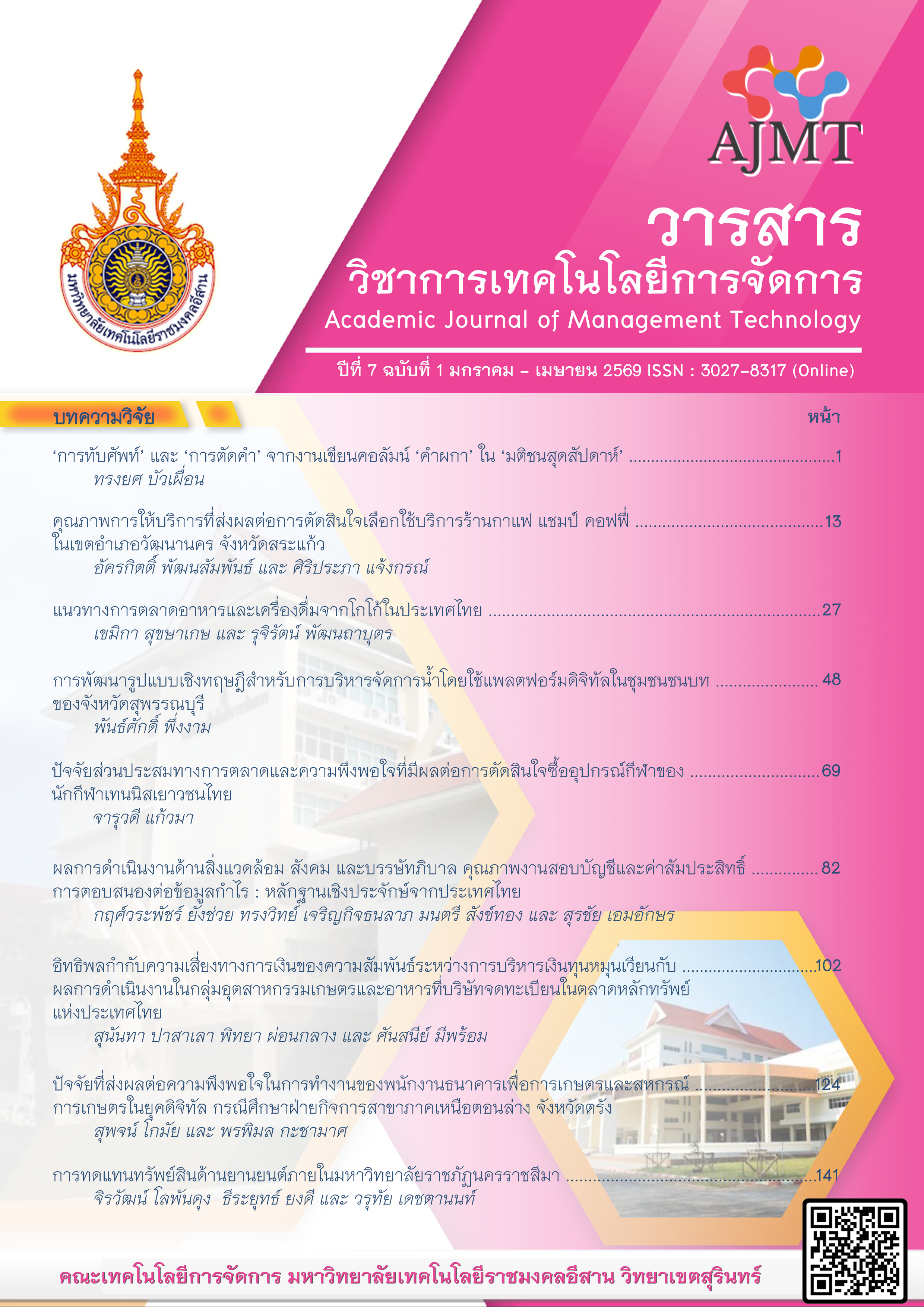
Factors Affecting Job Satisfaction of Employees of The Bank For Agriculture and Agricultural Cooperatives in the Digital Age : A Case Study of the Lower Northern Regional Branch Operations Division
DOI:
https://doi.org/10.14456/ajmt.2026.8Keywords:
Organizational Commitment, Job Satisfaction, BAAC, Digital Age, Organizational Factors, MotivationAbstract
This study investigates the influence of motivation, organizational commitment, and organizational factors on job satisfaction among employees of the Bank for Agriculture and Agricultural Cooperatives (BAAC), Lower Northern Regional Branch Operations Division, in the context of digital transformation. A quantitative research design was employed. A total of 412 respondents were selected through stratified random sampling from a population of 2,373. Data were collected via a structured questionnaire (75 items), with content validity verified by experts (IOC = 0.897) and reliability confirmed through a pilot test (Cronbach’s α = 0.987). The data were then analyzed using descriptive statistics, exploratory factor analysis (EFA), confirmatory factor analysis (CFA), and multiple regression analysis (Enter method). The results revealed that motivation, organizational commitment, and organizational factors each have a significant positive influence on job satisfaction. The model explained 81.2% of the variance (R² = 0.812). Among the sub-factors, Management System showed the strongest effect (β = 0.423), followed by Competence and Expertise (β = 0.217), Career Advancement Opportunity (β = 0.166), and Organizational Structure (β = 0.125). In contrast, some sub-dimensions — such as emotional commitment and challenging assignments — were not significant in the full model. These findings can inform human resource management practices in the digital age, especially in strengthening employee commitment and developing management systems responsive to technological change.
References
Bank for Agriculture and Agricultural Cooperatives. (2024). Annual Report, Fiscal Year 2024 (in Thai). https://www.baac.or.th/th/content-report.php?content_group_sub=3
Bank of Thailand. (2025). Payment Transactions Via Mobile Banking and Internet Banking Services. https://www.bot.or.th/th/statistics/payment.html
Best, J. W. (1977). Research in Education (4th ed.). Prentice-Hall.
Chanmuean, R. (2021). Employee Engagement of the Government Savings Bank Headquarters [Master’ s thesis, Ramkhamhaeng University].
Chartlertyose, R. (2022). The Influences of Demographic Characteristics and Job Satisfaction on the Organizational
Commitment of Employees in a Commercial Bank in Bangkok and Its Metropolitan Areas. Graduate Studies Journal, 15(2), 21–36.
Chompukum, P., & Chakrapeesirisuk, N. (2020). Factors Affecting Job Satisfaction and Motivation: A Case Comparison of Generation Y and Generation Z in Bangkok. Chulalongkorn Business Review, 42(3), 165–190.
Daohampae, P., & Boonlue, N. (2025). Factors Affecting Organizational Commitment of Employees of Government Housing Bank. Ramkhamhaeng Journal of Public Administration, 8(1), 620–632.
Dunn, T. J., Baguley, T., & Brunsden, V. (2014). From Alpha to Omega: A Practical Solution to the Pervasive Problem of Internal Consistency Estimation. British Journal of Psychology, 105(3), 399–412.
Efthymiopoulos, A., & Goula, A. (2024). Measuring the Reliability and Validity of Allen and Meyer’s Organizational Commitment Scale in the Public Sector. Corporate Governance and Organizational Behavior Review, 8(2), 113-123. https://doi.org/10.22495/cgobrv8i2p11
Fornell, C., & Larcker, D. F. (1981). Evaluating Structural Equation Models with Unobservable Variables and Measurement Error. Journal of Marketing Research, 18(1), 39–50.
Hair, J. F., Black, W. C., Babin, B. J., & Anderson, R. E. (2010). Multivariate Data Analysis (7th ed.). Pearson.
Herzberg, F., Mausner, B., & Snyderman, B. B. (1959). The Motivation to Work. John Wiley & Sons.
Hu, L.-T., & Bentler, P. M. (1999). Cutoff Criteria for Fit Indexes in Covariance Structure Analysis: Conventional
Criteria versus New Alternatives. Structural Equation Modeling: A Multidisciplinary Journal, 6(1), 1–55. https://doi.org/10.1080/10705519909540118
Kline, R. B. (2016). Principles and Practice of Structural Equation Modeling (4th ed.). The Guilford Press.
Kotchapakdee, R. (2022). A Motivation for Job Performance of Bangkok Bank Employees Public Company Limited Metropolitan Region 7 [Master’ s thesis, Dhonburi Rajabhat University].
Meyer, J. P., & Allen, N. J. (1991). A Three-Component Conceptualization of Organizational Commitment. Human Resource Management Review, 1(1), 61–89. https://doi.org/10.1016/1053-4822(91)90011-z
Nunnally, J. C., & Bernstein, I. H. (1994). Psychometric Theory (3rd ed.). McGraw-Hill.
Oldani, A., Ciara, F., & Monica, M. (2023). Job Analysis in Organizational Structure on Employee Performance. Proceedings of the International Conference on Islamic Economics & Business, 2(1), 53–64.
Puenhuan, W. (2019). The Effect of Digital Disruption on Commercial Bank Employees’ Performance [Master’ s thesis, Rangsit University]. Rangsit University Institutional Repository.https://rsuirlibrary.rsu.ac.th/handle/123456789/300
Robbins, S. P. (1996). Organizational Behavior (7th ed.). Prentice Hall.
Sawetbuppa, T., & Sato, S. (2023). Satisfaction and Motivation to Work of Employees of the Government Savings Bank (GSB) in Kalasin. Kalasin University Journal of Humanities Social Sciences and Innovation, 2(1), 64–79.
Singh, S., & Gupta, L. B. (2025). The Effect of Digitalization on Work Stress and Job Satisfaction in Banking. International Research Journal on Advanced Engineering and Management, 3(4), 1376–1380. https://doi.org/10.47392/irjaem.2025.0224
Spector, P. E. (1997). Job Satisfaction: Application, Assessment, Causes, and Consequences. Sage Publications.
Teerawong, D., & Veerapaiboon, W. (2023). The Causal Factors Influencing Intention to Stay of Bangkok Bank Employees in Head Office. Journal of Educational Management and Research Innovation, 5(2), 339–352.
Tungsinsirisit, T. (2007). Organizational Behavior. In S. Serirat (Ed.), Organizational Behavior (pp. 44–287). Thammasat University Press.
Wardiansyah, D. R., Indrawati, N., & Kurniawati, D. T. (2024). The Effect of Employee Motivation and Employee Engagement on Job Performance Mediated by Job Satisfaction. International Journal of Research in Business and Social Science, 13(1), 220–231. https://doi.org/10.20525/ijrbs.v13i1.3133
Wela-kerd, A., Pinveha, S., & Sawatsomboon, K. (2024). The Relationship Between Organizational Climate and Organizational Loyalty of Employees of the Bank for Agriculture and Agricultural Cooperatives in the Northeastern Region. Journal of Modern Learning Development, 9(3), 150–163.
Westerman, G., Bonnet, D., & McAfee, A. (2011). Digital Transformation: A Roadmap for Billion-Dollar Organizations. MIT Center for Digital Business and Capgemini Consulting.
Yamane, T. (1967). Statistics: An Introductory Analysis (2nd ed.). Harper & Row.
Downloads
Published
How to Cite
Issue
Section
License
Copyright (c) 2026 Faculty of Management Technology, Rajamangala University of Technology Isan Surin Campus

This work is licensed under a Creative Commons Attribution-NonCommercial-NoDerivatives 4.0 International License.
บทความที่ได้รับการตีพิมพ์เป็นลิขสิทธิ์ของคณะเทคโนโลยีการจัดการ มหาวิทยาลัยเทคโนโลยีราชมงคลอีสาน วิทยาเขตสุรินทร์
ข้อความที่ปรากฏในบทความแต่ละเรื่องในวารสารวิชาการเล่มนี้ เป็นความคิดเห็นส่วนตัวของผู้เขียนแต่ละท่านไม่เกี่ยวข้องกับคณะเทคโนโลยีการจัดการ มหาวิทยาลัยเทคโนโลยีราชมงคลอีสาน วิทยาเขตสุรินทร์ และคณาจารย์ท่านอื่นๆในมหาวิทยาลัยฯ แต่อย่างใด ความรับผิดชอบองค์ประกอบทั้งหมดของบทความแต่ละเรื่องเป็นของผู้เขียนแต่ละท่าน หากมีความผิดพลาดใดๆ ผู้เขียนแต่ละท่านจะรับผิดชอบบทความของตนเองแต่ผู้เดียว