
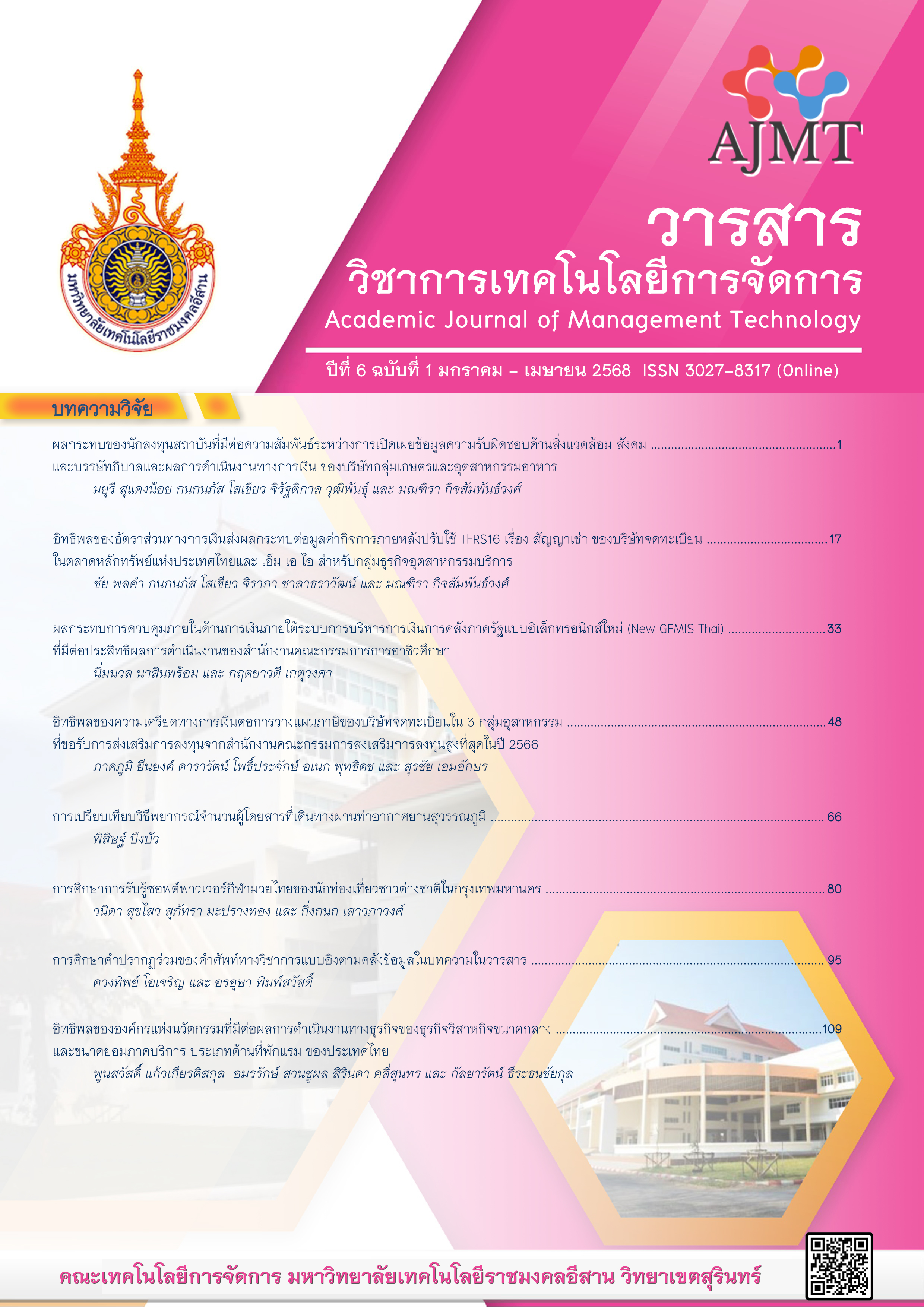
A Comparative Analysis of Forecasting Methods for Passenger Volume through Suvarnabhumi Airport
DOI:
https://doi.org/10.14456/ajmt.2025.5Keywords:
Forecasting, Time Series Analysis, Suvarnabhumi Airport, Passenger VolumeAbstract
This research aims to investigate and compare forecasting methodologies and determine the optimal forecast horizon for predicting passenger volume through Suvarnabhumi Airport. The study utilized daily domestic and international passenger data published by the Civil Aviation Authority of Thailand from March to December 2024. The dataset was partitioned into a training set (March–November 2024) for model development and a validation set (December 2024) for performance evaluation. Three forecasting methods were implemented: linear trend analysis, exponential smoothing, and time series decomposition. Model performance was evaluated using Mean Absolute Deviation (MAD) and Mean Absolute Percentage Error (MAPE) as accuracy metrics. Data analysis was conducted using Microsoft Excel software. Findings indicated that for domestic passenger forecasting, the exponential smoothing method with a smoothing parameter (α) of 0.8 and a one-week forecast horizon yielded optimal results. For international passenger forecasting, the exponential smoothing method with a smoothing parameter (α) of 1.0 and a one-month forecast horizon demonstrated superior predictive performance.
References
Aeronautical Radio of Thailand. (2024). Daily flight statistics. https://www.aerothai.co.th/th/flight-statistic
Airports of Thailand Public Co., Ltd. (2024). About AOT. https://www.airportthai.co.th/
Kumar, L., Sharma, K., & Khedlekar, U. K. (2024). Dynamic pricing strategies for efficient inventory management with auto-correlative stochastic demand forecasting using exponential smoothing method. Results in Control and Optimization, 15, 100432. https://doi.org/10.1016/j.rico.2024.100432
Nusane, P., Payakkapong, P., & Supapakorn, T. (2015). Comparison of forecasting models for crude oil production in Thailand. Journal of Science and Technology, 23(3), 377-384.
Ruekkasaem, L., & Aungkulanon, P. (2020). Comparison of forecasting methods for aggregate production planning in cleanroom apparel factory. Phranakhon Rajabhat Research Journal (Science and Technology), 15(1), 86-94.
Siriolan, P. (2018). Quantitative analysis (in Thai). SE-EDUCATION.
Taengphukieo, R., & Issarapong, N. (2019). Analysis of comparing forecasting methods for production planning: Case study of beef companies, Nakhon Phanom province. EAU Heritage Journal: Science and Technology, 13(3), 222-232.
The Civil Aviation Authority of Thailand. (2024). Air transport statistics. https://www.caat.or.th/th/archives/category/data-research-th/air-traffic-th/transport-statistics-th
Theeraviriya, C. (2017). A comparison of the forecasting method for electric energy demand in Nakhonphanom province. Naresuan University Journal: Science and Technology, 25(4), 124-137.
Thonglek, N. (2024). Old photos tell the legend: From Nong Ngu Hao… to Suvarnabhumi Airport (in Thai). https://www.matichon.co.th/columnists/news_4778593
Tirkeş, G., Güray, C., & Çelebi, N. (2017). Demand forecasting: A comparison between the Holt-Winters, trend analysis and decomposition models. Technical Gazette, 24(2), 503-509.
Wanichbancha, K. (2010). Quantitative analysis (3rd ed.) (in Thai). Siam Lada Partnership Ltd.
Wiwattanakornwong, K., Limlawan, V., Butrsai, S., Ninpan, N., Vannangkura, C., Thepkaew, A., Ngamdee, K., & Ploythummakun, P. (2023). Demand forecasting in beverage industry: A case study of business simulation game. Suthiparithat Journal, 37(1), 17-29.
Downloads
Published
How to Cite
Issue
Section
License
Copyright (c) 2025 Faculty of Management Technology, Rajamangala University of Technology Isan Surin Campus

This work is licensed under a Creative Commons Attribution-NonCommercial-NoDerivatives 4.0 International License.
บทความที่ได้รับการตีพิมพ์เป็นลิขสิทธิ์ของคณะเทคโนโลยีการจัดการ มหาวิทยาลัยเทคโนโลยีราชมงคลอีสาน วิทยาเขตสุรินทร์
ข้อความที่ปรากฏในบทความแต่ละเรื่องในวารสารวิชาการเล่มนี้ เป็นความคิดเห็นส่วนตัวของผู้เขียนแต่ละท่านไม่เกี่ยวข้องกับคณะเทคโนโลยีการจัดการ มหาวิทยาลัยเทคโนโลยีราชมงคลอีสาน วิทยาเขตสุรินทร์ และคณาจารย์ท่านอื่นๆในมหาวิทยาลัยฯ แต่อย่างใด ความรับผิดชอบองค์ประกอบทั้งหมดของบทความแต่ละเรื่องเป็นของผู้เขียนแต่ละท่าน หากมีความผิดพลาดใดๆ ผู้เขียนแต่ละท่านจะรับผิดชอบบทความของตนเองแต่ผู้เดียว