
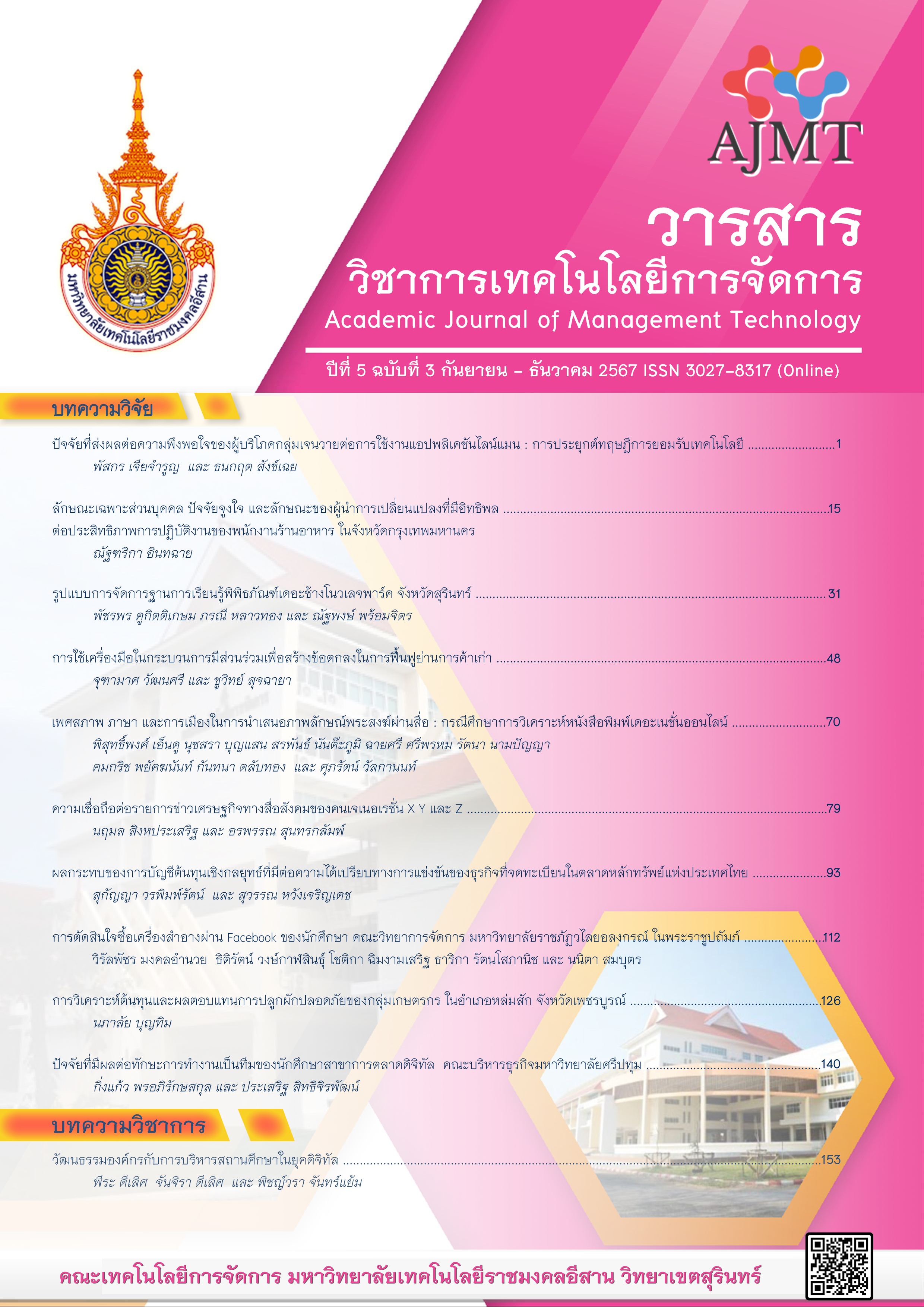
Trust in Social Media Economic News Programs Among Generations X, Y, and Z
DOI:
https://doi.org/10.14456/ajmt.2024.27Keywords:
Trust in Economic News Programs, Credibility, Generation X, Y, and Z, Social MediaAbstract
This research investigates differences in exposure patterns and trust perceptions of economic news programs on social media platforms among Generation X, Y, and Z audiences. Using purposive sampling, the study targeted Thai online media consumers aged 15 - 59 years who had engaged with economic news content on at least one social media platform. Data were collected through a validated questionnaire instrument (Cronbach’s alpha reliability coefficients: exposure = 0.87, trust = 0.88) administered between November 1, 2023, and February 20, 2024, yielding 352 valid responses. Analysis employed both descriptive statistics (frequencies, percentages, means, and standard deviations) and inferential statistics (Chi-Square and One-Way ANOVA) to test generational differences. Results indicated Facebook as the predominant platform for economic news consumption, followed by YouTube. Chi-Square analysis at α = 0.05 revealed significant generational differences in exposure patterns specifically for Line and TikTok platforms. One-Way ANOVA results demonstrated significant generational variations in trust dimensions, particularly regarding analytical depth and source citation reliability (p < 0.05), as well as program host credibility (p < 0.05). These findings contribute to understanding generational differences in social media news consumption patterns and trust formation in the digital age.
References
Boumans, D., Müller, H., & Sauer, S. (2023). How media content influences economic expectations : Evidence from a global expert survey. Journal of Forecasting. 42(6), 1295 - 1308. https://doi.org/10.1002/for.2961
Brann, M. & Himes, K. L. (2010). Perceived credibility of male versus female television newscasters. Communication Research Reports, 27(3), 243 - 252. https://doi.org/10.1080/08824091003737869
Bucy, E. P., D'Angelo, P., & Bauer, N. M. (2014). Crisis, credibility, and the press : A priming model of news evaluation. International Journal of Press/Politics. 19(4), 453 - 475. https://doi.org/10.1177/1940161214541682
Chanchaochai, D. (2021). Credibility : A Key Challenge for New Media. https://www.dataxet.co/medialandscape/2021-th/interview-media-trend
Chung, M. (2017). Not just numbers : The role of social media metrics in online news evaluations. Computers in Human Behavior, 75(C), 949 - 957. https://doi.org/10.1016/j.chb.2017.06.022
Cronbach, L. J. (1990). Essentials of psychological testing (5thed.). UCL Press.
Ceylan, G., Anderson, I. A., & Wood, W. (2023). Sharing of misinformation is habitual, not just lazy or biased. PNAS. 120(4), 1 - 8. https://doi.org/10.1073/pnas.2216614120
Damstra, A. (2020). Economic news : How it's made and how it matters [Doctoral Dissertation, University of Amsterdam]. UvA-DARE. https://dare.uva.nl/personal/pure/en/publications/economic-news(aed0ffc4-4847-4d1e-959f-cc6a07c1cd88).html
Ercömert, Ç. & Günes, S. (2021). Industrial Design Education : A Research on Generation Theories and Change in Turkey. Design and Technology Education : An International Journal, 26(3), 136 - 158. https://openjournals.ljmu.ac.uk/DATE/article/view/1363.
Inthawong, S. (2015). Adaptation of newspaper journalists in the transition from print media technology to digital media. In Paritchat, S. (Ed.), The Advanced Executive Program for Media Organization Leaders Batch 6 [Symposium]. Office of the National Press Council of
Thailand.
Ivanova, A. & Smrikarov, A. (2009). The new generations of students and the future of e-Learning in Higher Society - eLearning’ 09.
Berlin, Germany. https://www.researchgate.net/publication/242541494.
Johnson, T. & Kaye, B. (2010). Choosing is believing? How web gratifications and reliance affect tnternet credibility among politically interested users. Atlantic Journal of Communication, 18(1), 1 - 21. https://doi.org/10.1080/15456870903340431
Kemp, S. (2024). Digital 2024: Thailand. https://datareportal.com/reports/digital-2024-thailand
Kim, M. (2015). Partisans and controversial news online : Comparing perceptions of bias and credibility in news content from blogs and
mainstream media. Mass Communication and Society, 18(1), 17 -36. https://doi.org/10.1080/15205436.2013.877486
Lin, X., Spence, P. R. & Lachlan, K. A. (2016). Social media and credibility indicators : The effect of influencecues. Computers in Human Behavior, 63(2016), 264 - 271. https://doi.org/10.1016/j.chb.2016.05.002
Llamero, Ll., Fenoll, V., & Domingo, D. (2019). Predictors of credibility of online media in the Spanish polarized media system. Communication and Society, 32(2), 127 - 138.https://doi.org/10.15581/003.32.37855
Nedelcu, D. D. & Balaban, C. (2021). The role of source credibility and message credibility in fake news engagement. Perspectives from an experimental study. Journal of Media Research, 14(3), 42 - 62. https://doi.org/10.24193/jmr.41.3
Newly, P., Sui, M., & Searles, K. (2022). Look who’s writing : How gender affects news credibility and perceptions of news relevance. Journalism and Mass Communication Quarterly, 99(1), 183 - 212.https://doi.org/10.1177/ 10776990211042595
Newman, N. (2023). Overview and key findings of the 2023 Digital News Report. Reutersinstitute.https://reutersinstitute. politics.ox.ac.uk/digital-news-report/2023/dnr-executive-summary
Office of the National Statistical, Ministry of Digital Economy and Society. (2023). Survey on the use of information and communication technology in households, 2023 (Q2).https://www.nso.go.th/nsoweb/nso/survey_detail/jJ?set_lang=th
Pennycook, G., Epstein, Z., Mosleh, M., Arechar, A. A., Eckles D., & Rand, D.G. (2021). Shifting attention to accuracy can reduce misinformation online. Nature, 592, 590 - 595. https://doi.org/10.1038/s41586-021-03344-2
Satawethin, P. (1998). Mass communication: process & theory. Parbpim.
Singhaprasert, N., Wilainut, P.,& Treelayapewat, M. (2023). Confirmatory factor analysis of news organization brand credibility indicator model in Thailand. Journal of Information and Learning, 34(2), 142 - 157. https://doi.org/10.14456/jil.2023.27
Sladek & Grabinger. (2014). Gen Z The first generation of the 21st century has arrived!. XYZ University. https://www.xyzuniversity.com/research
Srisa-ard, B. (2017). Introduction to research (10th ed.). Suweeriya-sarn.
Tandoc, E. C., Jr., Duffy, A., Jones-Jang, S. M., & Pin, W. G. W. (2021). Poisoning the information well? : The impact of fake news on news media credibility. Journal of Language and Politics, 20(5), 783 - 802. https://doi.org/10.1075/jlp.21029.tan
Victoria-Mas, M., Lacasa, I., & Marimon, F. (2018). Assessing the consumer-based brand equity of news media firms : A new validated scale. Journal of Media Business Studies, 15(3), 214 -235. https://doi.org/10.1080/16522354.2018.1522199
Weibel, D., Wissmath, B., & Groner, R. (2008). How gender and age affect newscasters’ credibility an investigation in Switzerland. Journal of Broadcasting and Electronic Media, 52(3), 466 - 484. https://doi.org/10.1080/08838150802205801
Worthington, A, K., NussBaum, J. F., & Parrot, R. L. (2015). Organizational credibility : The role of issue involvement, value-relevant involvement, elaboration, author credibility, message quality, and message effectiveness in persuasive messages from public health advocacy organizations. Communication Research Reports, 32(3), 199 - 207. https://doi.org/10.1080/08824096.2015.1016153
Yamane, T. (1973). Statistics an introductory analysis (3rd ed.). Harper & Row.
Downloads
Published
How to Cite
Issue
Section
License
Copyright (c) 2024 Faculty of Management Technology, Rajamangala University of Technology Isan Surin Campus

This work is licensed under a Creative Commons Attribution-NonCommercial-NoDerivatives 4.0 International License.
บทความที่ได้รับการตีพิมพ์เป็นลิขสิทธิ์ของคณะเทคโนโลยีการจัดการ มหาวิทยาลัยเทคโนโลยีราชมงคลอีสาน วิทยาเขตสุรินทร์
ข้อความที่ปรากฏในบทความแต่ละเรื่องในวารสารวิชาการเล่มนี้ เป็นความคิดเห็นส่วนตัวของผู้เขียนแต่ละท่านไม่เกี่ยวข้องกับคณะเทคโนโลยีการจัดการ มหาวิทยาลัยเทคโนโลยีราชมงคลอีสาน วิทยาเขตสุรินทร์ และคณาจารย์ท่านอื่นๆในมหาวิทยาลัยฯ แต่อย่างใด ความรับผิดชอบองค์ประกอบทั้งหมดของบทความแต่ละเรื่องเป็นของผู้เขียนแต่ละท่าน หากมีความผิดพลาดใดๆ ผู้เขียนแต่ละท่านจะรับผิดชอบบทความของตนเองแต่ผู้เดียว