
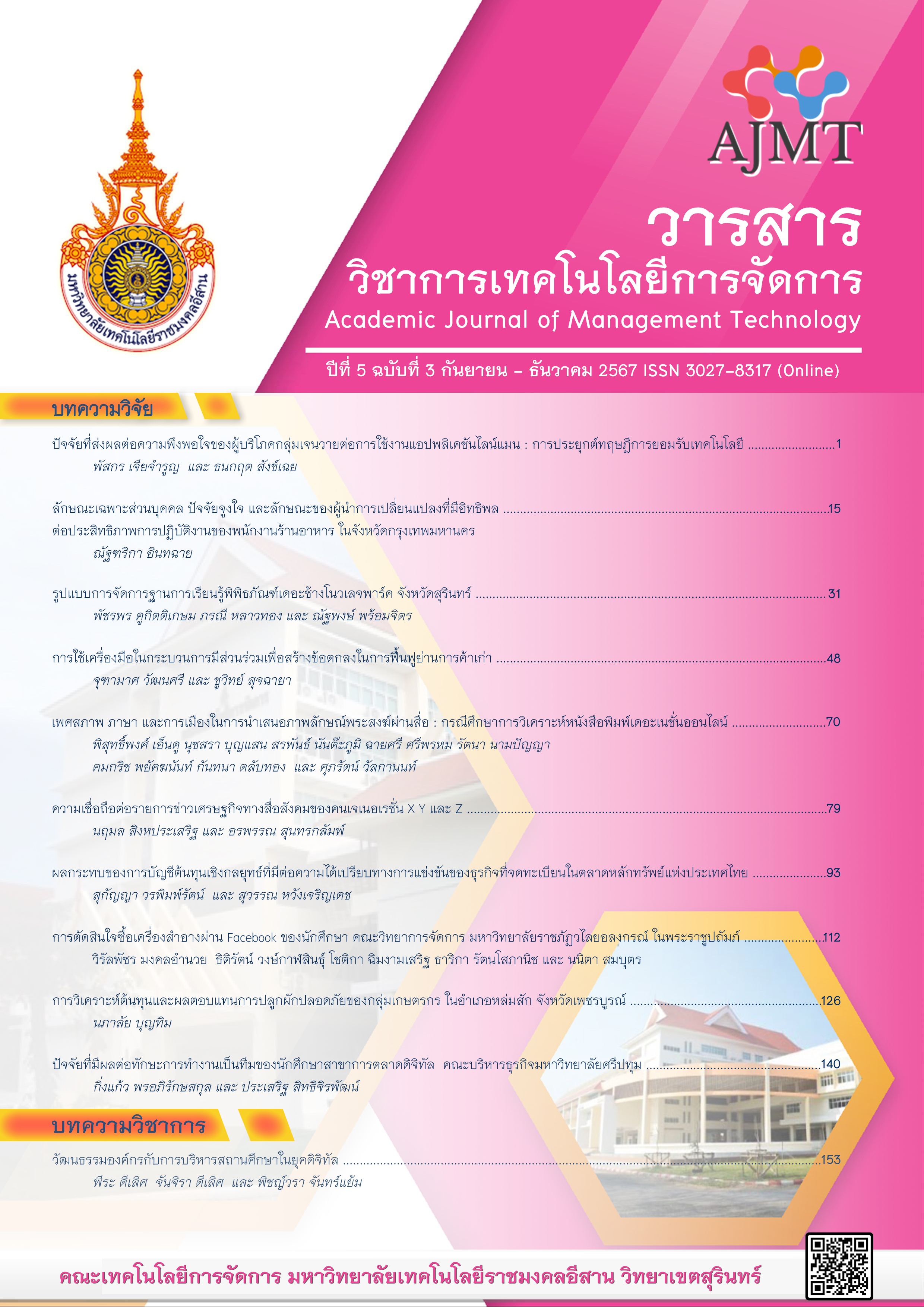
Factors Affecting Generation Y Consumers’ Satisfaction with the Use of the Lineman Application : Applying Technology Acceptance Model
DOI:
https://doi.org/10.14456/ajmt.2024.22Keywords:
Perceived Ease of Use, Perceived Usefulness, Food Delivery, ApplicationAbstract
This research aims to investigate the influence of perceived ease of use on perceived usefulness of the application, the impact of perceived ease of use on consumer satisfaction, and the influence of perceived usefulness on consumer satisfaction by applying the Technology Acceptance Model. The research sample comprised 250 Generation Y consumers in Bangkok who use the Lineman application. Data were collected through a questionnaires and analyzed using statistical software. The statistical analysis included frequency, percentage, mean, standard deviation, and multiple regression analysis. The results revealed that perceived ease of use significantly influenced perceived usefulness of the application. Moreover, both perceived ease of use and perceived usefulness demonstrated significant positive impacts on Generation Y consumers’ satisfaction. Therefore, food delivery platform developers should focus on developing application systems that are easy and convenient to use to enhance consumer satisfaction.
References
Buachum, S., Klaasa, P., & Wana, C. (2021). Factors related to behavioral intentions towards use of digital payment platforms for tourism Businesses. Academic Journal of Management Technology, 2(2), 89 - 99.
Cohen, J. (1977). Statistical power analysis for the behavioral sciences (Rev. ed.). Lawrence ErlbaumAssociates,Inc.
Chomchark, P. (2022). Influence of technology acceptance and use, satisfaction and engagement on intention to continue use through online application for shopping. Journal of Public Relations and Advertising, 15(1), 111 - 129.
Cronbach, L. J. (1951). Coefficient alpha and the internal structure of tests. Psychometrika, 16(3), 297 - 334.
Cronin Jr., J. J., & Taylor, S. (1992). Measuring service quality : A reexamination and extension. The Journal of Marketing, 56(3), 55 - 68.
Davis, F. (1989) Perceived usefulness, perceived ease of use, and user acceptance of information technology.MIS Quarterly, 13(3), 319 - 340.
Electronic Transactions Development Agency. (2020). Online Food Delivery Survey 2020 (in Thai). https://www.etda.or.th/th/https/www-etda-or- th/th/newsevents/pr-news/Online-Food-Delivery-Survey- 2020.aspx
Kasikorn Research Center. (2023). Food delivery in 2023 has a slowing trend. Platform to accelerate business balance to meet challenges. https://www.kasikornresearch.com/TH/analysis/ksocial-media/Pages/FOOD-DELIVERY-CIS3423-FB-21-07 2023.aspx
Kotler, P. (2000). Marketing management. The Millennium edition. New Jersey : Prentice - Hall.
Wongsupphalak, N. (2022). Factors affecting to customer satisfaction and brand loyalty of shopeefood application in Bangkok and vicinity [Unpublished Master’s thesis]. Mahidol University.
Lineman Wongnai. (2023). LINE MAN Wongnai reveals food delivery is growing against the market:Aggressive expansion of non-food and merchant solutions businesses to drive long-term growth. https://lmwn.com/line-man-wongnai-2h2023business-updates-th/
Liu, M.T., Brock, J.L., Shi, G.C., Chu, R., & Tseng, T. (2013). Perceived benefits, perceived risk, and trust : Influences on consumers’ group buying behavior. Asia Pacific Journal of Marketing and Logistics, 25(2), 225 - 248.
Mathayayothin. P. (2021). Examining factors influencing customer satisfaction and loyalty in using food delivery application : The case of working age group in Thailand [Unpublished Master’s thesis]. Bangkok University.
Phongsupat, N. (2018). A study on food application market and consumer behavior regarding food application choice [Unpublished Master’s thesis]. Thammasat University.
Jarutwiboonkul, P., Pornpeeravich, P., Phansuma, P., & Waraseneyawut, P. (2020). Factors affecting consumer satisfaction in using Foodpanda application services in Bangkok and its surrounding areas. Journal of the Network for the Promotion of Research in Humanities and Social Sciences, 3(2), 29 - 42.
Leksawatchaikul, K. (2019). Factors influencing the decision to use food delivery services via applications in Bangkok and its vicinity (Master's thesis). Thammasat University.
Punyawit, V. (2022). The impact of electronic service quality on customer satisfaction and loyalty in food delivery Applications : A case study of Grab Food. Master's Thesis in Management, Faculty of Management, Mahidol University.
Rattanopachartjaroen, L. (2020). Factors affecting the decision to use e-wallet payment for a food delivery service application in the Bangkok metropolitan area [Unpublished Master’s thesis]. Thammasat University.
Rovinelli, R. J., & Hambleton, R. K. (1976). On the use of content specialists in the assessment of criterionreferenced test item validity. Dutch Journal of Educational Research.
Tantai, J. (2015). The study of privileges application effectiveness on customer loyalty case study : Application galaxy gift [Unpublished Master’s thesis]. Thammasat University.
Venkatesh, V. & Davis, F.D. (2000). A theoretical extension of the technology acceptance model : Four longitudinal field studies. Management Science, 46(2), 186 - 204.
Taveeporn, T. (2022). Strategies for Developing Food Delivery App Marketing for Consumers Outside Bangkok and its Metropolitan Area. Mahidol University.
Weerapong, P. (2022). The effect of e-service quality application delivery service on customer satisfaction and customer loyalty case study : Grab food [Unpublished Master’s thesis]. Mahidol University.
Williams, K. C., & Page, R. A. (2011). Marketing to the generations : The journey to effective generational marketing. Journal of Behavioral Studies in Business, 3(April), 1 - 17.
Wongsuklap, N. (2022). Factors influencing satisfaction and brand loyalty of ShopeeFood users in Bangkok and its surrounding areas. Master's thesis, College of Management, Mahidol University.
Downloads
Published
How to Cite
Issue
Section
License
Copyright (c) 2024 Faculty of Management Technology, Rajamangala University of Technology Isan Surin Campus

This work is licensed under a Creative Commons Attribution-NonCommercial-NoDerivatives 4.0 International License.
บทความที่ได้รับการตีพิมพ์เป็นลิขสิทธิ์ของคณะเทคโนโลยีการจัดการ มหาวิทยาลัยเทคโนโลยีราชมงคลอีสาน วิทยาเขตสุรินทร์
ข้อความที่ปรากฏในบทความแต่ละเรื่องในวารสารวิชาการเล่มนี้ เป็นความคิดเห็นส่วนตัวของผู้เขียนแต่ละท่านไม่เกี่ยวข้องกับคณะเทคโนโลยีการจัดการ มหาวิทยาลัยเทคโนโลยีราชมงคลอีสาน วิทยาเขตสุรินทร์ และคณาจารย์ท่านอื่นๆในมหาวิทยาลัยฯ แต่อย่างใด ความรับผิดชอบองค์ประกอบทั้งหมดของบทความแต่ละเรื่องเป็นของผู้เขียนแต่ละท่าน หากมีความผิดพลาดใดๆ ผู้เขียนแต่ละท่านจะรับผิดชอบบทความของตนเองแต่ผู้เดียว