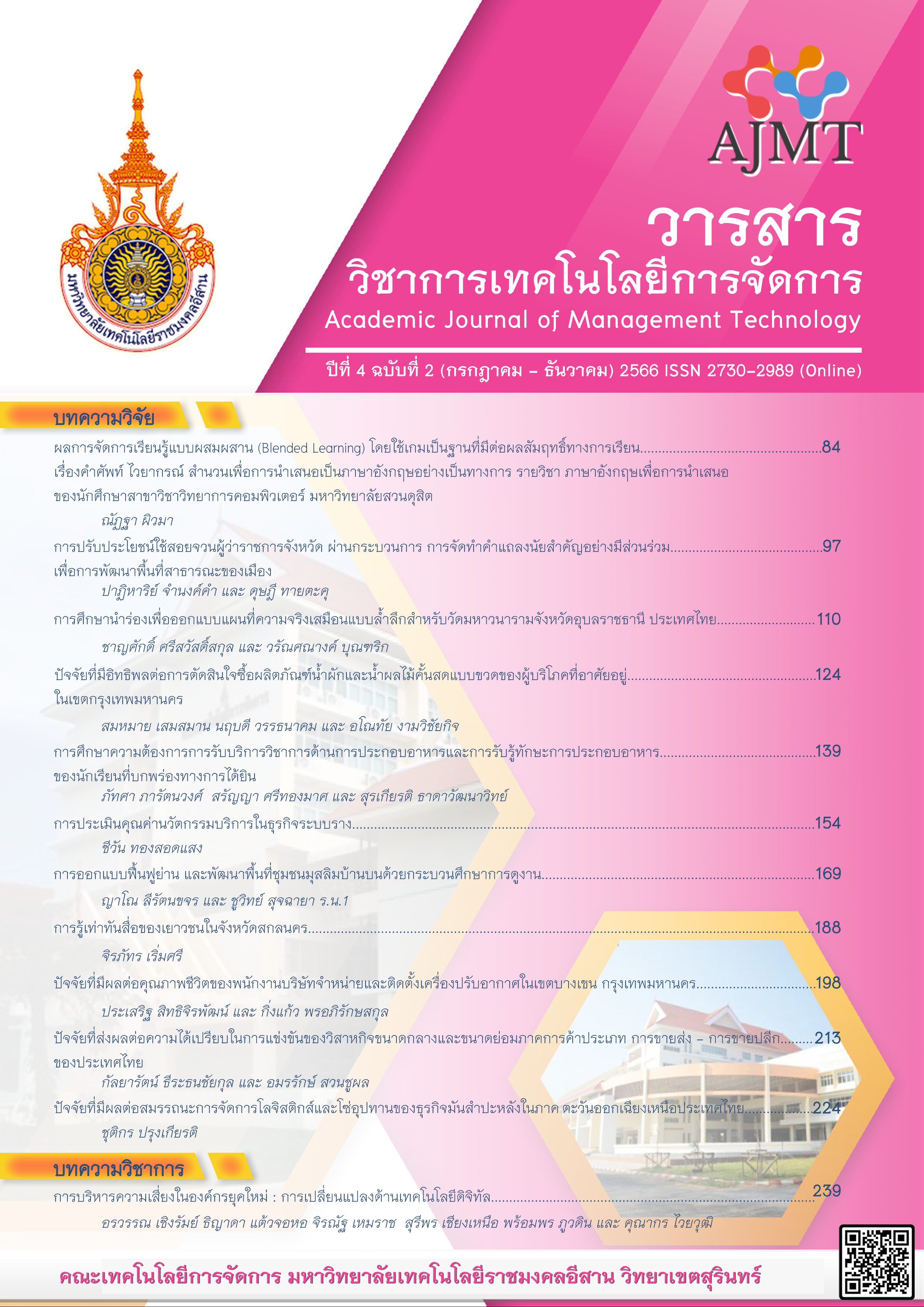
ปัจจัยที่มีผลต่อสมรรถนะการจัดการโลจิสติกส์และโซ่อุปทานของธุรกิจมันสำปะหลังในภาคตะวันออกเฉียงเหนือประเทศไทย
DOI:
https://doi.org/10.14456/ajmt.2023.16คำสำคัญ:
การสนับสนุนขององค์การที่โดดเด่น, ความได้เปรียบทางการแข่งขันอย่างยั่งยืน, ความสามารถในการเรียนรู้องค์การ, ภาวะผู้นำการเปลี่ยนแปลง, สมรรถนะการจัดการโลจิสติกส์และโซ่อุปทานบทคัดย่อ
การวิจัยนี้มีวัตถุประสงค์เพื่อศึกษาระดับสมรรถนะการจัดการโลจิสติกส์และโซ่อุปทานและอิทธิพลของปัจจัยที่ส่งผลต่อสมรรถนะการจัดการโลจิสติกส์และโซ่อุปทานของธุรกิจมันสำปะหลังในภาคตะวันออกเฉียงเหนือประเทศไทย โดยธุรกิจมันสำปะหลังในภาคตะวันออกเฉียงเหนือประเทศไทยที่เป็นสมาชิกในสมาคมโรงงานผู้ผลิตมันสำปะหลัง ภาคตะวันออกเฉียงเหนือ 302 แห่งเป็นกลุ่มตัวอย่างที่ใช้ในงานวิจัยครั้งนี้ เครื่องมือในการวิจัยคือแบบสอบถามที่ผ่าน การทดสอบความเที่ยงตรงและความเชื่อมั่นแล้ว และได้รับแบบสอบถามที่มีความสมบูรณ์ตอบกลับมา 175 ฉบับ สถิติที่ใช้ในการวิจัย ได้แก่ ร้อยละ ค่าเฉลี่ย ส่วนเบี่ยงเบนมาตรฐาน ค่าสัมประสิทธิ์สหสัมพันธ์ของเพียร์สัน และทดสอบสมมติฐานด้วยการวิเคราะห์การถดถอยพหุคูณ ผลการวิจัยพบว่า ระดับภาวะผู้นำการเปลี่ยนแปลง ความสามารถในการเรียนรู้ในองค์การ การสนับสนุนขององค์การที่โดดเด่น สมรรถนะการจัดการโลจิสติกส์และห่วงโซ่อุปทานและความได้เปรียบทางการแข่งขันอย่างยั่งยืนรวมและรายด้านอยู่ในระดับมาก นอกจากนั้นยังพบว่า 1) สมรรถนะการจัดการโลจิสติกส์และห่วงโซ่อุปทาน มีความสัมพันธ์เชิงบวกกับความได้เปรียบทางการแข่งขันอย่างยั่งยืน 2) ภาวะผู้นำการเปลี่ยนแปลงและการสนับสนุนขององค์การที่โดดเด่นมีความสัมพันธ์เชิงบวกกับสมรรถนะการจัดการโลจิสติกส์และโซ่อุปทาน และ 3) ความสามารถในการเรียนรู้ในองค์การมีความสัมพันธ์เชิงบวกกับสมรรถนะการจัดการโลจิสติกส์และโซ่อุปทานเฉพาะด้านความแม่นยำในการบริหารการผลิตและด้านความสามารถในการจัดส่งและรับคืนสินค้า อย่างมีนัยสำคัญทางสถิติที่ระดับ 0.05
เอกสารอ้างอิง
กล้วยไม้ วันทนัง, เมทินี รัษฎารักษ์, และ ณัฏฐกิตต์ เอี่ยมสมบูรณ์. (2563). การจัดการความหลากหลายของบุคลากรที่มี ผลต่อประสิทธิภาพในการปฏิบัติงานของพนักงานในบริษัทผู้ให้บริการขนส่งสินค้าทางอากาศแห่งหนึ่ง. วารสารวิชาการสังคมศาสตร์เครือข่ายวิจัยประชาชื่น, 2(2), 46-61.
จารุวรรณ สุภาชัยวัฒน์. (2561). ความสัมพันธ์ระหว่างบทบาทของโลจิสติกส์ที่มีต่อความยั่งยืนในห่วงโซ่อุปทานของอุตสาหกรรมมันสำปะหลังเขตพื้นที่ภาคตะวันออกเฉียงเหนือในประเทศไทย. วารสารการบัญชีและการจัดการ มหาวิทยาลัยมหาสารคาม, 10(4), 198-212.
แจ่มจันทร์ คล้ายวงษ์ และ บัณฑิต ผังนิรันดร์. (2563). อิทธิพลของภาวะผู้นําการเปลี่ยนแปลง นวัตกรรมองค์กรและการบริหารจัดการการเปลี่ยนแปลงที่มีต่อผลการดําเนินงานโรงพยาบาลเอกชนในประเทศไทย. วารสารสังคมศาสตร์และมานุษยวิทยาเชิงพุทธ, 5(4), 128-144.
ดวงใจ จันทร์ดาแสง และ วิโรจน์ เจษฎาลักษณ์. (2561). การรับรู้การสนับสนุนจากองค์การที่มีผลต่อประสิทธิผลการปฏิบัติงานผ่านความพึงพอใจของพนักงาน บริษัทผลิตภัณฑ์อาหารเสริม จำกัด กรุงเทพมหานคร. สักทอง: วารสารมนุษยศาสตร์และสังคมศาสตร์ (สทมส.), 24(1), 32-49.
นิศาชล รัตนมณี และ ประสพชัย พสุนนท์. (2562). อัตราการตอบกลับของแบบสอบถามในงานวิจัยเชิงปริมาณ. วารสารมนุษยศาสตร์และสังคมศาสตร์ มหาวิทยาลัยธนบุรี, 13(3), 181-188.
บุญชม ศรีสะอาด. (2560). การวิจัยเบื้องต้น. กรุงเทพฯ: สุวีริยาสาส์น.
ปฏิมา ถนิมกาญจน์ และ เพ็ญพร ปุกหุต. (2565). บรรยากาศองค์การส่งผลต่อประสิทธิภาพการทำงาน ผ่านคุณภาพชีวิตในการทำงานของพนักงานบริษัทในเขตนิคมอุตสาหกรรมสุรนารี. วารสารวิชาการเทคโนโลยีการจัดการ, 3(1), 83-96.
ปรียาณัฐ เอี๊ยบศิริเมธี. (2564). ประสิทธิภาพการทำงานที่มีผลต่อสมรรถนะการจัดการโลจิสติกส์และโซ่อุปทานของบริษัทผู้ผลิตมันสำปะหลังในเขตอำเภอเมือง จังหวัดนครราชสีมา. วารสารวิชาการสมาคมสถาบันอุดมศึกษาเอกชนแห่งประเทศไทย (สสอท.), 27(1), 21-32.
ภัทริยา พรปาริษา. (2563). การยกระดับศักยภาพแบบพลวัตขององค์กรธุรกิจที่คล่องตัวและการจัดการโซ่อุปทานที่คล่องตัวส่งผลต่อการตอบสนองตลาดและเครือข่ายเพื่อสร้างความได้เปรียบทางการแข่งขันอย่างยั่งยืน. วารสารวิทยาลัยพาณิชยศาสตร์บูรพาปริทัศน์, 15(1), 90-103.
ศรินภัสร์ ล้อมวลีรักษ์, ภาศิริ เขตปิยรัตน์, และ ศิริกานดา แหยมคง. (2565). ปัจจัยส่วนประสมทางการตลาดและคุณภาพการให้บริการที่มีอิทธิพลต่อความพึงพอใจของลูกค้าบริษัทห้องเย็นอุตรดิตถ์จํากัด. วารสารวิชาการการจัดการภาครัฐและเอกชน, 4(3), 91-105.
สมาคมโรงงานผู้ผลิตมันสำปะหลัง ภาคตะวันออกเฉียงเหนือ (2563). ผู้ประกอบการอุตสาหกรรมมันสำปะหลัง. [เว็บไซต์]. สืบค้นจาก http://www.nettathai.org/
สำนักงานเกษตรและสหกรณ์จังหวัดกำแพงเพชร กลุ่มสารสนเทศการเกษตร. (2565). ข้อมูลเพื่อการวางแผนพัฒนา การเกษตรรายสินค้ามันสำปะหลัง จังหวัดกำแพงเพชร ปีงบประมาณ พ.ศ. 2565. [เว็บไซต์]. สืบค้นจาก https://www.opsmoac.go.th/
สุดารัตน์ พิมลรัตนกานต์, เฉลิมชัย กิตติศักดิ์นาวิน, และ นลินณัฐ ดีสวัสดิ์. (2560). ปัจจัยด้านภาวะผู้นำการเปลี่ยนแปลงที่มีผลต่อการพัฒนาองค์การ. Veridian E-Journal, Silpakorn University, 10(1), 1643-1660.
สุดารัตน์ พิมลรัตนกานต์, ปิยมาศ กล้าแข็ง, อนุช นามภิญโญ, และ ศรีนครินทร์ นรเศรษฐโสภณ. (2566). การจัดการโลจิสติกส์และโซ่อุปทานเพื่อสร้างความได้เปรียบทางการแข่งขันและเพื่อผลการดำเนินงานของเกษตรกรสินค้าเกษตรใบเตยหอม. วารสารวิชาการเซาธ์อีสท์บางกอก, 9(1), 15-29.
เสกสรร สวัสดิรักษา และ ธรินี มณีศรี. (2565). การพัฒนาขั้นตอนวิธีการจัดการโลจิสติกส์และโซ่อุปทานสำหรับชุมนุมร้านสหกรณ์แห่งประเทศไทย. วารสารสังคมศาสตร์และมานุษยวิทยาเชิงพุทธ, 7(11), 91-109.
อัจฉรา ปล้องสอง, รวงทอง ถาพันธุ์, และ ทินกร พูลพุฒ. (2565). ภาวะผู้นําการเปลี่ยนแปลงของผู้บริหารสถานศึกษาส่งผลต่อการบริหารงานวิชาการสถานศึกษาขั้นพื้นฐาน สังกัดสำนักงานเขตพื้นที่การศึกษาประถมศึกษาพระนครศรีอยุธยา เขต 1. วารสารวิจัยมหาวิทยาลัยเวสเทิร์น มนุษยศาสตร์และสังคมศาสตร์, 8(3), 204-215.
อัยรินทร์ นันทธีรพัฒน์. (2563). แบบจําลองปัจจัยเชิงสาเหตุของคุณภาพการบริการหลังการขายที่มีอิทธิพลต่อความพึงพอใจของลูกค้าของธุรกิจอุตสาหกรรมการผลิตในประเทศไทย. วารสารสังคมศาสตร์และมานุษยวิทยาเชิงพุทธ, 5(8), 370-389.
Barney, J. B. (1991). Firm resources and sustained competitive advantage. Journal of Management, 17(1), 99-120.
Barney, J. B., & Wright, P. M. (1998). On becoming a strategic partner: The role of human resources in gaining competitive advantage. Human Resource Management, 37(1), 31-46.
Bass, B. M. (1990). From transactional to transformational leadership: learning to share the vision. Organizational Dynamics, 18(3), 19-32
Bass. B. M. & Riggio. R. E. (2006). Transformational leadership (2nd ed.). Mahwah, New Jersey: Lawrence Erlbaum Associates.
Chopra, S. & Meindl, P. (2012). Supply chain management: strategy, planning, and operations (5th ed.). London: Pearson.
Cronbach, L. J. (1990). Essentials of psychological testing (5th ed.). New York: Harper Collins Publishers.
Ehms, K. & Langen, M. (2001). Holistic development of knowledge management with KMMM®. Siemens AG / Corporate Technology. 1-8.
Eisenberger, R., Huntington, R., Hutchison, S. & Sowa, D. (1986). Perceived organizational support. Journal of Applied Psychology, 71(3), 500-507.
Gibson, J. L. Ivancevich, J. M. & Donnelly, J. H. (2000). Organizations: behavior, structure, processes. Boston, Mass: Irwin, McGraw-Hill.
Hair J. F., Black, W. C., Babin B. J., Anderson, R. E. & Tatham, R. L. (2006). Multivariate data analysis (6th ed.). New Jersey: Pearson Education International.
Kennedy, P. (2003). A guide to econometrics. Massachusetts: MIT Press, Cambridge.
Khorsheed, R. K., Abdulla, D. F. & Mohammed, H. O. (2020). The role of services marketing mix 7P’s on achieving competitive advantages (the case of Paitaxt Technical Institute in Kurdistan region of Iraq). Test Engineering and Management, 83(1), 15947-15971.
McKenna, E. F. (2020). Business psychology and organizational behavior (6th ed.). London: Routledge.
Njuguna, J. I. (2009). Strategic positioning for sustainable competitive advantage: an organizational learning approach. KCA Journal of Business Management, 2(1), 32-43.
Nunnally, J. C. & Bernstein, I. H. (1994). Psychometric theory (3rd ed.). New York: McGraw-Hill, Inc.
Oke. A., Munshi. N. and Walumbwa. F. O. (2009). The influence of leadership on innovation processes and activities. Organizational Dynamics, 38(1), 64-72.
Rhoades, L. & Eisenberger, R. (2002). Perceived organizational support: a review of the literature. Journal of Applied Psychology 2002, 87(4), 698-714.
Rovinelli, R. J., & Hambleton, R. K. (1997). On the use of content specialists in the assessment of criterion-referenced test item validity. Dutch Journal of Educational Research, 2(1), 49-60.
Schroeder, R. G., Goldstein, M. & Rungtusanatham, M. J. (2011). Operations management-contemporary concepts and cases (5th ed.). New York: McGraw-Hill.
Senge, P. M. (1990). The fifth discipline: The art and practice of the learning organization. London: Century Press.
Supply Chain Council. (2010). Supply chain operations reference (SCOR) model: Overview-version 10.0. Cypress, TX: The Council.
ดาวน์โหลด
เผยแพร่แล้ว
รูปแบบการอ้างอิง
ฉบับ
ประเภทบทความ
สัญญาอนุญาต
ลิขสิทธิ์ (c) 2023 คณะเทคโนโลยีการจัดการ มหาวิทยาลัยเทคโนโลยีราชมงคลอีสาน วิทยาเขตสุรินทร์

อนุญาตภายใต้เงื่อนไข Creative Commons Attribution-NonCommercial-NoDerivatives 4.0 International License.
บทความที่ได้รับการตีพิมพ์เป็นลิขสิทธิ์ของคณะเทคโนโลยีการจัดการ มหาวิทยาลัยเทคโนโลยีราชมงคลอีสาน วิทยาเขตสุรินทร์
ข้อความที่ปรากฏในบทความแต่ละเรื่องในวารสารวิชาการเล่มนี้ เป็นความคิดเห็นส่วนตัวของผู้เขียนแต่ละท่านไม่เกี่ยวข้องกับคณะเทคโนโลยีการจัดการ มหาวิทยาลัยเทคโนโลยีราชมงคลอีสาน วิทยาเขตสุรินทร์ และคณาจารย์ท่านอื่นๆในมหาวิทยาลัยฯ แต่อย่างใด ความรับผิดชอบองค์ประกอบทั้งหมดของบทความแต่ละเรื่องเป็นของผู้เขียนแต่ละท่าน หากมีความผิดพลาดใดๆ ผู้เขียนแต่ละท่านจะรับผิดชอบบทความของตนเองแต่ผู้เดียว