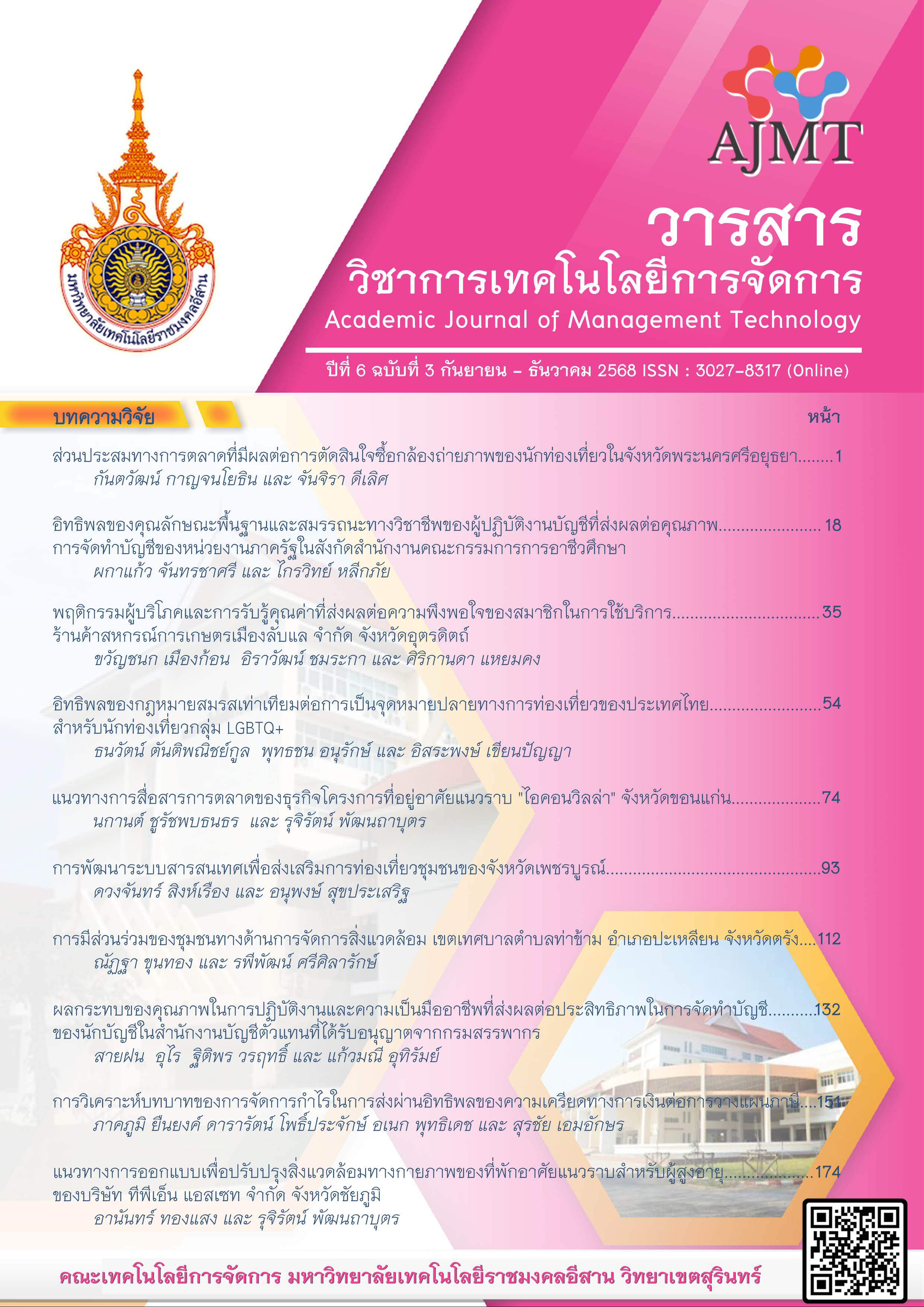
อิทธิพลของกฎหมายสมรสเท่าเทียมต่อการเป็นจุดหมายปลายทางการท่องเที่ยว ของประเทศไทย สำหรับนักท่องเที่ยวกลุ่ม LGBTQ+
DOI:
https://doi.org/10.14456/ajmt.2025.21คำสำคัญ:
การท่องเที่ยว LGBTQ+, กฎหมายสมรสเท่าเทียม, ความตั้งใจเดินทาง, ทฤษฎีพฤติกรรมตามแผนบทคัดย่อ
การวิจัยครั้งนี้มีวัตถุประสงค์เพื่อศึกษาผลของกฎหมายสมรสเท่าเทียม (MEL) ต่อทัศนคติ (ATT) บรรทัดฐานเชิงอัตวิสัย (SN) และการรับรู้การควบคุมพฤติกรรม (PBC) ของนักท่องเที่ยวกลุ่ม LGBTQ+ ตลอดจนวิเคราะห์อิทธิพล ของตัวแปรทั้งสามต่อความตั้งใจเดินทาง (INT) มาท่องเที่ยวประเทศไทย กลุ่มตัวอย่างคือผู้ที่ระบุว่าเป็น LGBTQ+ และยังไม่เคยเดินทางมาประเทศไทย จำนวน 400 คน เก็บข้อมูลผ่านแบบสอบถามออนไลน์ในชุมชนออนไลน์ของกลุ่ม LGBTQ+ เครื่องมือวิจัยเป็นแบบสอบถามมาตราส่วน Likert 5 ระดับ และใช้สถิติการวิเคราะห์การถดถอยพหุคูณ (Multiple Regression Analysis) ผลการวิจัยพบว่า MEL มีอิทธิพลเชิงบวกและมีนัยสำคัญทางสถิติต่อ ATT SN และ PBC โดยสามารถอธิบายความแปรปรวนได้ในระดับสูง (48 - 53%) นอกจากนี้ ATT และ PBC ส่งผลเชิงบวกและมีนัยสำคัญต่อ INT ขณะที่ SN แม้มีทิศทางเชิงบวก แต่ไม่พบอิทธิพลอย่างมีนัยสำคัญทางสถิติ โดยโมเดลการวิจัย สามารถอธิบายความแปรปรวนของความตั้งใจเดินทางได้ถึง 59.9% ผลการศึกษายืนยันว่ากฎหมายสมรสเท่าเทียมไม่เพียงแต่สร้างความเท่าเทียมทางสิทธิ แต่ยังมีบทบาทสำคัญในการสร้างทัศนคติที่ดีและความเชื่อมั่นของนักท่องเที่ยว LGBTQ+ ต่อประเทศไทยในฐานะจุดหมายปลายทางที่เป็นมิตรและปลอดภัย งานวิจัยนี้มีความสำคัญเชิงทฤษฎี ในการขยายการประยุกต์ใช้ทฤษฎีพฤติกรรมตามแผน (TPB) ในบริบทของกฎหมายและการท่องเที่ยว เชิงปฏิบัติช่วยให้ผู้ประกอบการออกแบบบริการที่ตอบสนองต่อกลุ่ม LGBTQ+ และเชิงนโยบายชี้ให้เห็นว่ากฎหมายสมรสเท่าเทียมสามารถใช้เป็นกลยุทธ์ในการยกระดับประเทศไทยให้เป็น LGBTQ+ Friendly Destination ที่มีศักยภาพในตลาดโลก
เอกสารอ้างอิง
Ajzen, I. (1991). The Theory of Planned Behavior. Organizational Behavior and Human Decision Processes, 50(2), 179–211. https://doi.org/10.1016/0749-5978(91)90020-T
Badgett, M. V. L. (2014). The Economic Impact of Extending Marriage to Same-Sex Couples: Evidence from the United States. The Williams Institute, UCLA School of Law.
Bangkok Post. (2024, September 24). Marriage Equality Bill Becomes Law. Author. https://www.bangkokpost.com/thailand/general/2871458/marriage-equality-bill-becomes-law
Binnie, J., & Klesse, C. (2013). The Politics of Age, Temporality and Intergenerationality in Transnational Lesbian, Gay, Bisexual, Transgender and Queer Politics. Sociology, 47(3), 580-595. https://doi.org/10.1177/0038038512453795
CBI Ministry of Foreign Affairs. (2024). The European Market Potential for LGBTQ+ Tourism. CBI. https://www.cbi.eu/market-information/tourism/lgbtq-tourism/market-potential
Chayut, S., & Panarat, T. (2024). Thailand Becomes First Southeast Asian Country to Legalise Same-Sex Marriage. The Guardian. https://www.theguardian.com/world/2024/jun/18/thailand-same-sex-marriage
Cochran, W. G. (1977). Sampling Techniques (3rd ed.). John Wiley & Sons.
Field, A. (2018). Discovering Statistics Using IBM SPSS Statistics (5th ed.). Sage Publications.
Floyd, F. J., & Bakeman, R. (2006). Coming-Out Across the Life Course: Implications of Age and Historical Context. Archives of Sexual Behavior, 35(3), 287-296. https://doi.org/10.1007/s10508-006-9022-x
Hair, J. F., Black, W. C., Babin, B. J., & Anderson, R. E. (2019). Multivariate Data Analysis (8th ed.). Cengage Learning.
Hughes, H. L. (2002). Gay Men's Holiday Destination Choice: A Case of Risk and Avoidance. International Journal of Tourism Research, 4(4), 299–312. https://doi.org/10.1002/jtr.383
Hughes, H. L., Monterrubio, C., & Miller, A. (2010). “Gay Tourism” in the UK: Dimensions of Sexual Orientation Tourism. Tourism Management, 31(1), 1-12. https://doi.org/10.1016/j.tourman.2009.01.012
Jensen-Campbell, C. (2004). The Gay/Lesbian Travel Marketplace [White Paper]. USDM.net.
Johnston, L. (2005). Queer Cosmopolitanism and the Politics of Pride. Antipode, 37(4), 875-899. https://doi.org/10.1111/j.0066-4812.2005.00524.x
Kiatkamolsri, P., & Thayansin, K. L.-I. (2020). Factors Influencing LGBT Tourists' Loyalty in Pattaya, Chonburi Province. In Proceedings of the 15th Graduate Research Conference, Academic Year 2020 (pp. 1070-1084). Graduate School, Rangsit University. https://rsujournals.rsu.ac.th/index.php/rgrc/article/download/1919/1500/
Kobkitpanichpol, B., & Keawthip, P. (2022). The Analysis of LGBTQ+ Tourists Behavior in Chiang Mai Province. Journal of Management Science, Chiang Rai Rajabhat University, 17(2), 89–110.
Lam, T., & Hsu, C. H. C. (2006). Predicting Behavioral Intention of Choosing a Travel Destination. Tourism Management, 27(4), 589–599. https://doi.org/10.1016/j.tourman.2005.02.003
McNeil, O. (2021). I Do (or Don’t): The Impact of Same-Sex Marriage Laws on International Tourism (Honors thesis). University of California, Berkeley. https://www.econ.berkeley.edu/sites/default/files/McNeil_Oliver_HonorsThesis_2021.pdf
MCOT NEWS. (2025). TAT Pull LGBTQ to travel to Thailand after spending more than 73,000 baht per trip (in Thai). [Facebook post]. Facebook. https://www.facebook.com/share/p/1Ahgun17Nt/
Monterrubio, C. (2020). Sexual Minorities, Tourism and Spaces of Tolerance: The Case of Mexico. Annals of Tourism Research, 80, 102828. https://doi.org/10.1016/j.annals.2019.102828
Monterrubio, C., & Hughes, H. (2019). Gay Tourism: New Perspectives. Journal of Policy Research in Tourism, Leisure and Events, 11(3), 273-279. https://doi.org/10.1080/19407963.2019.1575952
Nunnally, J. C., & Bernstein, I. H. (1994). Psychometric Theory (3rd ed.). McGraw-Hill.
Penñaloza, L. (1996). We're Here, We're Queer, and We're Going Shopping! a Critical Perspective on the Accommodation of Gays and Lesbians in the U.S. Marketplace. Journal of Homosexuality, 31(1-2), 9-41. https://doi.org/10.1300/J082v31n01_02
Pornsuksawat, S., Kheokao, J., Wilainuch, P., & Phovijit, P. (2021). Exposure to Media and Information on Travel to Thailand and Lifestyle Segmentation of LGBT Tourists. Journal of the International Academy for Case Studies, 27(1), 1-8. https://www.abacademies.org/articles/exposure-to-media-and-information-on-travel-to-thailand-and-lifestyle-segmentation-of-lgbt-tourists.pdf
Pritchard, A., Morgan, N. J., & Sedgley, D. (2002). In Search of Lesbian Space? The Experience of Manchester’s Gay Village. Leisure Studies, 21(2), 105–123. https://doi.org/10.1080/02614360210139865
Pritchard, A., Morgan, N., Sedgely, D., & Jenkins, A. (1998). Reaching Out to the Gay Tourist: Opportunities and Threats in an Emerging Market Segment. Tourism Management, 19(3), https://doi.org/10.1016/S0261-5177(98)80016-2
Pritchard, A., Morgan, N., Sedgley, D., & Jenkins, A. (2000). Sexuality and Holiday Choices: Conversations with Gay and Lesbian Tourists. Leisure Studies, 19(4), 267–282. https://doi.org/10.1080/026143600750022283
Quintal, V. A., Lee, J. A., & Soutar, G. N. (2010). Risk, Uncertainty and the Theory of Planned Behavior: A Tourism Example. Tourism Management, 31(6), 797–805. https://doi.org/10.1016/j.tourman.2009.08.006
Reuters. (2024). Thailand Passes Landmark Bill Recognising Marriage Equality. Reuters. https://www.reuters.com/world/asia-pacific/thailand-passes-landmark-bill-recognising-marriage-equality-2024-06-18/
Russell, P. (2001). The World Gay Travel Market. Travel and Tourism Analyst, 2, 37-58.
Surajai, S. (2022). Behaviors and Expectations of LGBT Thai Tourists Traveling in Koh Samet, Rayong [Master’s thesis, Dhurakij Pundit University]. DPU Learning Library. https://libdoc.dpu.ac.th/thesis/Sunisa.Sura.pdf
Tongterm, T. (2025). Designing Recreational Spaces and Activities for Gender Diversity: Lessonsfrom Countries with Marriage Equality Laws. Journal of Education and Human Development. Sisaket Rajabhat University, 5(1), 62-80
UNWTO. (2012). Global Report on LGBT Tourism. World Tourism Organization.
UNWTO. (2017). Second Global Report on LGBT Tourism. World Tourism Organization. https://www.e-unwto.org
Veilleux, A. (2021). LGBTQ Tourism in Thailand in the Light of Glocalization : Capitalism, Local Policies, and Impacts on the Thai LGBTQ Community. FrancoAngeli. https://library.oapen.org/handle/20.500.12657/53224
Waitt, G., & Markwell, K. (2006). Gay Tourism: Culture and Context. Haworth Hospitality Press.
Wisartsakul, W., Panyakamphon, C., Hiransalee, S., & Sindhuras, T. (2021). A Study of Tourism Supply Promptness in Welcoming LGBT Tourists: A Case Study of Gay Tourists. Journal of International and Thai Tourism, 17(1), 140-163.
Wongwichit, N., Nadee, M., Panthong, K., Thawiphrom, R., Sungsunchat, C., Khumtong, P., Ngammoh, N., Boonraum, K., & Kiatprasert, P. (2023). Marketing Strategies Affecting Decisionsto ChooseEcotourism Destinations of Generation Z Tourists in Thailand. Academic Journal of Management Technology, 4(1), 29-40. DOI: https://doi.org/10.14456/ajmt.2023.3
ดาวน์โหลด
เผยแพร่แล้ว
รูปแบบการอ้างอิง
ฉบับ
ประเภทบทความ
สัญญาอนุญาต
ลิขสิทธิ์ (c) 2025 คณะเทคโนโลยีการจัดการ มหาวิทยาลัยเทคโนโลยีราชมงคลอีสาน วิทยาเขตสุรินทร์

อนุญาตภายใต้เงื่อนไข Creative Commons Attribution-NonCommercial-NoDerivatives 4.0 International License.
บทความที่ได้รับการตีพิมพ์เป็นลิขสิทธิ์ของคณะเทคโนโลยีการจัดการ มหาวิทยาลัยเทคโนโลยีราชมงคลอีสาน วิทยาเขตสุรินทร์
ข้อความที่ปรากฏในบทความแต่ละเรื่องในวารสารวิชาการเล่มนี้ เป็นความคิดเห็นส่วนตัวของผู้เขียนแต่ละท่านไม่เกี่ยวข้องกับคณะเทคโนโลยีการจัดการ มหาวิทยาลัยเทคโนโลยีราชมงคลอีสาน วิทยาเขตสุรินทร์ และคณาจารย์ท่านอื่นๆในมหาวิทยาลัยฯ แต่อย่างใด ความรับผิดชอบองค์ประกอบทั้งหมดของบทความแต่ละเรื่องเป็นของผู้เขียนแต่ละท่าน หากมีความผิดพลาดใดๆ ผู้เขียนแต่ละท่านจะรับผิดชอบบทความของตนเองแต่ผู้เดียว