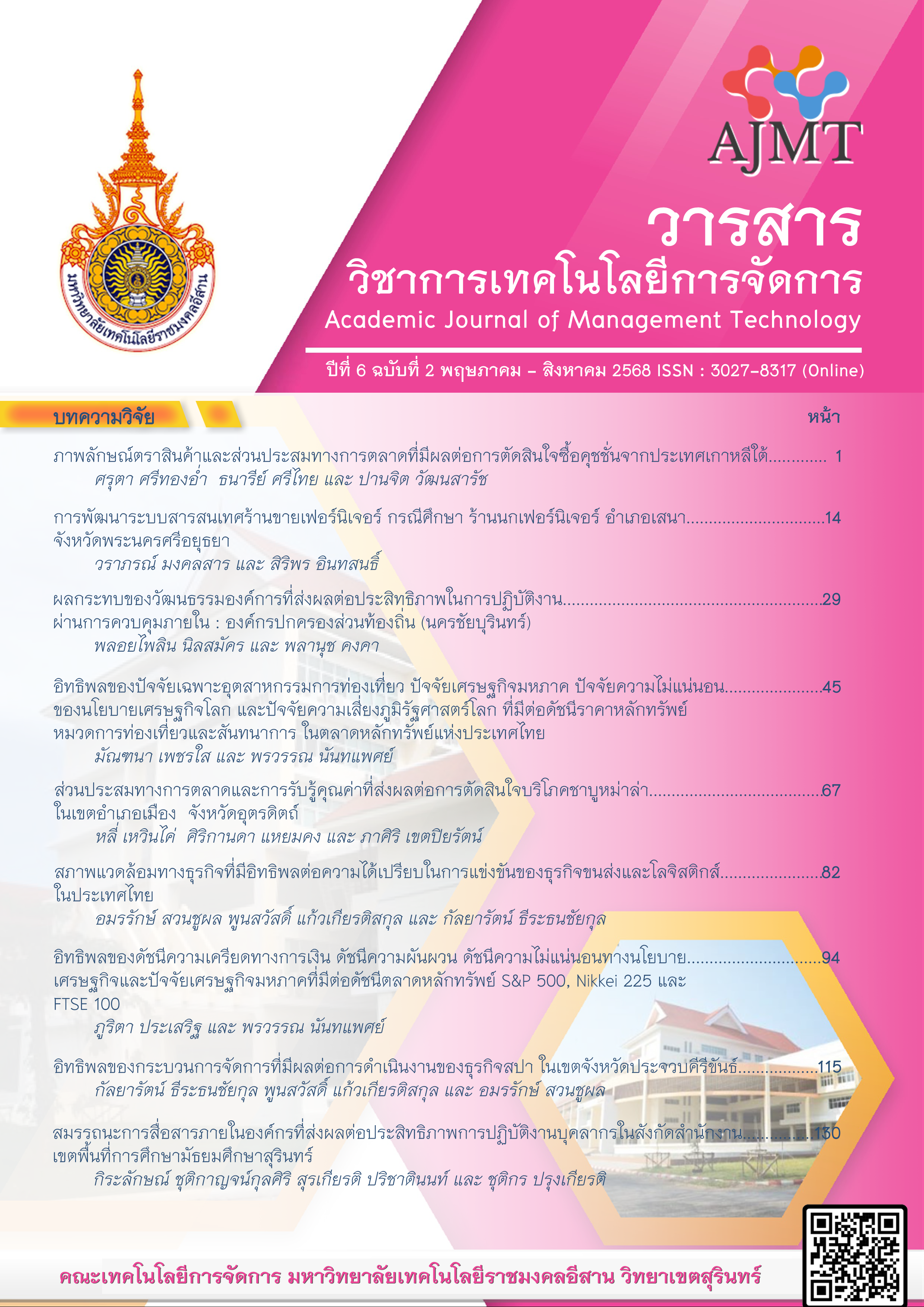
สภาพแวดล้อมทางธุรกิจที่มีอิทธิพลต่อความได้เปรียบในการแข่งขันของธุรกิจขนส่งและโลจิสติกส์ในประเทศไทย
DOI:
https://doi.org/10.14456/ajmt.2025.14คำสำคัญ:
การแข่งขันทางธุรกิจ, ความได้เปรียบในการแข่งขัน , ธุรกิจขนส่งและโลจิสติกส์, สภาพแวดล้อมทางธุรกิจบทคัดย่อ
การวิจัยครั้งนี้มีวัตถุประสงค์เพื่อศึกษาระดับของสภาพแวดล้อมทางธุรกิจที่มีอิทธิพลต่อความได้เปรียบในการแข่งขันของธุรกิจขนส่งและโลจิสติกส์ในประเทศไทย และศึกษาอิทธิพลของสภาพแวดล้อมทางธุรกิจที่ส่งต่อความได้เปรียบในการแข่งขันของธุรกิจขนส่งและโลจิสติกส์ในประเทศไทย กลุ่มตัวอย่างในการวิจัยครั้งนี้ ผู้วิจัยเลือกศึกษาเฉพาะ พนักงานที่ปฏิบัติงานในกลุ่มธุรกิจขนส่งและโลจิสติกส์ที่จดทะเบียนอยู่ในตลาดหลักทรัพย์แห่งประเทศไทย เท่านั้น จำนวน 400 คน โดยผู้วิจัยใช้วิธีการเลือกกลุ่มตัวอย่างแบบเจาะจง สถิติที่ใช้ในการวิจัยได้แก่ ค่าความถี่ ค่าร้อยละ ค่าเฉลี่ย ค่าเบี่ยงเบนมาตรฐาน และใช้การวิเคราะห์หาการถดถอยพหุคูณ ผลการวิจัย พบว่า ระดับของสภาพแวดล้อมทางธุรกิจที่ส่งต่อความได้เปรียบในการแข่งขันของธุรกิจขนส่งและโลจิสติกส์ในประเทศไทย อยู่ในระดับมาก และสภาพแวดล้อมทางธุรกิจมีอิทธิพลต่อความได้เปรียบในการแข่งขันของธุรกิจขนส่งและโลจิสติกส์ในประเทศไทยระดับสูงมาก ที่ระดับนัยสำคัญทางสถิติ 0.05
เอกสารอ้างอิง
Gunawan, A., Dewayana, T. S., Suryadi, K., & Marie, I. A. (2025). Sustainable Competitive Advantage in Creative SMEs : A Systematic Bibliometric Review of Scholar Literature. Multidisciplinary Reviews, 9(2), 2026065. https://doi.org/10.31893/multirev.2026065
Hambleton, R.K. (1984). Validating the Test Scores. In R. A. Berk. (Ed), A Guide to Criterion-Referenced Test Construction (pp. 199-223). The Johns Hopkins University Press.
Ivanov, D. (2021). The Impact of COVID-19 on Supply Chain Resilience and Competitive Advantage. International Journal of Production Research, 59(12), 3535-3552.
Jansen, J. J., Van Den Bosch, F. A., & Volberda, H. W. (2006). Exploratory Innovation, Exploitative Innovation, and Performance: Effects of Organizational Antecedents and Environmental Moderators. Management Cience, 52(11), 1661-1674.
Kamble, S. S., Gunasekaran, A., Kumar, V., Belhadi, A., & Foropon, C. (2021). The Role of Sustainability Practices in Enhancing Competitive Advantage in Logistics Firms. Technological Forecasting and Social Change, 16(3), 120-465
Krejcie, R.V., & Morgan, D.W. (1970). Determining Sample Size for Research Activities. Educational and Psychological Measurement, 30(3), 607-610.
Kotzab, T., Müllner, S., Hirsch, T., Noureldin, K., Nouri, B., Schmitz, M., & Pitz-Paal, R. (2022). The Impact of Regulatory Changes on Logistics and Transportation Firms' Competitive. Advantage Solar Energy, 23(9), 170-178.
Michael, E. (1990). Porter. The Competitive Advantage of Nations.
Van Hoa, N., Van Thu, P., Dat, N. T., & Loan, L. T. (2023). Analysis of the Business Environment of the Logistics and the Construction Industry in Vietnam after Covid-19. International Journal of Advanced Multidisciplinary Research and Studies, 3(1), 316-328.
Wang, Z., Gao, L., & Wang, W. (2025). The Impact of Supply Chain Digitization and Logistics Efficiency on the Competitiveness of Industrial Enterprises. International Review of Economics & Finance, 9(7), 103-759.
Wahyuni, N., Kulik, A. A., Lydia, E. L., Shankar, K., & Huda, M. (2020). Developing Region to Reduce Economic Gap and to Support Large Environment Activities. Journal of Environmental Treatment Techniques, 8(1), 540-545.
Wieland, T. (2020). The Influence of Digitalization on Supply Chain Resilience and Competitive Advantage. Safety Science, 13(1), 104-124.
ดาวน์โหลด
เผยแพร่แล้ว
รูปแบบการอ้างอิง
ฉบับ
ประเภทบทความ
สัญญาอนุญาต
ลิขสิทธิ์ (c) 2025 คณะเทคโนโลยีการจัดการ มหาวิทยาลัยเทคโนโลยีราชมงคลอีสาน วิทยาเขตสุรินทร์

อนุญาตภายใต้เงื่อนไข Creative Commons Attribution-NonCommercial-NoDerivatives 4.0 International License.
บทความที่ได้รับการตีพิมพ์เป็นลิขสิทธิ์ของคณะเทคโนโลยีการจัดการ มหาวิทยาลัยเทคโนโลยีราชมงคลอีสาน วิทยาเขตสุรินทร์
ข้อความที่ปรากฏในบทความแต่ละเรื่องในวารสารวิชาการเล่มนี้ เป็นความคิดเห็นส่วนตัวของผู้เขียนแต่ละท่านไม่เกี่ยวข้องกับคณะเทคโนโลยีการจัดการ มหาวิทยาลัยเทคโนโลยีราชมงคลอีสาน วิทยาเขตสุรินทร์ และคณาจารย์ท่านอื่นๆในมหาวิทยาลัยฯ แต่อย่างใด ความรับผิดชอบองค์ประกอบทั้งหมดของบทความแต่ละเรื่องเป็นของผู้เขียนแต่ละท่าน หากมีความผิดพลาดใดๆ ผู้เขียนแต่ละท่านจะรับผิดชอบบทความของตนเองแต่ผู้เดียว