
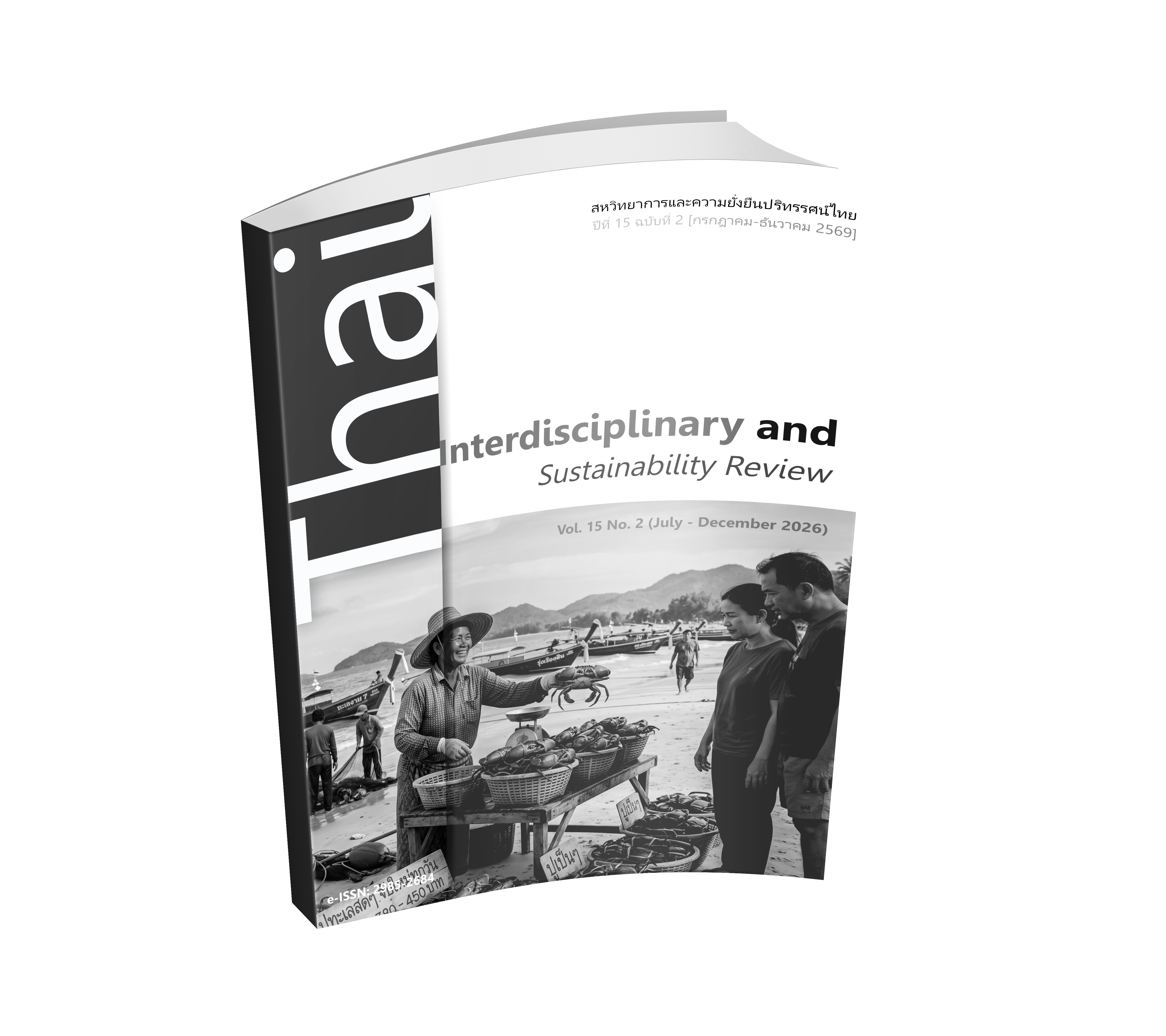
RESILIENT COMMUNITY CRAB BANKS: INSTITUTIONAL FOUNDATIONS FOR THAILAND'S SUSTAINABLE BLUE ECONOMY
DOI:
https://doi.org/10.14456/tisr.2026.22Keywords:
Community Crab Banks, Institutional Resilience, Blue Economy Development, Common-Pool Resource Management, Blue JusticeAbstract
This article synthesizes a seven-year research initiative (2018–2024) evaluating the expansion of 565 community blue swimming crab banks across 20 coastal provinces in Thailand. The study examines how these local initiatives build institutional resilience and function as effective mechanisms for a sustainable blue economy. Utilizing an integrated analytical framework encompassing common-pool resource management, community resilience, and blue justice, the research identifies four fundamental pillars of institutional stability: robust community ownership, proactive social and market support, state facilitation through researcher networks, and transparent governance systems. The findings empirically show that when these four forces work together, community crab banks meet the core dimensions of the Blue Economy Development Framework (BEDF): sustainable fisheries, community adaptive capacity, and long-term economic viability. Ultimately, this research argues that the institutional stability of community crab banks is a critical precondition for ecological sustainability, effectively transforming a micro-level conservation tool into a macro-level driver of an inclusive, just, and sustainable blue economy.
Downloads
References
Adger, W. (2000). Social and ecological resilience: Are they related?. Progress in Human Geography, 24(3), 347-364.
Bennett, N., Cisneros-Montemayor, A., Blythe, J., Silver, J., Singh, G., Andrews, N., … & Sumaila, U. (2019). Towards a sustainable and equitable blue economy. Nature Sustainability, 2, 991-993.
Berkes, F., & Ross, H. (2013). Community resilience: Toward an integrated approach. Society & Natural Resources, 26(1), 5-20.
Chuenpagdee, R., Fraga, J., & Euán-Avila, J. (2004). Progressing Toward Comanagement Through Participatory Research. Society & Natural Resources, 17(2), 147-161.
Duarte, C., Agusti, S., Barbier, E., Britten, G., Castilla, J., Gattuso, J., … & Worm, B. (2020). Rebuilding marine life. Nature, 580, 39-51.
Folke, C., Carpenter, S., Walker, B., Scheffer, M., Chapin, T., & Rockström, J. (2010). Resilience thinking: Integrating resilience, adaptability and transformability. Ecology and Society, 15(4), 20.
Food and Agriculture Organization of the United Nations. (2022). Blue transformation roadmap 2022-2030: A vision for FAO’s work on aquatic food systems. Retrieved from https://doi.org/10.4060/cc0459en.
Gutiérrez, N., Hilborn, R., & Defeo, O. (2011). Leadership, social capital and incentives promote successful fisheries. Nature, 470, 386-389.
Hardin, G. (1968). The tragedy of the commons. Science, 162, 1243-1248.
Jentoft, S. (2000). The community: A missing link of fisheries management. Marine Policy, 24(1), 53-60.
Kraisoraphong, K., Pongpanich, C., Sawusdee, A., Koolkalaya, S., Chaitanawisuti, N., Savangarrom, Y., & Supawinyu, K. (2025). Community blue swimming crab bank and related extension activities on the path of sustainable blue economy. Bangkok: National Research Council of Thailand.
Lincoln, Y., & Guba, E. (1985). Naturalistic Inquiry. California: SAGE Publications, Inc.
Makino, M., & Matsuda, H. (2005). Co-management in Japanese coastal fisheries: Institutional features and transaction costs. Marine Policy, 29(5), 441-450.
National Research Council of Thailand. (2025). White paper: Community blue swimming crab bank and related extension activities on the path of sustainable blue economy (Final report under the Blue Swimming Crab Bank Expansion Project to “Return Blue Swimming Crabs to the Thai Sea,” fiscal year 2025). Bangkok: National Research Council of Thailand.
Onsri, N., Sivaipram, I., Boonsanit, P., Sagulsawasdipan, K., & Saramul, S. (2024). Larval dispersal modelling of the blue swimming crab Portunus pelagicus (Linnaeus, 1758) from the crab banks along the coast of Trang Province, southern Thailand. Water, 16(2), 349.
Ostrom, E. (1990). Governing the commons: The evolution of institutions for collective action. Cambridge: Cambridge University Press.
Ostrom, E. (2009). A general framework for analyzing sustainability of social-ecological systems. Science, 325, 419-422.
Ostrom, E., Burger, J., Field, C., Norgaard, R., & Policansky, D. (1999). Revisiting the commons: Local lessons, global challenges. Science, 284, 278-282.
Pomeroy, R. (2012). Managing overcapacity in small-scale fisheries in Southeast Asia. Marine Policy, 36(2), 520-527.
Pomeroy, R., & Carlos, M. (1997). Community-based coastal resource management in the Philippines: A review and evaluation of programs and projects, 1984-1994. Marine Policy, 21(5), 445-464.
Russ, G., Alcala, A., Maypa, A., Calumpong, H., & White, A. (2004). Marine reserve benefits local fisheries. Ecological Applications, 14(2), 597-606.
Sawusdee, A., & Noosang, S. (2021). Handbook of Thailand’s blue swimming crab banks. Nakhon Si Thammarat: Walailak University.
Sawusdee, A., Koolkalya, S., Thapanand, T., & Jutagate, T. (2023). Evolution of the food web in Bandon Bay, the Gulf of Thailand: Ten years of the blue swimming crab stocking programme. Tropical Life Sciences Research, 34(2), 109-130.
Secretariat of the Cabinet. (2018). Cabinet resolution of 6 March 2018 on the Blue Swimming Crab Bank Expansion Project to “Return Blue Swimming Crabs to the Thai Sea”. Retrieved from www.soc.go.th/?page_id=14791.
Supmee, V., Sawusdee, A., Sangthong, P., & Suppapan, J. (2020). Population genetic structure of blue swimming crab (Portunus pelagicus) in the Gulf of Thailand. Biodiversitas Journal of Biological Diversity, 21(9), 4260-4268.
Suppapan, J., Songrak, A., Phinrub, W., Meesook, W., & Supmee, V. (2024). Genetic diversity of blue swimming crab (Portunus pelagicus) from a crab bank project and wild crabs in Trang and Krabi Province, Thailand using mtDNA control region sequences. Journal of Fisheries and Environment, 48(2), 94-111.
The World Bank. (2017). The Potential of the Blue Economy: Increasing Long-term Benefits of the Sustainable Use of Marine Resources for Small Island Developing States and Coastal Least Developed Countries. Retrieved from https://doi.org/10.1596/26843.
Virapongse, A., Brooks, S., Metcalf, E., Zedalis, M., Gosz, J., Kliskey, A., & Alessa, L. (2016). A social-ecological systems approach for environmental management. Journal of Environmental Management, 178, 83-91.
Voyer, M., Quirk, G., McIlgorm, A., & Azmi, K. (2018). Shades of blue: What do competing interpretations of the blue economy mean for oceans governance?. Journal of Environmental Policy & Planning, 20(5), 595-616.
World Bank Group. (2021). Core components of the BEDF and how each contributes to a blue economy. Retrieved from https://thedocs.worldbank.org/en/doc/e5c1bdb0384e732de3cef6fd2eac41e5-0320072021/original/BH023-BlueEconomy-FINAL-ENGLISH.pdf.
Downloads
Published
How to Cite
Issue
Section
License
Copyright (c) 2026 Keokam KRAISORAPHONG

This work is licensed under a Creative Commons Attribution-NonCommercial-NoDerivatives 4.0 International License.







.png)


