
Instructions for Authors
Thai Interdisciplinary and Sustainability Review (TISR) is committed to publishing high-quality, original research and review articles that contribute to the advancement of knowledge in science, technology, and health. These instructions provide guidelines for preparing and submitting your manuscript to TISR. Authors are strongly encouraged to carefully review these instructions before submitting their work.
Ethical Guidelines and Publication Policy
1) Originality and Authorship: Submission of a manuscript implies that the work described is original, has not been published previously (except in the form of an abstract or as part of a published lecture or academic thesis), and is not under consideration for publication elsewhere. All authors must approve the submission, and tacit or explicit approval must be granted by the responsible authorities where the research was conducted.
2) Copyright: Copyright for published articles remains with the authors. However, by submitting a manuscript, authors grant TISR first publication rights. Authors are responsible for seeking legal action if they believe their copyright has been infringed upon.
3) Plagiarism: TISR has a zero-tolerance policy towards plagiarism. All submissions are screened for plagiarism using appropriate software before being sent to reviewers. Manuscripts found to contain plagiarized material will be rejected. In accordance with COPE guidelines, any original wording taken directly from publications by other researchers must appear in quotation marks with appropriate citations. This also applies to an author’s own previously published work.
4) Citation Practices: Authors are responsible for ensuring accurate and complete citations.
• Material taken from other sources (including the author's own published work) must be clearly cited and, where appropriate, permission obtained.
• Excessive self-citation is discouraged.
• Authors should not copy references from other publications without having read the cited work.
• Preferential citation of one's own, friends', peers', or institution's publications is discouraged.
• Advertisements or advertorial material should not be cited.
5) Data Archiving: Authors are encouraged to deposit their data in a trusted repository and to include a data availability statement in their manuscript.
6) Permissions: If a manuscript includes figures, tables, or lengthy sections of text that have been previously published elsewhere, authors are responsible for obtaining written permission from the copyright holder(s) to reproduce this material in TISR.
7) Archiving and Indexing: Authors permit the publisher to apply a DOI to their articles and to archive them in databases and indexes such as CrossRef, Social Sciences Research Network, Google Scholar, and TCI.
Submission Guidelines and Evaluation Criteria
The Thailand Interdisciplinary and Sustainability Review (TISR) employs a Structured Peer Review system. To ensure a highly efficient editorial process and to maximize the manuscript's publication readiness, authors must strictly adhere to the following preparation guidelines. These guidelines are purposefully aligned with the exact criteria our peer reviewers use to evaluate the scientific rigor of your work.
1) General Requirements and Formatting
• Language: TISR accepts manuscripts written in either Thai or English.
• File Format: Manuscripts must be submitted in Microsoft Word (.doc or .docx) format.
• Manuscript Length: Papers should generally be between 5,000 and 8,000 words (including the abstract, main text, acknowledgments, and references). The strict minimum acceptable word count is 5,000 words.
• General Formatting (Applicable to ALL manuscripts):
- Paragraph & Line Spacing: Single spacing. Above paragraph: 0 pt.; Below paragraph: 0 pt.
- Numbers: Use a period as the decimal point (e.g., 3.14). Use a comma to separate numbers of more than three digits into groups of three (e.g., 10,000.47).
• Specific Formatting by Language:
- English Manuscripts: Font: Times New Roman, 12 pt. | Headings: Times New Roman, 12 pt., Bold.
- Thai Manuscripts: Font: Browallia New, 14 pt. | Headings: Browallia New, 16 pt., Bold.
2) Manuscript Structure and Evaluation Criteria
Manuscripts should be logically organized. Authors must ensure that the content within each section strictly satisfies our peer-review evaluation criteria outlined below:
2.1) Title Page & Front Matter
(Important Note for Thai Manuscripts: Authors submitting in Thai MUST provide dual-language information for the Title, Authors' Names/Affiliations, Abstract, and Keywords in both Thai and English).
• Title: Must be concise, informative, and optimized for searchability. Avoid abbreviations and formulae.
• Authors' Names and Affiliations: First name, middle initial(s), and last name. Omit all academic titles and degrees (e.g., Dr., Professor, Ph.D.). Limit affiliations to a maximum of three per author. Clearly indicate the corresponding author with an asterisk (*) and provide their active email address.
Example:
Kittisak WONGMAHESAK1 and Thanaporn SRIYAKUL2*
1 Faculty of Political Science, North Bangkok University, Thailand; Publication Research Institute and Community Service, Universitas Muhammadiyah Sidenreng Rappang, Indonesia; Faculty of Business and Management, Universiti Sultan Zainal Abidin, Malaysia; kittisak.wongmahesak@gmail.com
2 Faculty of Business Administration, Mahanakorn University of Technology, Thailand; ajbamut@gmail.com (Corresponding Author)
• Abstract: A single-paragraph abstract of 180–250 words without subheadings or references. Evaluation Criterion: The abstract must comprehensively reflect all essential aspects of the study.
- For Research Articles: Must include 1) Significance, 2) Objective, 3) Methodology, and 4) Results and Implications.
- For Review Articles: Must include 1) Context, 2) Purpose, 3) Approach, and 4) Conclusions and Implications.
• Keywords: Provide 3–5 keywords immediately after the abstract.
2.2) Main Text (Original Research Articles)
Divide the article into clearly defined and numbered sections. Ideally, a subsection should not exceed 800 words.
1) Introduction: Provide a clear scientific background and rationale. Evaluation Criterion: Authors must explicitly state both the primary and secondary objectives at the very end of this section.
2) Literature Review: Evaluation Criterion: Present a comprehensive, highly relevant, and up-to-date analysis of existing research to establish a solid theoretical foundation.
3) Methodology: Evaluation Criterion: Describe the methods with sufficient detail to enable complete replication. Clearly identify the experimental design, sample size estimation, and study population. Rigorously document all statistical analyses, sampling mechanisms, and relevant metrics (e.g., p-values, Confidence Intervals [CIs], effect sizes).
4) Results: Evaluation Criterion: Present data logically and objectively. If statistical analyses are used, ensure that sub-analyses, sensitivity analyses, and specific reporting metrics are thoroughly provided to substantiate findings.
5) Conclusion & Discussion: Evaluation Criterion: Interpret results strictly based on the collected data and study design. Authors must critically discuss implications and prominently emphasize the study's limitations.
(Note for Review Articles: The section headings may be flexible depending on the topic. However, reviewers will strictly evaluate the manuscript's rationale, historical insights, methodological transparency/reproducibility of the literature search, and structural flow).
3) Tables, Figures, and Equations
• Equations: Must be clear and legible, with text size similar to normal text. Define all symbols used.
• Tables: Number consecutively. Place the caption above the table body and the description below. Avoid vertical rules. Use tables sparingly and ensure data does not duplicate results described in the text.
• Figures and Schemes: Number consecutively. Place the caption and description below the figure. Figures must be of high quality with a minimum resolution of 300 DPI.
• General Visual Style: Avoid abbreviating titles (i.e., use Table 1, Figure 2, Equation 3) in captions or running text. Do not write "the table above/below" or "the figure on page 32," as positions change during typesetting.
4) References and Citation Policy
TISR strictly adheres to rigorous citation standards to maintain its academic standing.
• In-text Citations: Give, in parentheses, the last name of the author and the year published (e.g., Smith, 2023). For unpublished works, give the year produced. Cite works that have directly influenced your research.
• Cross-Referencing: Every reference cited in the text must appear in the reference list, and vice versa.
• Mandatory Reference Requirements:
- The reference list must contain a minimum of 15 items.
- Authors must heavily emphasize recent articles published in peer-reviewed academic journals, deliberately avoiding independent studies, unpublished theses, or uncertified internet sources.
- To maintain high academic standards, at least two-thirds (2/3) of the references must be sourced from reputable national (Thai) or international journals.
5) Editorial Rights and Copyediting
TISR reserves the absolute right to comprehensively edit, modify, and format accepted manuscripts during the production stage prior to final publication. To ensure that the published work maximizes its academic impact and perfectly aligns with the journal’s aims, scope, and national target audience, the Editor-in-Chief retains full authority and sole discretion to evaluate and make necessary substantive adjustments to the article’s title, abstract, keywords, and main content, as well as to refine the manuscript for grammatical accuracy, linguistic clarity, and structural flow. The Production Editor will be responsible exclusively for manuscript formatting, typesetting, and preliminary technical corrections.
By submitting a manuscript to TISR, authors explicitly acknowledge and agree that the Editorial Board holds the absolute right to finalize the publication. The journal will not send the final revised proof back to the authors for review or confirmation prior to publication. All modifications approved by the Editor-in-Chief during this production stage are final.
Reference Style
1) APA Style (7th Edition): TISR follows the referencing style outlined in the Publication Manual of the American Psychological Association (7th ed.). Authors are responsible for ensuring that all references conform to APA style.
• APA Style – References
• APA Style – Reference Examples
• APA Style – 7th Edition Common Reference Examples
2) In-Text Citations: Follow APA guidelines for formatting in-text citations, including providing the author's last name and year of publication in parentheses.
3) Reference List: Compile a complete list of references at the end of the manuscript, following APA formatting guidelines. Ensure that all references cited in the text appear in the reference list, and vice versa.
Submission Process
1) Online Submission: Manuscripts should be submitted electronically via the journal's website: https://so03.tci-thaijo.org/index.php/JIRGS/about/submissions
2) Registration: First-time users will need to register an account on the journal's website before submitting a manuscript.
3) File Upload: Follow the instructions on the website to upload your manuscript and any supplementary files.
4) Cover Letter: A cover letter is not required, but authors may choose to include one to briefly introduce their work and highlight its significance.
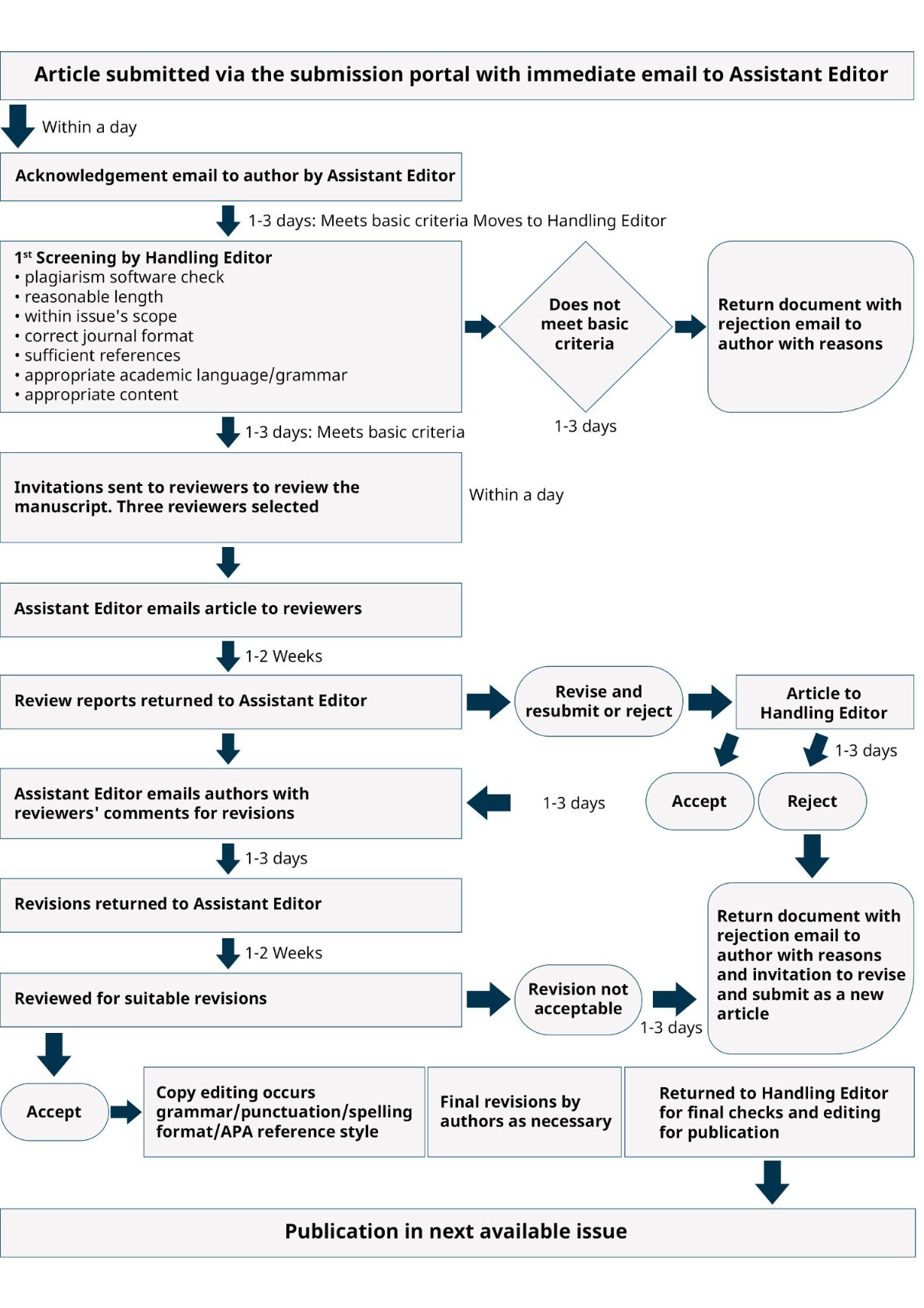
5) Submission Confirmation: Upon submission, an automatic confirmation email will be sent to the submitting author immediately. If you do not receive this confirmation, please check your spam folder and/or contact the editor.
Peer Review Process
1) Open Peer Review: TISR uses an open peer review system, where both authors and reviewers are aware of each other's identities.
2) Reviewer Selection: The editor will select at least two experts to review the manuscript. Authors may suggest potential reviewers who are knowledgeable in the relevant field; however, the editor reserves the right to make the final selection of reviewers based on expertise, availability, and other relevant criteria.
3) Review Timeline: The review process typically takes between ten and twenty-eight days.
4) Review Outcome: Authors will be notified of the outcome of the review by email.
5) Revision and Self-Certification: If revisions are required, authors will have up to three opportunities to revise their manuscript based on reviewers' comments. This includes the initial revision and up to two additional rounds, if necessary. Crucially, when submitting a revised manuscript, authors are required to complete, sign, and upload the "Author Self-Certification Form for Revised Manuscript Submission" as a "Supplementary File". Submissions without this form will be considered incomplete and will not be processed.
6) Rejection: If the manuscript does not meet publication standards after three revisions, it will be rejected. Rejected manuscripts may be substantially revised and resubmitted as new submissions.
7) Final Approval and Post-Acceptance Verification: Upon receipt of the revised manuscript and the Self-Certification Form, the Editorial Office will expedite the initial verification process, aiming to notify the result within 3 business days. Final approval will be granted if the revisions are satisfactory and comply with the self-certification conditions.
Note: The Editorial Board reserves the right to conduct a detailed post-acceptance verification within 30 days of issuing the Letter of Acceptance. If the Board detects any non-compliance with the "Author Self-Certification Form" (e.g., failure to address reviewers' comments, incorrect formatting, or use of Generative AI), the acceptance may be revoked, and the manuscript withdrawn from publication immediately.
Publication and Fees
1) Rationale and Transition to Page Charges (PC)
In strict alignment with the best practices and recommendations set forth by the Thai-Journal Citation Index Centre (TCI) and leading international ethical guidelines, the Thai Interdisciplinary and Sustainability Review (TISR) has restructured its publication fee model.
Effective July 1, 2026, the journal is transitioning from a bifurcated Article Processing Charge (APC)—which previously included an initial screening fee—to a streamlined, post-acceptance Page Charge (PC) model. This transition is designed to completely eliminate any perceived conflicts of interest, such as concerns that upfront fees might influence editorial decisions or serve as a financial burden for manuscripts that are ultimately declined (either as desk rejects or post-peer review).
Under this new model, authors will pay absolutely no fees upon submission, and no charges will apply to manuscripts that are not accepted for publication.
Furthermore, to enhance journal efficiency and minimize the burden on authors, detailed manuscript formatting is now fully managed by our in-house Production Editor. Authors are only required to ensure their submission contains complete, accurate content and structure as per our initial guidelines. The revised Page Charge strictly reflects the new cost structure, ensuring sustainable, high-quality publication while absorbing the operational costs of peer-reviewing declined manuscripts.
2) Page Charge (PC) Structure
Fees are applied only after a manuscript has successfully passed open peer review and received a formal preliminary acceptance from the Editor-in-Chief.
• Minimum Length: 5,000 words
• Recommended Maximum Length: 8,000 words
• Maximum Pages: No upper page limit is enforced.
|
Author Affiliation |
Post-Acceptance Page Charge (PC) |
Submission Fee |
|
Authors within Thailand |
1,500 THB per typeset page |
None (0 THB) |
|
International Authors |
50 USD per typeset page |
None (0 USD) |
(Note: The exact number of typeset pages will be calculated by the Production Editor once the manuscript is formatted into the journal’s final publication layout.)
3) Core Publishing Principles
3.1) Editorial Independence and Fair Play
At TISR, editorial decisions are fundamentally decoupled from financial transactions. The collection of Page Charges is handled entirely independently of the editorial and peer-review process. Although the journal operates under an open peer review system (where author and reviewer identities are known to each other to promote transparency), handling editors and reviewers evaluate manuscripts strictly based on academic merit, originality, and adherence to the journal's aims and scope. Evaluations are made entirely without consideration of the authors' funding status or ability to pay.
3.2) Page Charge (PC) Waivers and Discounts
We remain committed to ensuring that financial barriers do not prevent the publication of exceptional research. Authors from low-income economies (as classified by the World Bank) or those facing severe temporary funding constraints may apply for a PC waiver or discount. Waiver requests must be submitted during the initial manuscript submission process and will be assessed entirely separately from the scientific review of the paper.
3.3) Special Waiver Program (2025-2027)
In our effort to foster global research collaboration and support specific scholarly communities, TISR is offering a Special PC Waiver Program valid from 2025 to 2027. Under this program, a full (100%) Page Charge waiver is automatically granted to all International Authors whose manuscripts are submitted during this period.
3.4) Note on Costs and Financial Transparency
TISR operates on a sustainable cost-recovery and cross-subsidization model. The collection of Page Charges is essential to ensure the long-term viability of the journal, maintain high-quality publishing standards, and support our dedicated editorial and production teams. Rather than prioritizing profit maximization, our fee structure is designed primarily to offset the substantial operational expenses of rigorous open access academic publishing and to nurture emerging academic platforms within our network.
To maintain complete financial transparency with our authors and stakeholders, our primary operational expenses include:
• Platform and Partnership Fees: Approximately 70,000 THB annually for maintaining the Open Journal Systems (OJS) and our publishing partnership with the Social Science Research Network (Elsevier-SSRN).
• Administrative and Production Staff: Approximately 10,000 THB monthly to compensate our dedicated personnel managing journal administration and manuscript typesetting.
• Reviewer Honoraria: 2,000 THB per article to acknowledge the rigorous work of our peer reviewers.
Based on 2025 data across the association's network of 9 journals, with an average publication volume of 16 articles per journal annually, the baseline operational cost amounts to approximately 7,000 THB per published article. It is crucial to emphasize that any revenue collected that exceeds this baseline cost is directly reinvested into our scholarly ecosystem. For instance, in 2025, 4 out of our 9 journals operated entirely without charging any publication fees. The margin generated from the 5 fee-charging journals was strategically utilized to cross-subsidize and develop these 4 emerging journals, thereby providing accessible publication spaces for authors at absolutely zero cost. Furthermore, these funds sustain our extensive fee waiver programs for editorial board members and all international authors.
3.5) Access to Published Articles
TISR is a fully Open Access journal. Upon publication, all articles are immediately and permanently free to access, download, and share by anyone, anywhere in the world. Articles are published under the terms of the Creative Commons Attribution License (CC BY), allowing for maximum visibility and reuse, provided the original work is properly cited.
3.6) Refund Policy regarding Revocation and Retraction
Page Charges are non-refundable once an article has been published online. In the rare event of an article retraction or revocation due to ethical breaches, scientific misconduct, or significant errors (in accordance with COPE guidelines), the article will be retracted, but no refunds will be issued to the authors or their institutions.
4) Payment Method
4.1) Bank Name: Siam Commercial Bank Public Company Limited
• Branch: Kasetsart University
• Account Name: White Tiger Legal, Business and Research Consultants Co., Ltd.
• Account Number: 235-299780-8
• Swift code: SICOTHBK (www.scb.co.th)
4.2) Bank Name: Government Savings Bank
• Branch: The Mall Ngamwongwan
• Account Name: Association of Legal & Political Studies
• Account Number: 020491569735
• Swift code: GSBATHBK (www.gsb.or.th)
Publication Process and Timeline (Continuous Article Publishing)
Please note that, effective from the 2027 volume onwards, Thai Interdisciplinary and Sustainability Review (TISR) employs a Continuous Article Publishing (CAP) model to ensure the rapid dissemination of your research.
• Immediate Publication: Upon successfully passing the peer-review process and achieving final acceptance, your manuscript will be immediately typeset, assigned a DOI, and published online in the current annual volume. Authors do not need to wait for a scheduled quarterly or bi-annual issue release.
• Annual Cut-off Date: To manage the publication workflow effectively, the Editorial Board establishes an annual cut-off date once the target number of accepted manuscripts is reached. Authors are strongly encouraged to submit their work and complete any requested revisions promptly. Manuscripts that achieve final acceptance after the annual cut-off date will automatically be published in the following year's volume.
Contact Information
For any questions or inquiries regarding the submission process, please contact the editor at alps.journals@gmail.com








.png)


