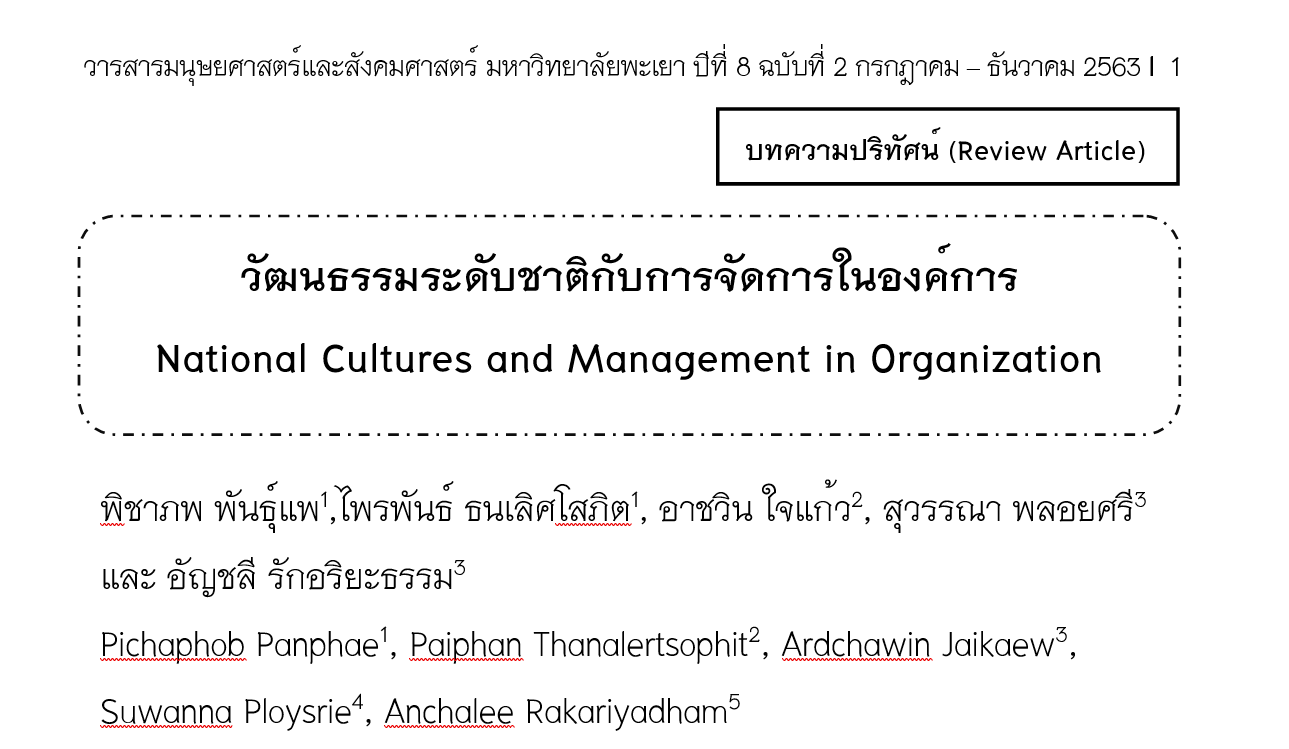
วัฒนธรรมระดับชาติกับการจัดการในองค์การ
คำสำคัญ:
วัฒนธรรมระดับชาติ, การจัดการในองค์การบทคัดย่อ
This article aimed at clarifying the meaning of culture which varied by background of all academia who tried to explain the idea on their own ways while the author synthesized the meaning on his basis. At the same time, the author explained the meaning and components of management, the level of cultures that has been divided by National, Business, and organizations cultures. Then, expressed their relationship toward management functions in organizations by employing Hofstede’s cultural dimension. In addition, this article explained the impact of national cultures toward leaders’adaptation. The necessary leadership skills, competencies that work effectively in diversify organizations. Furthermore, the article clarified the impact of national cultures toward employees’ motivation, and teamwork that eventually brought them to be highly successful organizations among difference cultures.
เอกสารอ้างอิง
เฮนรี่ มินซ์เบิร์ก. (1973). ธรรมชาติของงานบริหาร. นิวยอร์ค: สำนักพิมพ์ ฮาร์เปอร์และโรว์, 93-94.
Aycan Zeynep, Kanungo Rabindra N., and Mendonca Manuel. (2014). Organizations and Management in Cross- Cultural Context. Singapore: SAGE Publications Asia-Pacific Ltd.
Berry John W., Poortinga Yape H., Segall Marshall H., and Dasen Pierre R. (2003) Cross-Cultural Psychology: Research and Applications 2ed. Cambridge: Cambridge University Press.
Browaeys Marie-Joelle and Price Roger. (2015). Understanding Cross-Cultural Management 3rd. Edinburgh Gate Harlow. United Kingdom: Peason Education published.
Connerley Mary L. and Pedersen Paul B. (2005). Leadership in a Diverse and Multicultural Environment: Developing Awareness, Knowledge, and Skills. California: Sage Publications, Inc.
Daft Richard L.and Marcic Dorothy. (2012). Understand Management 8th edition. Mason, Ohio: Thomson South-Western.
Deresky Helen. (2014). International Management: Managing Across Cultures; Text and Cases 8th ed. Kendallville: Pearson Education Limited.
Fukuda, John K. (1991). Japanese style management transferred: The experience of East Asia. New York: Routledge, Chapman and Hall, Inc.
Guirdham Maureen. (2005). Communicating Across Cultures at Work. New York: Palgrave Macmillan.
Hofstede Geert & Gert Jan. (2005). Cultures and Organizations Software of the Mind. New York: Mc. Graw Hill.
Luthans Fred and Doh Jonathan P. (2009). International Management: Culture, Strategy, and Behavior. Boston, MA: Mc Graw-Hill Irwin.
Mead Richard and Andrews Tim G. (2010). International Management 4th ed. Chichester, West Sussex, John Wiley and Son Ltd.
Putti, Joshep M. (1998). Essentials of Management An Asian Perspective Singapore. Mc Graw-Hill Companies Inc.
Saee John. (2005). Managing Organizations in a Global Economy: An Intercultural Perspective. Ohio: Thomson Corporation.
Schneider Susan C. and Barsoux Jean-Louis. (2003). Managing Across Cultures. London: Pearson Education Limited.
Smith, Brent. (2010). If Culture is Software of The Mind, Then ours Needs an Upgrade: Lamentations on our Illiteracy of African Business and Culture. Journal of Business & Economics Research, 8(3), 83-92.
Steers Richard M., Sanchez-Runde Carlos J., and Nardon Luciara. (2010). Management Across Cultures: Challenges and Strategies. Cambridge: Cambridge University Press.
Shephard, Peter. (2002). Leading Diverse and Muti-Cultural Teams: The whole Brain Way. Sendirian Berhad; Kuala Lumper: Brain Domimance Technologies.
Thomas David C. and Peterson Mark F. (2018). Cross-Cultural Management: Essential Concepts 4th ed. Singapore: SAGE Publications Asia-Pacific Pte.Ltd.
Tu, Yu-Te; Lin, Shean-Yuh; Chang, Yu-Yi. (2011). A Cross-Cultural Comparison by Idividualism/Collectivism among Brazil, Russia, India and China. International Business Research, 4(2), 175-182.
ดาวน์โหลด
เผยแพร่แล้ว
รูปแบบการอ้างอิง
ฉบับ
ประเภทบทความ
สัญญาอนุญาต
Authors are responsible for the content of their manuscripts. The University of Phayao does not necessarily endorse or agree with the views expressed in published articles. Interested parties may reproduce or use the content; however, they must obtain prior written permission from the copyright holder and provide proper citation and acknowledgment.