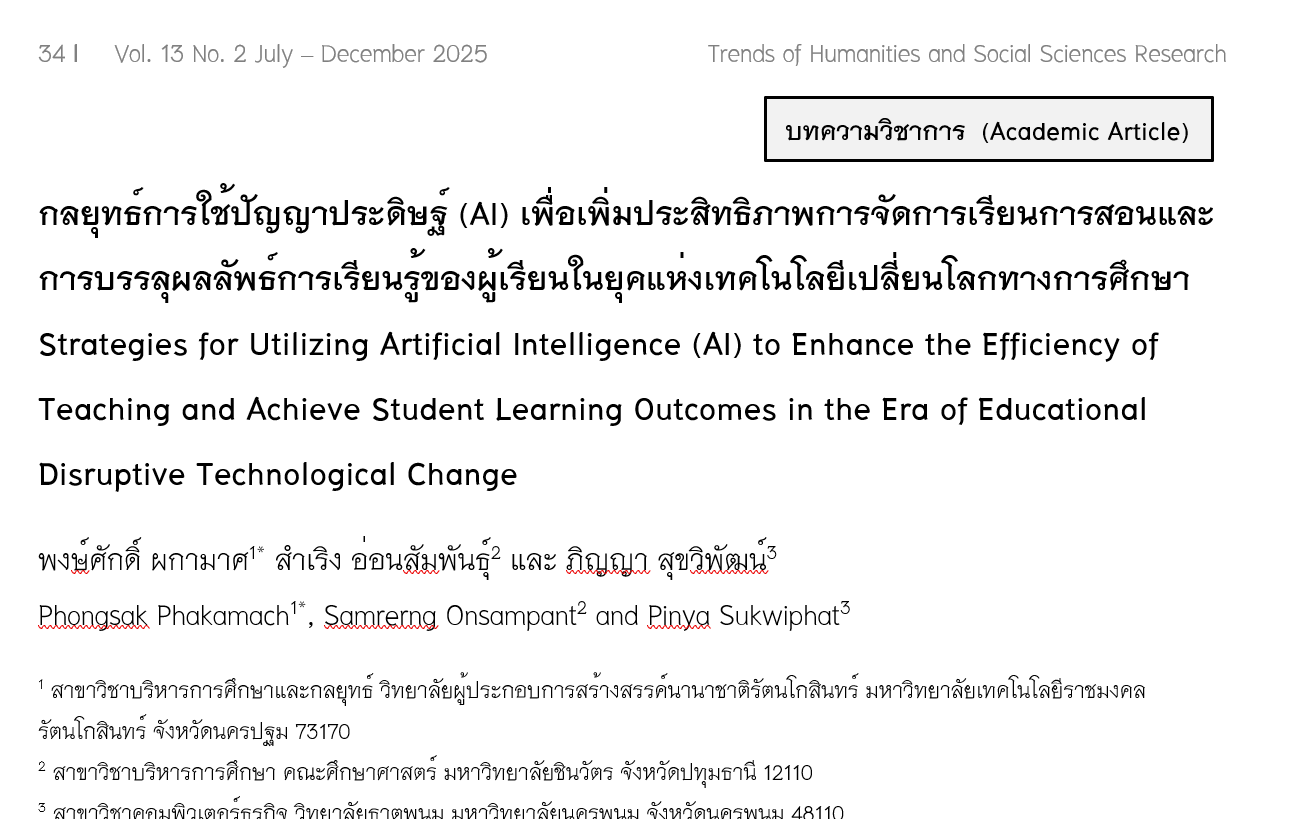
Strategies for Utilizing Artificial Intelligence (AI) to Enhance the Efficiency of Teaching and Achieve Student Learning Outcomes in the Era of Educational Disruptive Technological Change
Keywords:
Artificial intelligence, Teaching and learning management, Learning outcomes, Disruptive technologiesAbstract
This article aims to synthesis strategies for utilizing Artificial Intelligence (AI) to enhance the efficiency of teaching management and achieve student learning outcomes in the era of educational disruptive technological change. It reviews relevant concepts, theories, and literature concerning the application of AI in education, emphasizing its potential to improve student learning, support educators, and develop learning management systems. The article presents effective strategies such as advanced personalized learning, supporting educators with intelligent tools, developing smart learning environments, promoting 21st century skills, and supporting lifelong learning, along with practical guidelines for implementing these strategies. These guidelines emphasize planning, personnel development, appropriate technology selection, data management and privacy, monitoring and evaluation, and collaboration. Furthermore, the article provides examples of successful case studies in applying AI in various educational contexts worldwide, demonstrating tangible results in elevating the quality of education. Ultimately, the article concludes and discusses key issues, challenges, and policy and implementation recommendations to ensure the smooth and efficient integration of AI in education for the maximum benefit of students and the education system in the era of disruptive technological change. The recommendations focus on developing policy frameworks, investing in research, promoting collaboration, developing personnel, raising awareness, and supporting access to technology. For implementation, the emphasis is on starting with pilot projects, assessing readiness, developing teachers, integrating AI, data collection and evaluation, building learning communities, prioritizing students, and collaborating with technology developers. Therefore, it can be concluded that the presented strategies for using AI, derived from all the specified content, can genuinely be applied to enhance teaching and learning management and achieve learning outcomes for students in the era of educational disruptive technological change.
References
Aad, S., & Hardey, M. (2025). Generative AI: Hopes, controversies and the future of faculty roles in education. Quality Assurance in Education, 33(2), 267-282.
Ahmed, S.F., Alam, M. S.B., Hassan, M., Rozbu, M.R., Ishtiak, T., Rafa, N., & Gandomi, A.H. (2023). Deep learning modelling techniques: current progress, applications, advantages, and challenges. Artificial Intelligence Review, 56, 1-97.
Arslan, N., Haj Youssef, M., & Ghandour, R. (2025). AI and learning experiences of international students studying in the UK: An exploratory case study. Artificial Intelligence in Education, 1(1), 1-23.
Asad, M.M., & Ajaz, A. (2024). Impact of ChatGPT and generative AI on lifelong learning and upskilling learners in higher education: Unveiling the challenges and opportunities globally. International Journal of Information and Learning Technology, 41(5), 507-523.
Baca, G., & Zhushi, G. (2025). Assessing attitudes and impact of AI integration in higher education. Higher Education, Skills and Work-Based Learning, 15(2), 369-383.
Baker, R.S.J.d. (2020). AI and education: Promises and pitfalls. International Journal of Artificial Intelligence in Education, 30(3), 638-645.
Bilal, D., He, J., & Liu, J. (2025). Guest editorial: AI in education: transforming teaching and learning. Information and Learning Sciences, 126(1/2), 1-7.
Chan, C.K.Y. (2023). A comprehensive AI policy education framework for university teaching and learning. International Journal of Educational Technology in Higher Education, 20(1), 38.
Chen, K., Tallant, A.C., & Selig, I. (2025). Exploring generative AI literacy in higher education: student adoption, interaction, evaluation and ethical perceptions. Information and Learning Sciences, 126(1/2), 132-148.
Cook, J.S., & Cook, J. (2024). Artificial intelligence in management education: transformative potential and challenges. SAM Advanced Management Journal, 89(4), 340-355.
Dastane, O., Turner, J., & Nankervis, A. (2024). The trajectory of artificial intelligence for competency-based personalised learning: Past, present and future. International Journal of Information and Learning Technology, 41(5), 473-489.
Ellikkal, A., & Rajamohan, S. (2025). AI-enabled personalized learning: empowering management students for improving engagement and academic performance. Vilakshan - XIMB Journal of Management, 22(1), 28-44.
Ferhataj, A., Memaj, F., Sahatcija, R., Ora, A., & Koka, E. (2025). Ethical concerns in AI development: analyzing students’ perspectives on robotics and society. Journal of Information, Communication and Ethics in Society, 23(2), 165-187.
Gizzi, E., Nair., L., Chernova, S., & Sinapov, J. (2022). Creative problem solving in artificially intelligent agents: a survey and framework. Journal of Artificial Intelligence Research, 75, 857–911.
Hardaker, G., & Glenn, L.E. (2025). Artificial intelligence for personalized learning: a systematic literature review. International Journal of Information and Learning Technology, 42(1), 1-14.
Hazaimeh, M., & Al-Ansi, A.M. (2024). Model of AI acceptance in higher education: arguing teaching staff and students perspectives. International Journal of Information and Learning Technology, 41(4), 371-393.
Hidayat-ur-Rehman, I. (2024). Examining AI competence, chatbot use and perceived autonomy as drivers of students’ engagement in informal digital learning. Journal of Research in Innovative Teaching & Learning, 17(2), 196-212.
Hwang, G.J., Xie, H., Zeng, Q., & Abelson, R. (2020). Application of artificial intelligence in education: Learning analytics and personalized learning. Computers & Education: Artificial Intelligence, 1, 100002.
Jafari, F., & Keykha, A. (2024). Identifying the opportunities and challenges of artificial intelligence in higher education: A qualitative study. Journal of Applied Research in Higher Education, 16(4), 1228-1245.
Kang, H. (2023). Artificial intelligence and its influence in adult learning in China. Higher Education, Skills and Work-Based Learning, 13(3), 450-464.
Karanja, E., & Malone, L.C. (2021). Improving project management curriculum by aligning course learning outcomes with Bloom’s taxonomy framework. Journal of International Education in Business, 14(2), 197-218.
Li, K.C., & Wong, B.T.-M. (2023). Artificial intelligence in personalised learning: A bibliometric analysis. Interactive Technology and Smart Education, 20(3), 422-445.
Lytras, M.D., & Ordonez De Pablos, P. (2024). Guest editorial: Active and transformative learning in higher education in times of artificial intelligence and ChatGPT. Interactive Technology and Smart Education, 21(4), 489-498.
Marengo, A., Pagano, A., Pange, J., & Soomro, K.A. (2024). The educational value of artificial intelligence in higher education: a 10-year systematic literature review. Interactive Technology and Smart Education, 21(4), 625-644.
Mariyono, D., & Nur Alif Hd, A. (2025). AI’s role in transforming learning environments: A review of collaborative approaches and innovations. Quality Education for All, 2(1), 265-288.
Moravec, J.W., & Martínez-Bravo, M.C. (2023). Global trends in disruptive technological change: Social and policy implications for education. On the Horizon, 31(3/4), 147-173.
Phakamach, P. (2023). Educational innovation: Elements and mechanisms for the development of Thai educational institutions Towards Internationalization. Journal of Education and Innovative Learning, 3(2), 161-180.
Phakamach, P., Panjarattanakorn, D., & Onsampant, S. (2025). HyFlex blended learning: A graduate-level case study in strategic educational management. Asian Education and Learning Review, 3(2), 1-17.
Phakamach, P., Senarith, P., & Wachirawongpaisarn, S. (2022). The metaverse in education: The future of immersive teaching & learning. RICE Journal of Creative Entrepreneurship and Management, 3(2), 75-88.
Ronaghi, M.H. (2023). The effect of virtual reality technology and education on sustainable behavior: A comparative quasi-experimental study. Interactive Technology and Smart Education, 20(4), 475-492.
Ronaghi, M.H., & Ronaghi, M. (2025). How does the use of artificial intelligence affect sustainability rating in Middle Eastern universities?. Asian Education and Development Studies, 14(2), 152-172.
Routray, R., & Khandelwal, K. (2024). Artificial intelligence (AI) adoption: Do Generation Z students feel technostress in deploying AI for completing courses of study at universities?. Asian Education and Development Studies, 13(5), 534-545.
Saha, P., Hossain, M.S., Roy, N.C., Masud, A.A., & Amin, R. (2025). Unlocking the power of AI in education: Students’ intentions and AI tool use driving learning success in an emerging economy. On the Horizon, 33(1), 126-144.
Tahiru, F. (2021). AI in education. Journal of Cases on Information Technology, 23(1), 1-20.
Tamanna, M., & Sinha, B. (2025). A conceptual analysis of artificial intelligence (AI) on academic opportunities and challenges: A case study based on higher educational institutions in Bangladesh. Quality Assurance in Education, 33(2), 218-236.
Wawak, S., Teixeira Domingues, J.P., & Sampaio, P. (2024). Quality 4.0 in higher education: Reinventing academic-industry-government collaboration during disruptive times. The TQM Journal, 36(6), 1569-1590.
Wood, D., & Moss, S.H. (2024). Evaluating the impact of students’ generative AI use in educational contexts. Journal of Research in Innovative Teaching & Learning, 17(2), 152-167.
Zawacki-Richter, O., Bai, J.Y.H., Lee, K., Slagter van Tryon, P.J., & Prinsloo, P. (2024). New advances in artificial intelligence applications in higher education?. International Journal of Educational Technology in Higher Education, 21, 1-4.
Zhai, X., Chu, X., Chai, C.S., Jong, M.S.Y., Istenic, A., Spector, M., Liu, J.-B., Yuan, J., & Li, Y. (2021). A review of artificial intelligence (AI) in education from 2010 to 2020. Complexity, 2021, 1-18.
Downloads
Published
How to Cite
Issue
Section
License
Copyright (c) 2025 Phayao University

This work is licensed under a Creative Commons Attribution-NonCommercial-NoDerivatives 4.0 International License.
Authors are responsible for the content of their manuscripts. The University of Phayao does not necessarily endorse or agree with the views expressed in published articles. Interested parties may reproduce or use the content; however, they must obtain prior written permission from the copyright holder and provide proper citation and acknowledgment.