
From Inner Awareness to Human Flourishing: Buddhist Wisdom in a Changing World
Article Sidebar
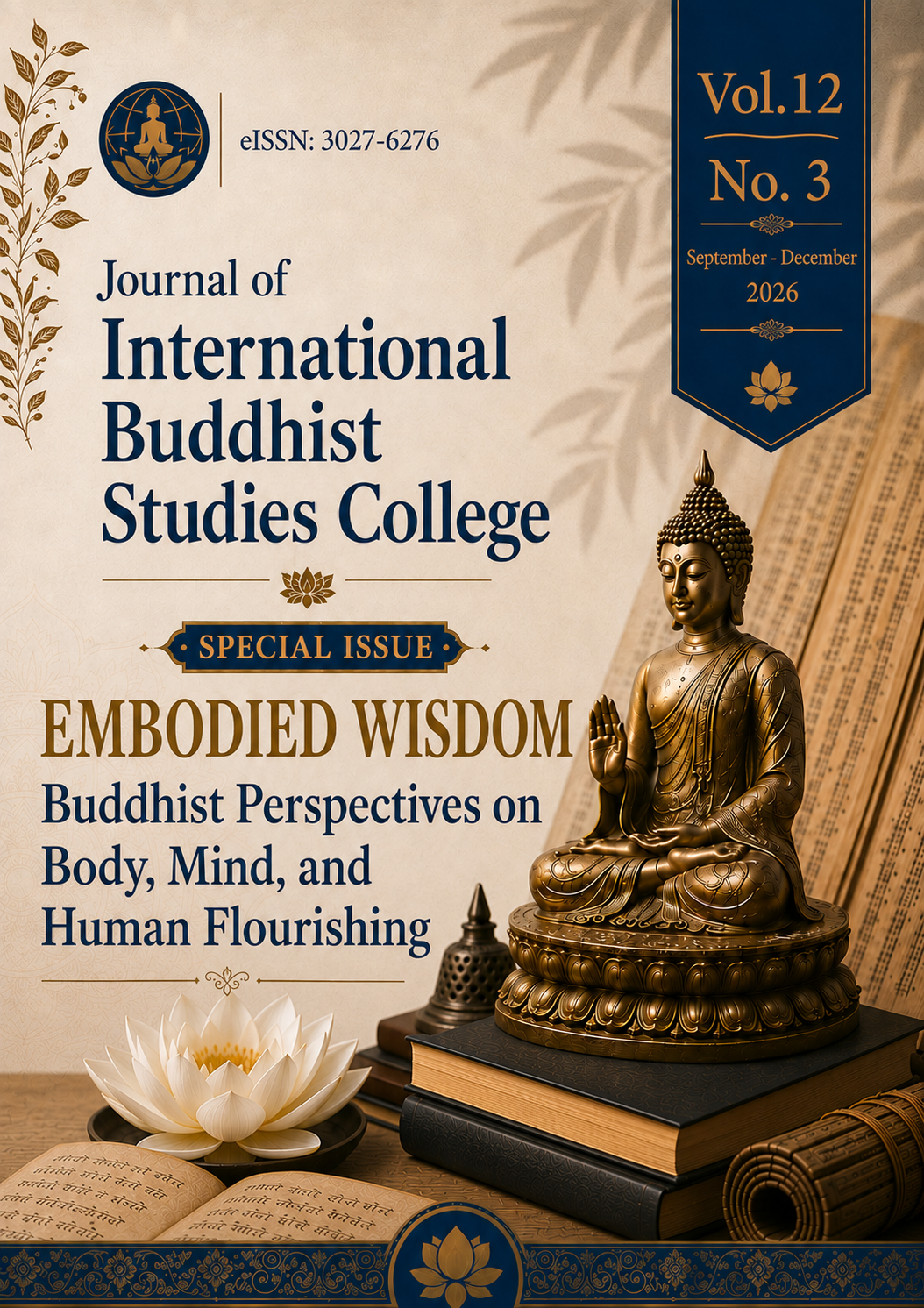
Main Article Content
Abstract
Contemporary societies are characterized by rapid technological change, expanding access to information, and unprecedented forms of communication. Yet greater connectivity has not necessarily produced greater clarity, deeper relationships, or stronger well-being. Psychological distress, social fragmentation, loneliness, conflict, and competition for human attention remain significant concerns. Recent international reports have therefore emphasized social connection as an important dimension of health and well-being, while also recognizing that digital technologies can both strengthen and weaken human relationships.
These conditions raise an enduring Buddhist question: What does it mean to live well in a changing world?
Buddhist traditions approach human flourishing differently from models centered primarily on pleasure, productivity, material success, or the absence of distress. Quality of life closely depends on how individuals understand experience, respond to suffering, regulate desire and aversion, cultivate ethical conduct, and relate to others. Mindfulness, wisdom, moral discipline, and compassion therefore function not as isolated techniques but as interdependent capacities for reducing suffering and living responsibly.
This editorial argues that Buddhist wisdom contributes to human flourishing not simply by helping individuals become calmer, but by cultivating the awareness, ethical discernment, and compassionate responsibility required to live wisely amid changing conditions.
Article Details

This work is licensed under a Creative Commons Attribution-NonCommercial-NoDerivatives 4.0 International License.
The Journal of TCI is licensed under a Creative Commons Attribution-NonCommercial-NoDerivatives 4.0 International (CC BY-NC-ND 4.0) licence unless otherwise stated. Please read our Policies page for more information on Open Access, copyright and permissions.
References
Anālayo Bhikkhu. (2003). Satipaṭṭhāna: The direct path to realization. Windhorse Publications.
Bodhi Bhikkhu. (1994). The Noble Eightfold Path: The Way to the End of SufferingEditorial. Buddhist Publication Society.
Fredrickson, B. L., Cohn, M. A., Coffey, K. A., Pek, J., & Finkel, S. M. (2008). Open hearts build lives: Positive emotions, induced through loving-kindness meditation, build consequential personal resources. Journal of Personality and Social Psychology, 95(5), 1045–1062. https://doi.org/10.1037/a0013262
Good, D. J., Lyddy, C. J., Glomb, T. M., Bono, J. E., Brown, K. W., Duffy, M. K., Baer, R. A., Brewer, J. A., & Lazar, S. W. (2016). Contemplating mindfulness at work: An integrative review. Journal of Management, 42(1), 114–142. https://doi.org/10.1177/0149206315617003
Harvey, P. (2000). An introduction to Buddhist ethics: Foundations, values and issues. Cambridge University Press.
OECD. (2025). Social connections and loneliness in OECD countries. OECD Publishing. https://doi.org/10.1787/6df2d6a0-en
Purser, R. E. (2019). McMindfulness: How mindfulness became the new capitalist spirituality. Repeater Books.
Shapiro, S. L., Carlson, L. E., Astin, J. A., & Freedman, B. (2006). Mechanisms of mindfulness. Journal of Clinical Psychology, 62(3), 373–386. https://doi.org/10.1002/jclp.20237
World Health Organization. (2025). From loneliness to social connection: Charting a path to healthier societies. World Health Organization.