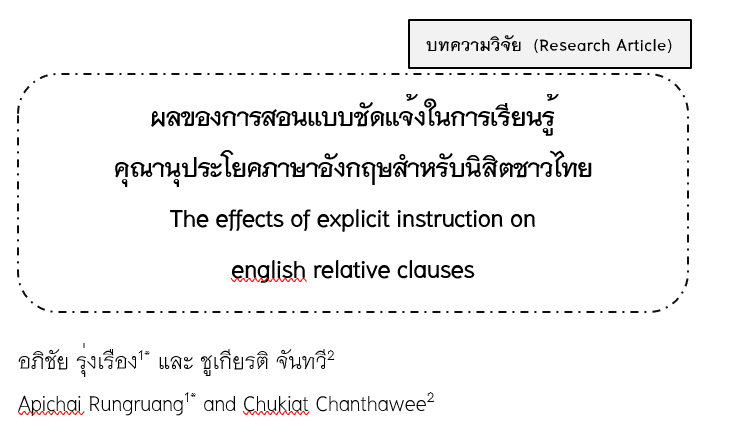
ผลของการสอนแบบชัดแจ้งในการเรียนรู้ คุณานุประโยคภาษาอังกฤษสำหรับนิสิตชาวไทย
คำสำคัญ:
คุณานุประโยคภาษาอังกฤษ, แนวคิดลำดับนามวลี , ผู้เรียนชาวไทยที่เรียนภาษาอังกฤษเป็นภาษาต่างประเทศบทคัดย่อ
ผู้เรียนชาวไทยที่เรียนภาษาอังกฤษเป็นภาษาต่างประเทศมักจะประสบปัญหาในการสร้างคุณานุประโยคในภาษาอังกฤษ จากงานวิจัยที่เกี่ยวข้องมักจะระบุว่าปัญหาการสร้างคุณานุประโยคในภาษาอังกฤษ (English Relative Clause-ERC) เป็นปัญหาในเรื่องของวากยสัมพันธ์ (syntactic structure) ดังนั้น งานวิจัยนี้จึงมีวัตถุประสงค์ (1) เพื่อที่จะแก้ปัญหาการสร้างคุณานุประโยคในภาษาอังกฤษที่ผิดพลาดโดยการใช้วิธีการสอนแบบแจ้งชัด (Explicit Instruction) (2) ทดสอบสมมุติฐานตามแนวคิดลำดับนามวลี (the Noun Phrase Accessibility Hierarchy –NPAH) ที่กล่าวว่าโครงสร้างประพันธสรรพนามประธานคุณานุประโยค (Subject ERC) นั้นง่ายที่สุดและโครงสร้างประพันธสรรพนามแสดงความเป็นเจ้าของคุณานุประโยค (Genitive ERC) นั้นยากสำหรับผู้เรียนในระดับมหาวิทยาลัยที่เป็นชาวไทย โดยในการวิจัยนี้ผู้เข้าร่วมงานวิจัยจำนวน 22 คนใช้เวลา 4 สัปดาห์ในการเรียนคุณานุประโยคภาษาอังกฤษ ERCs ผ่านการสอนโดยวิธีการสอนแบบชัดแจ้ง (Explicit instruction) ผลจากการทดลองหลังการเรียนพบว่าผู้เข้าร่วมวิจัยสามารถสร้างประโยคที่มีโครงสร้างแบบ ERCs ได้ดีขึ้น จากการทำแบบทดสอบการรวมประโยคและและแบบทดสอบการแปล โดยมีนัยสำคัญที่แตกต่างทางสถิติทั้งสองแบบทดสอบ อย่างไรก็ตามความสามารถในการสร้างโครงสร้างประโยคแบบ ERCs ไม่ได้เป็นไปตาม NPAH ในทุกกรณี งานวิจัยนี้พบว่าโครงสร้างประธานประพันธสรรพนามคุณานุประโยค (Subject ERC) นั้นเรียนรู้ได้ง่ายที่สุด ในส่วนของโครงสร้างประพันธสรรพนามกรรมคุณานุประโยค (Object ERC) และโครงสร้างประพันธสรรพนามแสดงความเป็นเจ้าของคุณานุประโยค (Genitive ERC) นั้น ซึ่งถือว่าเป็นโครงสร้างที่ยากที่สุด พบว่าผู้เรียนทำคะแนนได้ดีกว่าในโครงสร้างประพันธสรรพนามกรรมคุณานุประโยค ในแบบทดสอบการรวมประโยคแต่ในแบบทดสอบการแปล ผู้เรียนทำคะแนนในโครงสร้างประพันธสรรพนามกรรมคุณานุประโยคได้ดีกว่าโครงสร้างประพันธสรรพนามแสดงความเป็นเจ้าของคุณานุประโยค
เอกสารอ้างอิง
Alroudhan, E. H. (2016). The acquisition of English restrictive relative clauses by Arab Adult EFL Learners. Advances in Language and Literary Studies, 7(1), 33-53.
Amornwongpeeti, A., & Pongpairoj, N. (2014). The acquisition of English restrictive and non-restrictive relative clauses by L1 Thai Learners. NIDA Journal of Language and Communication, 19(21), 1-54.
Andrews, K. (2007) The effects of implicit and explicit instruction on simple and complex grammatical structures for adult English language learners. The Electronic Journal for English as a Second Language, 11(2), 1-5.
Archer, A. L., & Hughes, C. A. (2011). Explicit instruction: effective and efficient teaching. New York: The Guilford Press.
Caponigro, I., & Pear, L. (2009). The nominal nature of where, when, and how: Evidence from free relatives. Linguistic Inquiry, 40(1), 155–164.
Chaiyapho, P. (2017). The effect of explicit instruction by using phrase structure rules on acquisition of noun clauses. (Master’s Thesis). Ubon Ratchathani: Ubon Ratchathani University.
Choi, I. & Kim, J. (2008). Noun phrase accessibility and acquisition of English relative clauses by Korean learners. Linguistic Research, 25(2), 83-104.
Greenberg, J. H., ed.. (1963). Universals of Language. Massachusetts: MIT Press.
Gurevich, N. (2001). A critique of markedness-based theories in phonology. Studies in the Linguistic Sciences, 31(2), 89-114.
Intaraprapong, I. (2013). Comprehension of complex sentences by Thai students. (Master’s Thesis). Ubon Ratchathani: Ubon Ratchathani University.
Kanno, K (2007). Factors affecting the processing of Japanese relative clauses by L2 learners. Studies in Second Language Acquisition, 29(2), 197-218.
Keenan, E. L., & Comrie, B. (1979). Noun phrase accessibility hierarchy revisited. Language, 55(3), 649-664.
Keenan, E. L.,& Comrie, B. (1977). Noun phrase accessibility hierarchy and universal Grammar. Linguistic Inquiry, 8, 63-99.
Kuno, S. (1974). The position of relative clauses and conjunctions. Linguistic Inquiry, 1, 117-136.
Lee, C., & Lee, JS. (2012). Gap in “gapless” relative clauses in Korean and other Asian. UCLA Working Papers in Linguistics, Theories of Everything. 17, Article 25, 204-214.
Leenakitti, N., & Pongpairoj, N. (2019). A study of translation of relative clauses from English into Thai. PASAA: Journal of Language Teaching and Learning in Thailand, 58, 95-130.
Lin, C., & Chuang, S. (2014) Taiwanese EFL learners’ English relative clauses learning. International Journal of English Linguistics, 4(4), 99-106.
Madsen, R. (2016). Relative clauses in second language acquisition. Belgrade English Language and Literature Studies, 8, 91-105.
Nezakat-Alhossaini, M, Youhanaee, M, & Moinzadeh, A. (2014). Impact of explicit instruction on EFL learners’ implicit and explicit knowledge: A case of English relative clauses. Journal of Language and Linguistic Studies, 10(2), 183-199.
Ngam-kitjawat, A. (2013). A comparative study of complex sentences in three English academic books. Rajabhat Chiangmai Research Journal, 14(2), 134-142.
Nuamthanom Kimura, L. (2015). Is Left or Right better? A branching direction and the processing of English relative clauses of Thai university students. Journal of Liberal Arts Ubon Ratchathani University, 11(1), 141-185.
Ozeki, H., & Shirai, Y. (2007). Does the Noun Phrase Accessibility Hierarchy predict the difficulty order in the acquisition of Japanese relative clauses?. Studies in Second Language Acquisition, 29(2), 169-196.
Phoocharoensil, S. (2009). A Study of English Relative Clauses in the Interlanguage of Thai EFL Learners. (Ph.D. dissertation). Bangkok: Chulalongkorn University.
Phoocharoensil, S. (2012). On the adverbial relativiser Where and prepositional relatives from an interlanguage perspective. Hong Kong Journal of Applied Linguistics, 13(2), 85-114.
Phoocharoensil, S. (2015). A corpus-based analysis of the relativizer THAT in L1-Thai speakers’ interlanguage. The International Journal of Communication and Linguistic Studies, 13(4), 49-66.
Phoocharoensil, S., & Simargool, N. (2010). English relativization and learners’ problems. Journal of Pan-Pacific Association of Applied Linguistics, 14(1), 109-129. Form http://files.eric.ed.gov/fulltext/EJ920506.pdf.
Promsupa, P; Varasarin, P& Brudhiprabha, P. (2017). An analysis of grammatical errors in English writing of Thai university students. HRD Journal, 8(1), 67-100.
Rattanasak, S., & Phoocharoensil, S. (2014). Avoidance in processing English non-restrictive relative clauses in Thai EFL learners’ interlanguage. Asian Social Science, 10(17), 265-277.
Renaud, C. (2011). The acquisition of French: the development of inflectional morphology and syntax in L1 acquisition, bilingualism, and L2 acquisition. Studies in Second Language Acquisition, 33(3), 464-466.
Şavran, E. (2022). Re-evaluation of Noun Phrase Accessibility Hierarchy (NPAH): Does It Work in Turkish EFL Context?. Education & Science. Turkish: EFE Academy, 159-173.
Thep-Ackrapong, T. (2009). Teaching English in Thailand: an uphill battle. Manutsat Paritat Journal of Humanities, 2(1), 51-62.
Waelateh, B; Boonsuk, Y; Ambele, E.A & Jaeharsae, F. (2019). An Analysis of the Written Errors of Thai EFL Students’ Essay Writing in English. Journal of Social Sciences and Humanities Research in Asia (JSHRA), 25(3), 55-82.
Wen, H. (2020). Relative Clauses in Mandarin Chinese. (Ph.D. dissertation). London: University of London.
Xu, Y. (2011). The accessibility hierarchy in Chinese relative clauses. Proceedings of the 16th Conference of Pan-Pacific Association of Applied Linguistics (68-73).
Yas, E. (2012). Acquisition of English relative clauses by German L1 and Turkish L1 speakers. (Ph.D. dissertation). Germany: Institut für Englische Philologie der Freien Universität Berlin.
ดาวน์โหลด
เผยแพร่แล้ว
รูปแบบการอ้างอิง
ฉบับ
ประเภทบทความ
สัญญาอนุญาต
ลิขสิทธิ์ (c) 2023 มหาวิทยาลัยพะเยา

อนุญาตภายใต้เงื่อนไข Creative Commons Attribution-NonCommercial-NoDerivatives 4.0 International License.
Authors are responsible for the content of their manuscripts. The University of Phayao does not necessarily endorse or agree with the views expressed in published articles. Interested parties may reproduce or use the content; however, they must obtain prior written permission from the copyright holder and provide proper citation and acknowledgment.