การศึกษาความผิดทางไวยากรณ์ของผู้เรียนภาษาอังกฤษชาวเติร์กเมน
คำสำคัญ:
ภาษาอังกฤษในฐานะเป็นภาษาต่างประเทศ, ความผิดทางไวยากรณ์, ผู้เรียนภาษาอังกฤษชาวเติร์กบทคัดย่อ
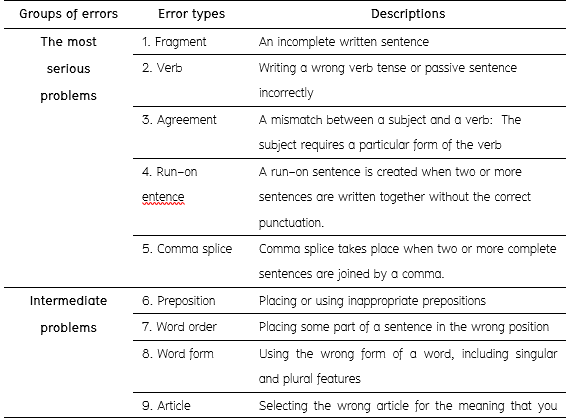
ภาษาอังกฤษในฐานะเป็นภาษาของโลกได้แผ่ขยายไปทั่วทุกมุมโลก รวมทั้งประเทศเติร์กเมนิสถานในทวีปเอเชียกลาง ซึ่งภาษาอังกฤษได้เข้ามาแทนที่ภาษารัสเซีย ในปัจจุบันภาษาอังกฤษยังเป็นวิชาบังคับเรียนในสถานศึกษาสำหรับชาวเติร์กเมน อย่างไรก็ตามความสามารถทางภาษาอังกฤษของชาวเติร์กเมนยังไม่เป็นที่ประจักษ์กันมากนัก งานวิจัยชิ้นนี้จึงมีจุดประสงค์ในการวิเคราะห์ลักษณะความผิดทางไวยากรณ์ในงานเขียนภาษาอังกฤษระดับย่อหน้าที่เขียนโดยชาวเติร์กเมนจำนวน 17 คน โดยใช้กรอบการวิจัยของเบิร์ดและเบนสัน (1994) ในการวิเคราะห์ความผิดทางไวยากรณ์เบิร์ดและเบนสันได้จัดกลุ่มความผิดทางไวยากรณ์ไว้ 3 ระดับโดยแบ่งย่อยออกเป็น 12 กลุ่ม ผลการศึกษาแสดงให้เห็นว่าความผิดทางไวยากรณ์ในงานเขียนของชาวเติร์กเมนเกิดขึ้นมากที่สุดในระดับที่ 2 คือในระดับคำ แต่เป็นที่น่าสังเกตว่าจำนวนความผิดไม่จำเป็นต้องมีความเกี่ยวข้องกับความร้ายแรงของความผิด และอาจกล่าวได้ว่าความผิดทางไวยากรณ์ในงานเขียนของชาวเติร์กเมนอาจเป็นผลมาจากการแทรกแซงจากภาษาแม่
เอกสารอ้างอิง
Abushihab, I. (2014). An analysis of grammatical errors in writing made by Turkish learners of English as a foreign language. International Journal of Linguistics, 6(4), 213-223.
Brown, H. D. (1994). Principles of language learning and teaching. Upper Saddle River, NJ: Pearson.
Byrd, P., & Benson, B. (1994). Problem/solution: A reference for ESL writers. Boston, MA: Heinle& Heinle.
Chang, C. B. (2012). Rapid and multifaceted effects of second-language learning on first-language speech production. Journal of phonetics, 40(2), 249-268.
Corder, S. P. (1967). The significance of learner's errors. IRAL-International Review of Applied Linguistics in Language Teaching, 5(1-4), 161-170.
Corder, S. P. (1971). Idiosyncratic dialects and error analysis. IRAL-International Review of Applied Linguistics in Language Teaching, 9(2), 147-160.
Corder, S. P. (1981). Error analysis and interlanguage. Oxford, England: Oxford University Press.
Corder, S. P. (1983). A role for the mother tongue. Language transfer in language learning, 1, 85-97.
Cook, G. (2003). Applied linguistics. Oxford, England: Oxford University Press.
Cullen, R., & KUO, I. C. V. (2007). Spoken grammar and ELT course materials: A missing link?. Tesol Quarterly, 41(2), 361-386.
Crystal, D. (2005). The stories of English. Woodstock, NY: The Overlook Press.
Davidson, D. (1970). Events and particulars. Noûs, 4(1), 25-32.
Ellis, R. (1997). The empirical evaluation of language teaching materials. ELT journal, 51(1), 36-42.
Harmer, J. (1987). Teaching and learning grammar. London, England: Longman.
Hinnon, A. (2014). Common errors in English writing and suggested solutions of Thai university students. Humanities and Social Sciences, 31(2), 165-180.
Jantarach, V. (2011). Attitude towards the instruction in writing English in an English foundation course. Veridian E- Journal Silpakorn University, 4(2), 108-124.
Loewen, S., & Reinders, H. (2011). Key concepts in second language acquisition. Hampshire, NY: Palgrave Macmillan.
Nareerak, P. (2018). An analysis of errors in English signboards in Muang Kamphaengphet. The Golden Teak: Humanity and Social Science Journal, 24(1), 77-91.
Nemser, W. (1971). Approximative systems of foreign language learners. IRAL-International Review of Applied Linguistics in Language Teaching, 9(2), 115-124.
Norrish, J. (1983). Language learners and their errors. London, England: Macmillan.
Petraki, E., & Hill, D. (2011). Effective grammar teaching: Lessons from confident grammar teachers. TESOL in Context, 21(2), 34.
Phettongkam, H. (2017). Grammatical errors in spoken English of undergraduate Thai leaners in a communicative business English course. LEARN Journal, 10(1), 93-117.
Prabhu, N. S. (1987). Second language pedagogy. Oxford, England: Oxford University Press.
Richards, J. (1974). Error analysis: Perspectives on second language learning. London: Longman.
Selinker, L. (1972). Interlanguage. IRAL-International Review of Applied Linguistics in Language Teaching, 10(1-4), 209-232.
Ua-umakul, A., & Vittayapirak, J. (2016). Corpus-based error analysis of Thai students’ laboratory scientific abstract writing in English. Journal of Industrial Education, 15(2), 183-190. Retrieved from https://tci-thaijo.org/index.php/JIE/article/view/122716
Yasemin, K. (2010). An analysis of written errors of Turkish adult learners of English. Procedia Social and Behaviorial Sciences, 2, 4352-4358.
Yuksel, G. (2007). Grammatical errors in the compositions written by Turkish learners of English. A Master’s Thesis. Erzrum: Ataturk University, Turkey.
ดาวน์โหลด
เผยแพร่แล้ว
รูปแบบการอ้างอิง
ฉบับ
ประเภทบทความ
สัญญาอนุญาต
Authors are responsible for the content of their manuscripts. The University of Phayao does not necessarily endorse or agree with the views expressed in published articles. Interested parties may reproduce or use the content; however, they must obtain prior written permission from the copyright holder and provide proper citation and acknowledgment.