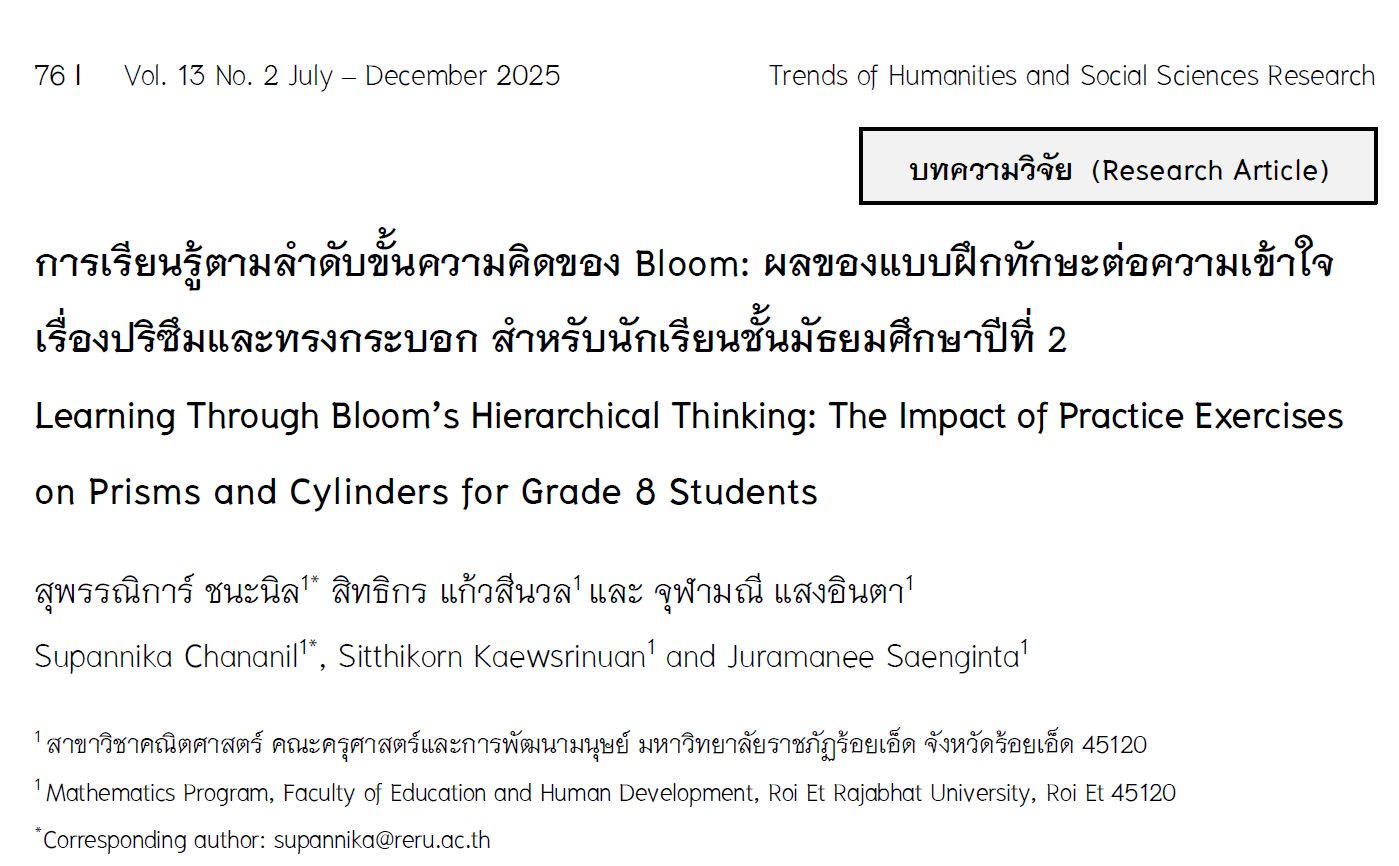
Learning Through Bloom’s Hierarchical Thinking: The Impact of Practice Exercises on Prisms and Cylinders for Grade 8 Students
Keywords:
Practice exercises, Bloom’s taxonomy, Mathematical understanding, Prisms, CylindersAbstract
This research aimed to 1) develop a set of practice exercises based on Bloom’s Taxonomy for enhancing students’ understanding of prisms and cylinders, 2) evaluate the effectiveness of the developed exercises using the 80/80 efficiency criterion, and 3) examine the impact of the exercises on students’ mathematical understanding. The study employed a one-group pretest–posttest design. The sample consisted of 34 from Grade 8/1 at Phanom Phrai Witthayakhan School, Roi Et Province, during the first semester of the 2024 academic year selected through purposive sampling. The research instruments included 15 lesson plans, five sets of Bloom’s Taxonomy-based practice exercises, and a 20-item multiple-choice achievement test. The exercises were validated for content accuracy with IOC values ranging from 0.67 to 1.00, and the test had a reliability coefficient (KR-20) of 0.82. Data were analyzed using mean, standard deviation, dependent samples t-test, and efficiency analysis (E1/E2). The results revealed that the developed learning exercises demonstrated an efficiency level of 82.94/83.82, which exceeded the standard criterion of 80/80. Students’ posttest scores (= 8.38) were significantly higher than their pretest scores (
= 5.94) at the .05 significance level. These findings indicate that practice exercises based on Bloom’s taxonomy were effective in enhancing students’ understanding of prisms and cylinders in a statistically significant manner.
References
กิตติศักดิ์ จันทร์หล่ม. (2567). ผลการจัดการเรียนรู้คณิตศาสตร์ตามแนวคิด 6P Model โดยใช้แบบฝึกทักษะเป็นสื่อเพื่อเสริมสร้างทักษะกระบวนการทางคณิตศาสตร์ ด้านการแก้ปัญหา เรื่อง รูปสี่เหลี่ยม สำหรับนักเรียนชั้นประถมศึกษาปีที่ 5. วารสารวิชาการและวิจัย มหาวิทยาลัยภาคตะวันออกเฉียงเหนือ, 14(1), 273–285.
จงกลนี เดชพร และ ศิริพงษ์ เพียศิริ. (2565). การพัฒนาความสามารถในการให้เหตุผลและความคิดสร้างสรรค์ทางคณิตศาสตร์ของนักเรียนชั้นมัธยมศึกษาปีที่ 6 โดยใช้การจัดการเรียนรู้แบบโครงงานเป็นฐานร่วมกับเทคนิคการจัดการเรียนรู้แบบร่วมมือ LT. วารสารวิจัย มข. สาขามนุษยศาสตร์และสังคมศาสตร์ (บัณฑิตศึกษา), 10(1), 60–71.
ชลดา ภูล้นแก้ว, สมใจ ภูครองทุ่ง และ ปัญญรัชต์ วงศ์พระธาตุ. (2567). การพัฒนาผลสัมฤทธิ์ทางการเรียนคณิตศาสตร์ เรื่อง การแปลงทางเรขาคณิตของนักเรียนระดับชั้นมัธยมศึกษาปีที่ 2 โดยใช้วิธีสืบเสาะหาความรู้ (5E). วารสารครุศาสตร์ มหาวิทยาลัยราชภัฏยะลา, 3(1), 52–61.
ชาญชัย ชนไพโรจน์, ปวีณา ขันธ์ศิลา และ ประภาพร หนองหารพิทักษ์. (2566). การพัฒนาบทเรียนเรื่อง ปริซึมและทรงกระบอก โดยใช้กระบวนการจัดการเรียนรู้ CPA ร่วมกับโปรแกรม GeoGebra เพื่อเพิ่มผลสัมฤทธิ์ทางการเรียนของนักเรียนชั้นมัธยมศึกษาปีที่ 2. วารสารครุศาสตร์อุตสาหกรรม, 23(2), 15–26. จาก https://doi.org/10.55003/JIE.23205.
วรพล ภาคไพรี, วันดี เกษมสุขพิพัฒน์ และ ทรงชัย อักษรคิด. (2565). การศึกษาผลจากการจัดกิจกรรมการเรียนรู้ด้วยสื่อการเรียนรู้แบบออนไลน์ที่ส่งเสริมความเข้าใจทางคณิตศาสตร์ เรื่องปริซึมและทรงกระบอก สำหรับนักเรียนชั้นมัธยมศึกษาปีที่ 2. วารสาร มจร พุทธปัญญาปริทรรศน์, 8(2), 42–54. จาก https://so03.tci-thaijo.org/index.php/jmbr/article/view/261125.
วรภพ ทองสร้าง, เกษม เปรมประยูร และ สุวรรณี เปลี่ยนรัมย์. (2568). แนวทางการจัดการเรียนรู้ด้วยวิธีการแบบเปิดที่ส่งเสริมความสามารถในการสื่อสารทางคณิตศาสตร์ด้านการเขียนของนักเรียนชั้นมัธยมศึกษาปีที่ 3. ใน การประชุมวิชาการระดับชาติและนานาชาติ ครั้งที่ 18: สร้างสรรค์ความรู้เพื่อพัฒนาสังคมและเศรษฐกิจ (350–358). ประเทศญี่ปุ่น: เมืองโอซาก้า.
Aryawan, M., Wayan, I., Gusti, I. & Gede, I. (2023). Bloom’s taxonomy revision-oriented learning activities to improve procedural capabilities and learning outcomes. International Journal of Educational Methodology, 9(2023), 261-270. From https://doi.org/10.12973/ijem.9.1.261.
Adams, N. E. (2015). Bloom’s taxonomy of cognitive learning objectives. Journal of the Medical Library Association, 103(3), 152–153. From https://doi.org/10.3163/1536-5050.103.3.010.
Anderson, L. W., & Krathwohl, D. R. (2001). A taxonomy for learning, teaching, and assessing: A revision of Bloom’s taxonomy of educational objectives. Longman.
Battista, M. T. (2007). The development of geometric and spatial thinking. In F. K. Lester Jr. (Ed.), Second handbook of research on mathematics teaching and learning (843–908). Charlotte, National Council: Teachers of Mathematics.
Boaler, J. (2016). Mathematical mindsets: Unleashing students’ potential through creative math, inspiring messages and innovative teaching. Research in Mathematics Education, 18(3),1-4.
Clements, D. H., & Sarama, J. (2011). Early childhood teacher education: The case of geometry. Journal of Mathematics Teacher Education, 14(2), 133–148. From https://doi.org/10.1007/s10857-011-9173-0.
Forehand, M. (2010). Bloom’s taxonomy. In M. Orey (Ed.). Emerging perspectives on learning, teaching, and technology. University of Georgia.
Nitko, A. J., & Brookhart, S. M. (2014). Educational assessment of students (7th ed.). Pearson Education.
OECD. (2019). PISA 2018 results (Volume I): What students know and can do. OECD Publishing. Form https://doi.org/10.1787/5f07c754-en.
Rovinelli, R. J., & Hambleton, R. K. (1977). On the use of content specialists in the assessment of criterion-referenced test item validity. Dutch Journal of Educational Research, 2(2), 49–60.
Zohar, A., & Dori, Y. J. (2003). Higher order thinking skills and low-achieving students: Are they mutually exclusive? The Journal of the Learning Sciences, 12(2), 145–181. Form https://doi.org/10.1207/S15327809JLS1202_1.
Downloads
Published
How to Cite
Issue
Section
License
Copyright (c) 2025 Phayao University

This work is licensed under a Creative Commons Attribution-NonCommercial-NoDerivatives 4.0 International License.
Authors are responsible for the content of their manuscripts. The University of Phayao does not necessarily endorse or agree with the views expressed in published articles. Interested parties may reproduce or use the content; however, they must obtain prior written permission from the copyright holder and provide proper citation and acknowledgment.