Equal Liberty in Family Formation of LGBTQ+ Gen Z in Thailand
Keywords:
Equal liberty, LGBTQ+, Family formation, ThailandAbstract
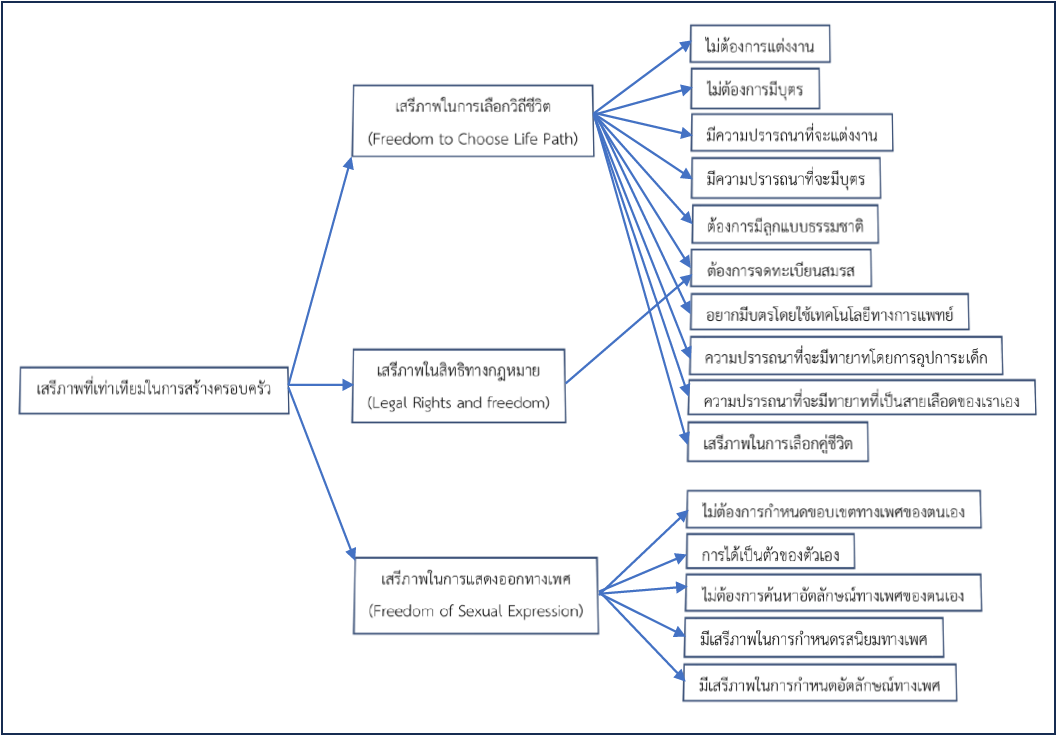
This research employed qualitative research based on phenomenology. It aims to explore the needs of the LGBTQ+ Gen Z group in Thailand regarding the freedom to create a family according to phenomenological principles. The key informants, who provided firsthand experiences and comprehensive data, consisted of five university students. Data were collected through in-depth interviews using tools such as personal interview records, semi-structured interview guides, and audio recorders. The data were analyzed based on Rawls’ theory of equal liberty. Through synthesizing the essential meanings and identifying the essence of the studied phenomenon, the findings were presented in the form of descriptive analysis. The results revealed that the needs of LGBTQ+ Gen Z in family formation can be analyzed through the lens of equal liberty in three aspects: (1) freedom to choose one’s lifestyle, (2) freedom of legal rights, and (3) freedom of sexual expression. Additionally, the study identified a dimension of expectations regarding social acceptance of diversity. This research proposes policy and social development guidelines such as reviewing laws to protect rights, promoting awareness through public media, incorporating human rights concepts into educational curricula, and fostering support from families and society. These measures aim to create a space where the voices and hopes of LGBTQ+ Gen Z in Thailand regarding stable and equal family formation can be recognized.
References
ราชกิจจานุเบกษา. (2567). พระราชบัญญัติการจดทะเบียนคู่ชีวิต พุทธศักราช 2567. จาก https://www.ratchakitcha.soc.go.th.
เรวัต แสงสุริยงค์. (2021). ครอบครัวไทย. วารสารมนุษยศาสตร์และสังคมศาสตร์ มหาวิทยาลัยบูรพา, 4(3), 41-51.
วฤษสพร ณัฐรุจิโรจน์. (2017). ครอบครัวทางเลือกและการคงอยู่ของสถาบันครอบครัว. Veridian E-Journal, Silpakorn University (Humanities, Social Sciences and arts), 10(2), 1817-1827.
สมถวิล เอี่ยมโก๋, เลหล้าตรี เอกานุกูล, วิกรม บุญนุ่น และ โกมินทร์ วังอ่อน. (2022). ยุทธศาสตร์การส่งเสริมการเข้าถึงสิทธิของบุคคลผู้มีความหลากหลายทางเพศในประเทศไทย. วารสารวิชาการสังคมมนุษย์ มหาวิทยาลัยราชภัฏนครศรีธรรมราช ISSN: 2774-1141 (Online), 12(2), 116-132.
องค์การการศึกษาวิทยาศาสตร์และวัฒนธรรมแห่งสหประชาชาติ. (2562). แนวปฏิบัติสากลทางวิชาการ เรื่องเพศวิถีศึกษา โดยใช้แนวทางที่มีหลักฐานทางวิทยาศาสตร์สนับสนุน (ฉบับปรับปรุง). จาก https://unesdoc.unesco.org/ark:/48223/pf0000368655.
Boonyang, A., & Tawalwongsr, S. (2021). ละครสร้างสรรค์เพื่อสร้างความเข้าใจในความหลากหลายทางเพศ. The Golden Teak: Humanity and Social Science Journal, 27(4), 184-191.
Butler, J., & Trouble, G. (1990). Feminism and the subversion of identity. Gender trouble, 3(1), 3-17.
Butler, J. (2004). Undoing gender (1st Ed.). New York: Routledge.
Carcieri, M. D. (2013). Rawls and gender discrimination. J. Gender, Race & Just, 16, 423.
Chan, S. (2020). The evolving family structures and norms in Thai society. Journal of Social Studies, 38(2), 102-118.
Fraser, N. (2000). Rethinking recognition. New left review, 3(3), 107-118.
Health, Empowerment, Rights & Accountability (HERA). (1999). Rights and needs: rethinking the connections in debates over reproductive and sexual rights. Health and human rights, 2(4), 17-29. From https://doi.org/10.2307/4065194.
John, W., Creswell, P., & Poth, C. N. (2018). Qualitative inquiry and research design: Choosing among five approaches. United Kingdom: SAGE Publishing.
Macedo, S. (1990). Liberal virtues: Citizenship, virtue, and community in liberal constitutionalism. Oxford University Press.
Meksuk, C., & Siriwong, P. (2018). Life partner, Family formation, and Child parenting of the transgender. Rajamangala University of Technology Srivijaya Research Journal, 10(1), 37-51.
Nussbaum, M. C. (2006). Frontiers of justice: Disability, Nationality, Species membership. Scandinavian Journal of Disability Research, 9(2), 133-136. From https://doi.org/10.1080/15017410601003171.
Peletz, M. (2006). Transgenderism and gender pluralism in Southeast Asia since early modern times. Current Anthropology, 47(2), 309-340.
Phongpaichit, P., & Baker, C. (2009). Thaksin: (Expanded) (2nd Ed). Chiang Mai: Silkworm Books.
Rawls, J. (1971). A theory of justice: Original edition. Cambridge, MA: Harvard University Press. Form https://doi.org/10.2307/j.ctvjf9z6v.
Rawls, J. (1997). A theory of justice (Rev. ed.). Cambridge, MA: Harvard University Press.
Rawls, J. (2001). Justice as fairness: A restatement (E. Kelly, Ed.). Cambridge, MA: Harvard University Press. Form https://doi.org/10.2307/j.ctv31xf5v0.
Saengmaneejeeranandacha, T., & Sonsuphap, R. (2020). Equality of gender groups towards marriage and child adoption: opportunities and challenges of Thai society. Journal of Graduate Studies Valaya Alongkorn Rajabhat University, 14(1), 61-70.
Smith, D. E. (1993). The standard North American family: SNAF as an ideological code. Journal of family issues, 14(1), 50-65. Form https://doi.org/10.1177/0192513X93014001005.
Sothanasathian, S., & Thubkaew, P. (2006). Communication for managing gay organizations in Thailand. Bangkok: The Thailand Research Fund.
Tasker, F., Moller, N., Clarke, V., & Hayfield, N. (2018). New frontiers of family: LGBTQ people pushing back the boundaries of family. Journal of Family Issues, 39(18), 4127-4132. Form https://doi.org/10.1177/0192513X18810930.
Thongthai, V., Sakolnakorn, T. P. N., & Phondej, W. (2023). Gender Identity and self-expression among LGBTQ+ Youth in Bangkok. Journal of Youth and Society in Transition, 4(2), 75–98.
Visessuvanapoom, P., Thummanond, C., Klaikeow, C., & Phatthanagumphol, K. (2022). Lesbian, Gay, Bisexual, Transgender and Queer (LGBTQ) Adolescents: Understanding and Support. Suranaree Journal of Social Science, 16(2), 119-131.
Downloads
Published
How to Cite
Issue
Section
License
Copyright (c) 2025 Phayao University

This work is licensed under a Creative Commons Attribution-NonCommercial-NoDerivatives 4.0 International License.
Authors are responsible for the content of their manuscripts. The University of Phayao does not necessarily endorse or agree with the views expressed in published articles. Interested parties may reproduce or use the content; however, they must obtain prior written permission from the copyright holder and provide proper citation and acknowledgment.