The Effects of School Development in the Kru Rak Thin Project Reinforced by the S.A.V.E. Model
Keywords:
S.A.V.E Model, Supplementation, Kru Rak Thin ProjectAbstract
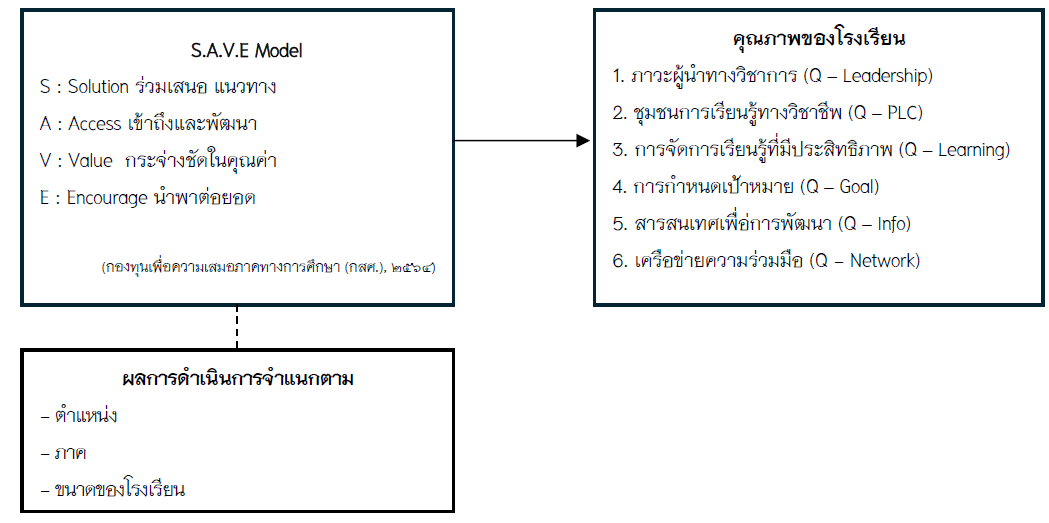
The objectives of this research were 1) compare the assessment results before and after the implementation of school development under the "Kru Rak Thin" project, supplemented by the S.A.V.E. model. 2) To compare the assessment results categorized by position, region, and school size following the implementation of school development under the "Kru Rak Thin" project, supplemented by the S.A.V.E. model The sample consisted of 249 schools participating in the "Kru Rak Thin" project using stratified random sampling methods, and three informants from each school, including a teacher, an administrator, and a reinforcement team, provided the data. Data collection was conducted using 6Q quality measure evaluation form. The data were analyzed using mean, standard deviation, and nonparametric tests such as the Wilcoxon signed rank test, Kruskal-Wallis test, and Mann-Whitney test.
The results were as follows: 1) Overall, the post-implementation scores were significantly higher than the pre-implementation scores. 2) The comparison of post-implementation scores, categorized by position, region, and school size using the S.A.V.E. Model, revealed no significant differences at the .05 level among teachers, administrators, and reinforcement team. When comparing post-implementation scores across regions using the S.A.V.E. model, significant differences were found at the .05 level. Pairwise comparisons revealed no significant difference in post-implementation scores between the Northeastern and Southern regions, while other regions differed significantly at the .05 level. Schools with 720 or more students demonstrated significantly different performance from the other size categories.
References
กนกพิชญ์ อุ่นคง. (2565). ถอดบทเรียน 4 โมเดล พัฒนาคุณภาพการเรียนรู้ สู่อนาคตการศึกษาที่ยั่งยืน. จาก https://thepotential.org/social-issues/50th-education-journey/.
กัลชิญา ทองหัตถา. (2565). ปัจจัยที่ส่งผลต่อการบริหารงานวิชาการในโรงเรียนคุณภาพประจำตำบล สังกัดสำนักงานเขตพื้นที่การศึกษาประถมศึกษาตรัง เขต 1. (วิทยานิพนธ์ศึกษาศาสตร์มหาบัณฑิต). สงขลา: มหาวิทยาลัยหาดใหญ่.
กรมส่งเสริมคุณภาพสิ่งแวดล้อม. (2562). คู่มือการจัดทำคู่มือปฏิบัติงาน (Work Manual). กรุงเทพฯ: กรมส่งเสริมคุณภาพสิ่งแวดล้อม.
จิรภัทร มหาวงค์. (2559). การพัฒนารูปแบบการบริหารเครือข่ายความร่วมมือทางวิชาการของโรงเรียนในถิ่นทุรกันดารบนเขตพื้นที่สูง. วารสารศึกษาศาสตร์ มหาวิทยาลัยนเรศวร, 18(4),114-127.
วาโร เพ็งสวัสดิ์. (2552). การวิจัยและพัฒนารูปแบบ. วารสารมหาวิทยาลัยราชภัฎสกลนคร, 2(4), 9-10.
วิยดา เหล่มตระกูล, จุติมา เมทนีธร, ศศิวรรณ พชรพรรณพงษ์, นงลักษณ์ ใจฉลาด, หฤทัย อนุสสรราชกิจ, อารี สาริปา, ... วิทเอก สว่างจิตร. (2562). โครงการวิจัยและพัฒนาแนวทางการหนุนเสริมทางวิชาการเพื่อพัฒนากระบวนการผลิตและพัฒนาครูโดยบูรณาการแนวคิดจิตตปัญญาศึกษา ระบบพี่เลี้ยง และการวิจัยเป็นฐานของคณะครุศาสตร์ มหาวิทยาลัยราชภัฏ: รายงานวิจัยฉบับสมบูรณ์. กรุงเทพฯ: สำนักงานคณะกรรมการส่งเสริมวิทยาศาสตร์ วิจัยและนวัตกรรม.
สมาน อัศวภูมิ. (2550). เส้นทางสู่คุณภาพและมาตรฐาน (พิมพ์ครั้งที่ 8). อุบลราชธานี: ออฟเซทการพิมพ์.
สำนักงานกองทุนเพื่อความเสมอภาคทางการศึกษา. (2564). การพัฒนารูปแบบการหนุนเสริมโรงเรียนในโครงการครูรัก(ษ์)ถิ่น (รายงานการวิจัย). กรุงเทพฯ: กองทุนเพื่อความเสมอภาคทางการศึกษา.
สำนักงานกองทุนเพื่อความเสมอภาคทางการศึกษา. คู่มือการดำเนินการสำหรับทีมหนุนเสริมการพัฒนาโรงเรียนในพื้นที่ห่างไกลเพื่อเตรียมความพร้อมสำหรับการพัฒนาครูรุ่นใหม่ โครงการครูรัก(ษ์)ถิ่น. กรุงเทพฯ: กองทุนเพื่อความเสมอภาคทางการศึกษา.
สำนักงานคณะกรรมการการศึกษาขั้นพื้นฐาน. (2561). แนวทางการพัฒนารูปแบบการนิเทศภายในโรงเรียน. กรุงเทพฯ: สำนักงานคณะกรรมการการศึกษาขั้นพื้นฐาน.
อรรถพงษ์ อินต๊ะวงศ์, อนุชา กอนพ่วง, ปกรณ์ ประจันบาน และ ธีรศักดิ์ อุปไมยอธิชัย (2566). รูปแบบความสัมพันธ์เชิงสาเหตุการเปลี่ยนแปลงโรงเรียนทั้งระบบของสถานศึกษา สังกัดสำนักงานคณะกรรมการการศึกษาขั้นพื้นฐาน. วารสารสันติศึกษาปริทรรศน์ มจร, 11(3), 951–964. จาก https://so03.tci-thaijo.org/index.php/journal-peace/article/view/256255.
Castaner, X., & Oliveira, N. (2020). Collaboration, coordination, and cooperation among organizations: Establishing the distinctive meanings of these terms through a systematic literature review. Journal of Management, 46(6), 965–1001.
Cefai, C., Downes, P., & Cavioni, V. (2021). A systemic, whole-school approach to mental health and well-being in schools in the EU (NESET Analytical Report No. 2/2021). Publications Office of the European Union. Form https://nesetweb.eu/wp-content/uploads/2021/10/NESET-AR2-2021.pdf.
Fullan, M. (2007). The new meaning of educational change (4th ed.). New York: Teachers College Press.
Krejcie, R. V., & Morgan, D. W. (1970). Determining sample size for research activities. Educational and psychological measurement, 30(3), 607-610.
UNESCO & UNICEF. (2021). How to include the whole school in foundational education for health and well-being (Briefing Sheet No. 3). Form https://www.unicef.org/media/158036/file/BSF3.%20How%20to%20Include%20the%20Whole%20School%20in%20Foundational%20Education%20for%20Health%20and%20Well-being.pdf.pdf.
Downloads
Published
How to Cite
Issue
Section
License
Copyright (c) 2025 Phayao University

This work is licensed under a Creative Commons Attribution-NonCommercial-NoDerivatives 4.0 International License.
Authors are responsible for the content of their manuscripts. The University of Phayao does not necessarily endorse or agree with the views expressed in published articles. Interested parties may reproduce or use the content; however, they must obtain prior written permission from the copyright holder and provide proper citation and acknowledgment.