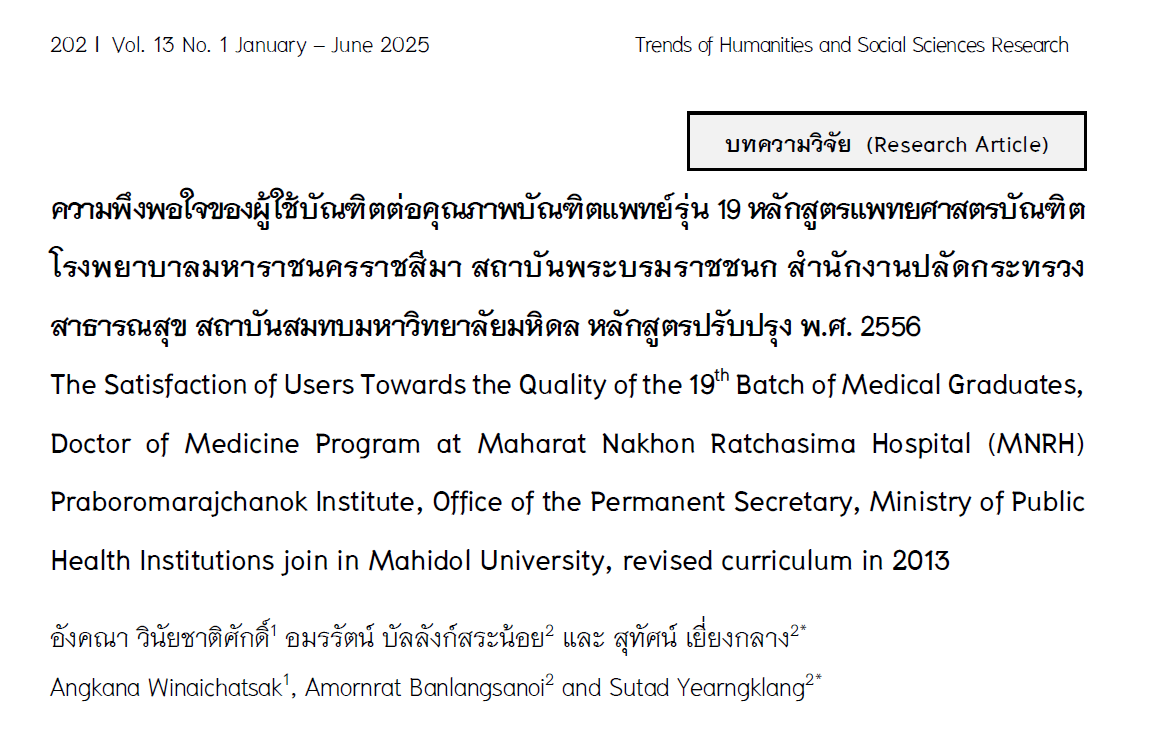
The Satisfaction of users Towards the Quality of the 19th Batch of Medical Graduates, Doctor of Medicine Program at Maharat Nakhon Ratchasima Hospital (MNRH) Praboromarajchanok Institute, Office of the Permanent Secretary, Ministry of Public Health Institutions join in Mahidol University, Revised Curriculum in 2013
Keywords:
Graduate user satisfaction, Quality of medical graduates, Doctor of medicine programAbstract
Background: Maharat Nakhon Ratchasima Hospital has been producing rural physicians since 1997. Monitoring and evaluating the performance and competencies of medical graduates after one to two years of practice provides essential data for improving, adjusting, and refining the curriculum of the Medical Education Center. This ensures the production of high-quality medical graduates capable of effectively working in rural areas and meeting the healthcare needs of Health Region 9. Objective: To assess the satisfaction of employers and colleagues regarding the quality of medical graduates from the 19th cohort and to compare satisfaction levels based on different evaluators' characteristics (gender, age, and roles), the province of practice, and the duration of collaboration. Methodology: The study sample consisted of 258 individuals who employed or worked with the 19th cohort medical graduates. A satisfaction questionnaire was used to assess various aspects of graduate performance, with a five-point rating scale. Data were analyzed using frequency distribution, percentage, mean, standard deviation. Comparisons were made using t-test, and one-way analysis of variance (ANOVA). Results: The overall satisfaction of the stakeholders with the quality of the 19th batch of graduates was rated as good (mean = 4.25). The most prominent strengths were the graduates’ ethics and professionalism (mean = 4.30), followed by their ability to communicate and build relationships with patients, families, colleagues, and communities effectively (mean = 4.29), and their ability to work efficiently and happily in community settings (mean = 4.29). The area identified for improvement was the integration of knowledge from various fields, including social sciences, humanities, behavioral sciences, medical technology, as well as principles of patient care, the healthcare system, and relevant laws, to provide holistic patient management (mean = 4.12). In terms of evaluators' roles and work locations, hospital directors and employers in Surin Province showed significantly higher satisfaction levels (p = 0.015 and p = 0.030, respectively). Conclusion: The overall satisfaction with the quality of the 19th batch of medical graduates from the revised curriculum (2013) was good. However, further development is needed in the integration and application of knowledge in patient care, such as the appropriate use of laboratory tests, in future curriculum revisions.
References
รจนารถ ชูใจ. (2558). ความพึงพอใจของผู้ใช้บัณฑิตต่อคุณภาพบัณฑิตพยาบาล วิทยาลัยพยาบาลบรมราชชนนี ราชบุรี ปีการศึกษา 2555. การประชุมวิชาการและนำเสนอผลการวิจัยระดับชาติและนานาชาติ ครั้งที่ 6 (418-425). กรุงเทพฯ: มหาวิทยาลัยราชภัฏสวนสุนันทา.
กฤชกันทร สุวรรณพันธ์, ลำพึง วอนอก, วรรณศรี แววงาม และ สุทิน ชนะบุญ. (2563). สมรรถนะและความพึงพอใจของผู้ใช้บัณฑิตหลักสูตรสาธารณสุขศาสตรบัณฑิต สาขาวิชาสาธารณสุขชุมชน วิทยาลัยการสาธารณสุขสิรินธร จังหวัดขอนแก่น ก่อนเป็นสถาบันอุดมศึกษาในกำกับของรัฐ. วารสารทันตาภิบาล, 31(1), 148-164.
ผ่องใส ถาวรจักร. (2554). ความพึงพอใจของผู้ใช้บัณฑิต วิทยาลัยราชภัฏราชพฤกษ์ ปีการศึกษา 2554 (รายงานการวิจัย). นนทบุรี: วิทยาลัยราชภัฏราชพฤกษ์.
Downloads
Published
How to Cite
Issue
Section
License
Copyright (c) 2025 Phayao University

This work is licensed under a Creative Commons Attribution-NonCommercial-NoDerivatives 4.0 International License.
Authors are responsible for the content of their manuscripts. The University of Phayao does not necessarily endorse or agree with the views expressed in published articles. Interested parties may reproduce or use the content; however, they must obtain prior written permission from the copyright holder and provide proper citation and acknowledgment.