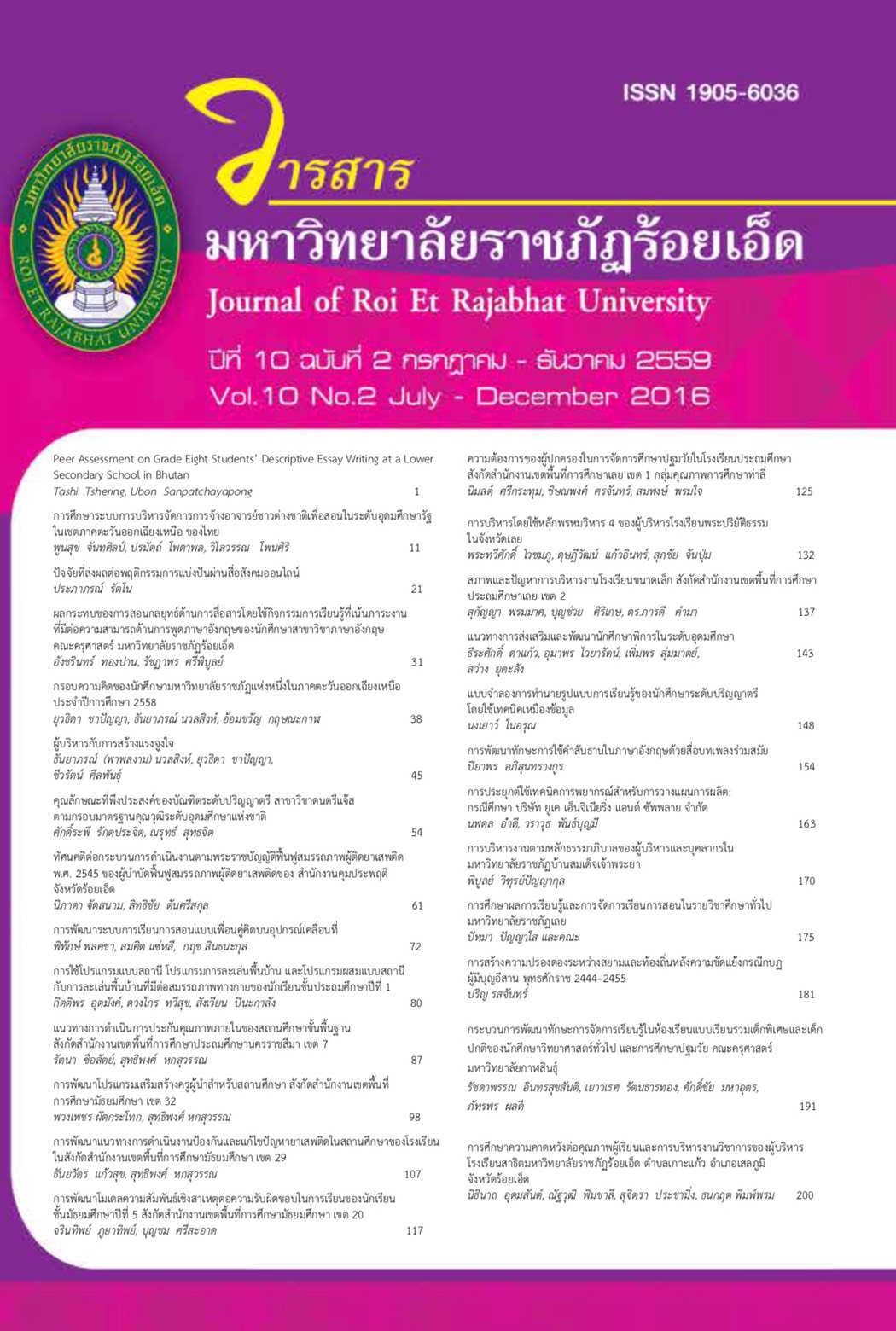
การประเมินผลการเขียนเรียงความเชิงพรรณนาของนักเรียนชั้นมัธยมศึกษาปีที่ 2 ของโรงเรียนระดับมัธยมศึกษาตอนต้นในประเทศภูฏาน
คำสำคัญ:
การประเมินโดยเพื่อน, การเขียนเรียงความเชิงพรรณนา, โรงเรียนมัธยมศึกษาตอนต้นบทคัดย่อ
การวิจัยนี้เพื่อศึกษาวิธีการที่นักเรียนชั้น มัธยมศึกษาปีที่ 2 พัฒนาและใช้การประเมินโดยเพื่อนในการเขียนเรียงความเชิงพรรณนาซึ่งได้ดําเนินการวิจัยที่โรงเรียนมัธยมศึกษาตอนต้นในประเทศภูฎานในภาคเรียนที่ ตอนต้นในประเทศภูฎานในภาคเรียนที่ ตอนต้น 2 ปีการศึกษา 2558 ระหว่างเดือนสิงหาคมถึงเดือน กันยายน กลุ่มตัวอย่างได้แก่นักเรียนชั้นมัธยมศึกษาปีที่ 2 จํานวน 35 คน ที่คัดเลือกจากผลคะแนนงานเขียนเรียงความเชิงพรรณนาในการสอบกลางภาคในปีการศึกษา 2558 การออกแบบการวิจัยชิ้นนี้เป็นการวิจัยแบบผสมโดย รวบรวมข้อมูลจาก การสัมภาษณ์ แบบสอบถาม บันทึกการ รวบรวมข้อมูลจาก การสัมภาษณ์ แบบสอบถาม บันทึกการสะท้อนผลของนักเรียสะท้อนผลของนักเรียนและบันทึกของครู
ผลการวิจัยประเด็นแรกพบว่าการพัฒนาการประเมินงานเขียนโดยเพื่อนกระตุ้นให้ผู้เรียนเกิดความรับผิดชอบในฐานะผู้ประเมินส่งเสริมความร่วมมือระหว่างกันของผู้ประเมิน พัฒนาภาษาที่ใช้ในงานเขียนและทําให้มี ประสบการณ์ในการประเมินโดยเพื่อนผลการวิจัยประเด็นที่สองพบว่านักเรียนมีความพึงพอใจในการฝึกการประเมินงานเขียนโดยเพื่อน ผลจากแบบประเมินหลังการฝึกชี้ให้เห็นค่าค่าเฉลี่ยโดยรวมที่ระดับ 3.7 ที่บ่งว่านักเรียนส่วนใหญ่เห็นความสําคัญของการฝึกการเขียนเชิงพรรณนาและการประเมินโดยเพื่อน นอกจากนี้ยังพบว่านักเรียนมีพัฒนาการในการเขียนเชิงพรรณนาหลังจากการฝึกการประเมินโดยเพื่อนอีกทั้งการมีส่วนร่วมในการประเมินทําให้นักเรียนมีทัศนคติต่อการประเมินในเชิงบวก
เอกสารอ้างอิง
Beaver, C., & Beaver, S. (2011). “The Effect of Peer-Assessment on the Attitudes of Pre-Service Elementary Service Elementary and Middle School Teachers about Writing and Assessing Mathematics,” Issues in the Issues in the Undergraduate Mathematics Preparation of School Teachers. 5: 14.
Brown, S. (Ed.). (1998). Peer assessment in practice. Birmingham: SEDA. Cassidy, S. (2006). “Developing employability skills: Peer assessment in higher education,” Education+ Education+ training. 48(7):508-517.
Department of Curriculum and Research Department. (2014). PP-XII English Framework. Bhutan: Ministry of Education.
Dollard, N., &Christensen, L. (1996). Constructive classroom management,” Focus on Exceptional Focus on Exceptional Children. 29(2):1-12.
Gelb, I., & Whiting, R. (1993). Academic American Encyclopedia. Grolier, Danby, Connecticut. Gokhale, A.A. (1995). “Collaborative learning enhances critical thinking,” Journal of Educational Journal of Educational Technology.
Gooden-Jones, E. (2000). “Developing Writing Proficiency through Cooperative Learning Strategies in Limited Proficient College Students,” Dissertation Abstracts International
Lundstrom, K., & Baker, W. (2009). To give is better than to receive: The benefits of peer review to the reviewer's own writing,” Journal of second language writing. 18(1): 30-43.
McLaughlin, P., & Simpson, N. (2004). “Peer assessment in first Year University: How the students feel,” Studies in Educational Evaluation. 30(2): 135-149.
Min, H.T. (2006). “The effects of trained peer review on EFL students’ revision types and writing quality,” Journal of second language writing Journal of second language writing. 15(2) : 118 - 141
Sahin, S. (2008). “An application of peer assessment in higher education,” The Turkish Online Journal The Turkish Online Journal of Educational Technology. 7(2): 6.
Sluijsmans, D. M., Brand-Gruwel, S., van Merriënboer, J. J., & Martens, R. L. (2004). “Training teachers in peer-assessment skills: effects on performance and perceptions,” Innovations inEducation and Education and Teaching International Teaching International. 41(1 41(1) ): : 59 59-78.
Stefani, L.A. (1994). “Peer, self and tutor assessment: Relative Peer, self and tutor assessment: Relative reliabilities,” Studiesin Higher in Higher Education,19(1):69-75.
Watkins, C., Carnell, E., & Lodge, C. (2007). Effective learning in classrooms. Paul Chapman Educational. White, E. (2009). “Student perspectives of peer assessment for learning in a public speaking Student perspectives of peer assessment for learning in a public speaking course,” Asian EFL Journal. 33(1): 1-36.
ดาวน์โหลด
เผยแพร่แล้ว
รูปแบบการอ้างอิง
ฉบับ
ประเภทบทความ
สัญญาอนุญาต
บทความที่ได้รับการตีพิมพ์เป็นลิขสิทธิ์ของวารสารมหาวิทยาลัยราชภัฎร้อยเอ็ด
ข้อความที่ปรากฏในบทความแต่ละเรื่องในวารสารวิชาการเล่มนี้เป็นความคิดเห็นส่วนตัวของผู้เขียนแต่ละท่านไม่เกี่ยวข้องกับมหาวิทยาลัยราชภัฎร้อยเอ็ด และคณาจารย์ท่านอื่นๆในมหาวิทยาลัยฯ แต่อย่างใด ความรับผิดชอบองค์ประกอบทั้งหมดของบทความแต่ละเรื่องเป็นของผู้เขียนแต่ละท่าน หากมีความผิดพลาดใดๆ ผู้เขียนแต่ละท่านจะรับผิดชอบบทความของตนเองแต่ผู้เดียว



