
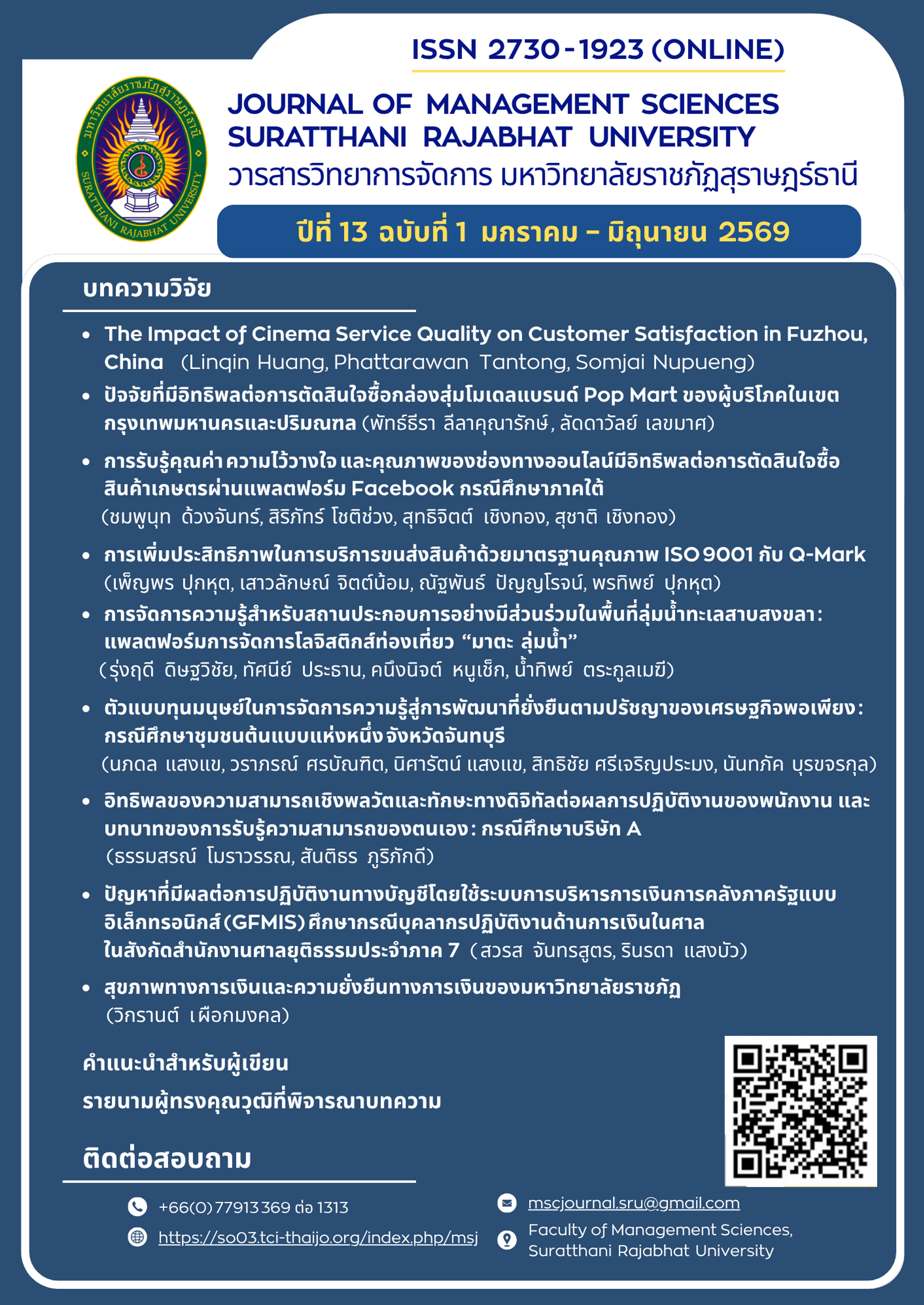
The Impact of Cinema Service Quality on Customer Satisfaction in Fuzhou, China
Article Sidebar
Main Article Content
Abstract
This study aimed to examine the influence of cinema service quality factors on customer satisfaction in Fuzhou City, People's Republic of China, against the backdrop of post-COVID-19 economic recovery and shifting consumer behavior, which has intensified competition in the cinema industry. As competition continues to escalate, service quality has become a critical factor in sustaining customer satisfaction and market competitiveness. This study applies the SERVQUAL model to evaluate service quality across five dimensions: tangibility, reliability, responsiveness, assurance, and empathy. Data were collected through a questionnaire survey administered to 400 randomly selected customers from a population of 80,000 cinema-goers. Reliability and validity of the instrument were confirmed using Cronbach's Alpha coefficient and KMO and Bartlett's tests. Pearson correlation analysis and simple linear regression analysis were employed to examine the relationships between service quality dimensions and customer satisfaction. The results reveal that all five service quality dimensions, namely tangibility, reliability, responsiveness, assurance, and empathy, have statistically significant positive effects on customer satisfaction, collectively explaining 65.1% of the variance in customer satisfaction. Customers place considerable importance on the tangibility of cinema facilities and staff presentation; however, improvements remain needed in the overall cinema environment. Reliability and assurance, reflected through consistent service delivery, staff professionalism, and brand reputation, positively influence customer satisfaction. Responsiveness and empathy, demonstrated through timely staff assistance and personalized attention to customer needs, further strengthen the overall customer experience. Overall, this study demonstrates that service quality significantly impacts customer satisfaction in Fuzhou cinemas and serves as a key driver of competitive advantage. The findings provide empirical evidence and practical guidance for cinema managers seeking to optimize service strategies and enhance long-term customer loyalty
Article Details

This work is licensed under a Creative Commons Attribution-NonCommercial-NoDerivatives 4.0 International License.
References
Altuntas, S., & Kansu, S. (2019). An innovative and integrated approach based on SERVQUAL, QFD and MEA for service quality improvement. Kybernetes, 49(10), 2419-2453.
Cronbach, L. J. (1951). Coefficient alpha and the internal structure of tests. Psychometrika, 16(3), 297-334. https://doi.org/10.1007/BF02310555.
Fattah, A., & Al-Azzam, M. (2015). The impact of service quality dimensions on customer satisfaction: A field study of Arab Bank in Irbid City, Jordan. European Journal of Business and Management, 7(15), 45-53. Fuzhou.
icipal People's Government. (2023). Measures to support the development of film and television industry in Fuzhou (R.Z.Z. [2023] No. 119). Fuzhou Municipal People's Government.
Hamid, A., Uzir, M., & Latiff, A. (2019). Does customer satisfaction exist in purchasing and usage of electronic home appliances in Bangladesh through interaction effects of social media. International Journal of Business Excellence, 23(1), 113-137.
Hou, Q. (2008). The influence of service quality on customer satisfaction and customer loyalty [Unpublished master’s thesis]. Shandong University.
Jain, N. K., Singh, A. K., & Kaushik, K. (2019). Evaluating service quality in automobile maintenance and repair industry. Asia Pacific Journal of Marketing and Logistics, 32(1), 117-134.
Kasiri, L. A., & Mansori, S. (2016). Standardization, customization, and customer loyalty in service industry. Journal of Marketing Analytics, 4(23), 66-76. https://doi.org/10.1057/s41270-016-0002-3.
Li, M., Lowrie, D. B., Huang, C. Y., Lu, X. C., Zhu, Y. C., Wu, X. H., & Lu, H. Z. (2015). Evaluating patients' perception of service quality at hospitals in nine Chinese cities by use of the ServQual scale. Asian Pacific Journal of Tropical Biomedicine, 5(6), 497-504.
Lin, J. (2017). Research on the status reconstruction of shopping center supporting categories under the background of experiential marketing: A case study of cinema. Business Economics Research, (6), 38-40.
Liu, Z. (2005). Theoretical analysis and empirical research on influencing factors of customer satisfaction [Unpublished master’s thesis]. Hunan University.
Lu, J., & Liu, H. (2018). Analysis of the development of Chinese film industry in 2018. Contemporary Film.
Parasuraman, A., Zeithaml, V. A., & Berry, L. L. (1988). SERVQUAL: A multi-item scale for measuring consumer perceptions of service quality. Journal of Retailing, 64(1), 12-40.
Pena, M. M., Da Silva, E. M. S., Tronchin, D. M. R., & Melleiro, M. M. (2013). The use of the quality model of Parasuraman, Zeithaml and Berry in health services. Revista Da Escola De Enfermagem Da USP, 47(5), 1227-1232.
Petersen, C. G. (2019). The address of the ass: D-BOX motion code, personalized surround sound, and focalized immersive spectatorship. Journal of Film and Video, 71(1), 3-19.
Rahayu, N., Prasetia, R., & Priyanto, P. (2019). The effect of service quality on customer satisfaction in JKT48 Theater. TRJ Tourism Research Journal, 3(1), 86-99.
Robson, K. (2015). Enhancing customer service through theatre improvisation: A theory. In: In K. Kubacki (Ed.), Ideas in Marketing: Finding the New and Polishing the Old. Developments in Marketing Science: Proceedings of the Academy of Marketing Science (pp. 570-573). Springer. https://doi.org/10.1007/978-3-319-10951-0_205.
Roy, S., & Mukherjee, I. (2015). A framework for service quality improvement in multi-stage processes. International Journal of Services and Operations Management, 21(2), 150-174. https://doi.org/10.1504/IJSOM.2015.069882.
Su, Z., Zhou, J., & Zhao, Y. (2016). Service quality improvement strategy of express delivery enterprises based on reliability theory. Logistics Technology, 35(2), 5-9.
Tang, Z., & Yu, L. (2020). The configurational influence mechanism of film consumption experience on customer satisfaction. Journal of Consumer Behaviour, 20(1), 132-147.
Uzir, M., Uzir, H., & Jerin, I. (2020). Does quality stimulate customer satisfaction where perceived value mediates and the usage of social media moderates. Heliyon, 6(12), 1-19. https://doi.org/10.1016/j.heliyon.2020.e05710.
Wu, T., & Li, Y. (2017). Research on the development path of cinema brand in popular culture. Cultural Soft Power Research, 3(2), 66-73.
Yamane, T. (1967). Statistics: An introductory analysis (2nd ed.). Harper and Row.
Yuan, M., Gu, Y., & Yuan, X. (2019). Improving emergency medical service quality based on quality function. Chinese Journal of Health Quality Control, 28(5), 55-59.
Zeithaml, V. A., Berry, L. L., & Parasuraman, A. (1996). The behavioral consequences of service quality. Journal of Marketing, 60(2), 31-46. https://doi.org/10.2307/1251929.
Zhang, X., Zhang, S., & Wang, J. (2022). Empirical study on influencing factors of Meituan campus delivery service quality to customer satisfaction. Logistics Engineering and Management, 44(2), 127-130.
Zhang, Y. (2019). The impact of innovative payment methods on college students' consumption. Consumer Economics, 35(3), 79-81.
