
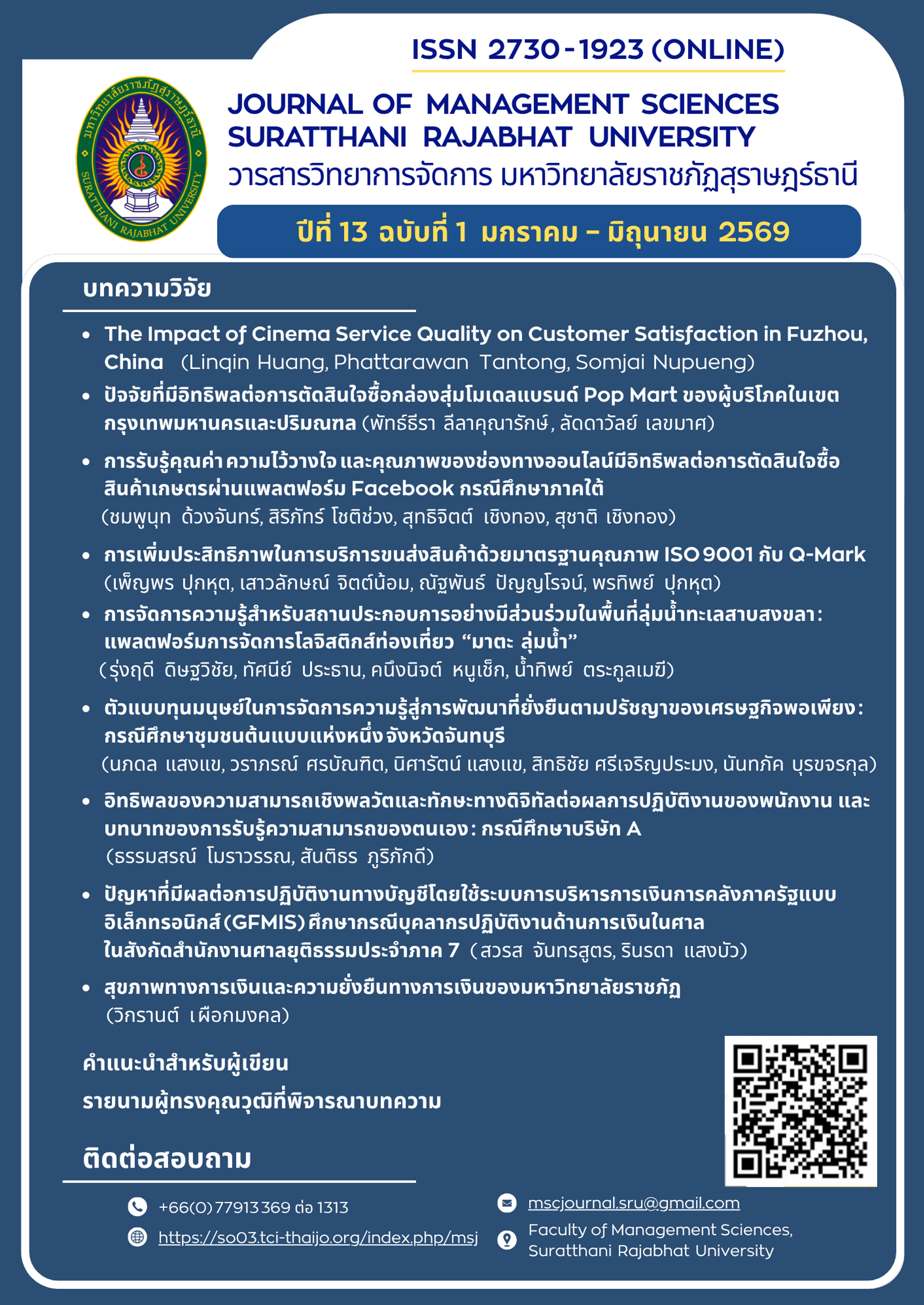
Human Capital Model in Knowledge Management for Sustainable Development According to the Sufficiency Economy Philosophy: A Case Study of a Prototype Community in Chanthaburi Province
Article Sidebar
Main Article Content
Abstract
Past experiences have heightened awareness of the need to navigate uncertainty and change across multiple dimensions. Human capital serves as a critical mechanism for building resilience and sustainability in organizations across all sectors. This study therefore aimed: 1) to examine the conditional factors of human capital that influence sustainable development; and 2) to present a human capital and knowledge management model for sustainable development based on the Sufficiency Economy Philosophy, focusing on production and consumption in communities recognized as model Sufficiency Economy villages by the Ministry of Interior. Data were collected through in-depth interviews and focus group discussions with 21 community stakeholders, selected using purposive sampling and snowball sampling techniques. The findings revealed that the community possesses human capital factors conducive to sustainable development, characterized by diverse human capital, clearly defined roles and responsibilities, and a strong foundation of organic agricultural wisdom. Key dimensions identified include: 1) community leaders with a development-oriented mindset who apply their knowledge and skills to build trust, establish networks, and integrate various knowledge resources, while actively prioritizing human capital development; and 2) community members who demonstrate readiness in terms of attitudes, values, environmental and social management, and problem-solving capabilities. The conditional factors identified from the interviews and focus group discussions were extracted and synthesized within a theoretical framework to develop a human capital management model for sustainable development comprising three components: 1) lifelong learning; 2) application of the Sufficiency Economy Philosophy in daily life; and 3) fostering community knowledge and understanding. This model is intended for adaptation by other communities. For successful implementation, government agencies should provide concrete support, including synthesizing indigenous local wisdom into an academic framework to establish systematic practices that guide communities toward stability and long-term sustainability
Article Details

This work is licensed under a Creative Commons Attribution-NonCommercial-NoDerivatives 4.0 International License.
References
Armstrong, M. (2015). Armstrong’s handbook of performance management: An evidence-based guide to delivering high performance. Kogan Page.
Bateman, S. T., & Snell, A. S. (2009). Management: Leading and collaborating in a competitive world (8th ed.). McGraw-Hill.
Beaulieu, L. J. (2014). Community vitality & sustainability: The community capitals framework [Introduction]. Purdue Center for Regional Development. https://pcrd.purdue.edu/wp-content/uploads/2020/09/Community-Capitals-Framework-Writeup-Oct-2014.pdf.
Boonrat, S., & Kovitarttwatee, P. (2018). The development of the country with the philosophy of a sufficient philosophy in the era of Thailand 4.0. Journal of MCU Buddhapanya Review, 3(2), 197-206.
Caballero, P. (2019). The SDGs: Changing how development is understood. Global Policy, 10(1), 138-140.
Chabowski, B., Mena, J. A., & Gonzalez-Padron, T. (2011). The structure of sustainability research in marketing, 1958–2008: A basis for future research opportunities. Journal of the Academy of Marketing Science, 39(1), 55–70.
Chaipattana Foundation. (2017). The inception of the philosophy of sufficiency economy. https://www.chaipat.or.th/site_content/item/3579-2010-10-08-05-24-39.
Chelong, A., & Jeawkok, J. (2020). The lesson learned for lifelong learning in human. Journal of Graduate Studies Valaya Alongkorn Rajabhat University, 14(2), 241-250.
Community Strengthening Office. (2019). Sufficiency economy village development for community well-being. Community Development Department.
Davenport, T. O. (1999). Human capital: What it is and why people invest it. Jossey-Bass.
Deller, S. (2013). The Floras’ community capitals: Human capital [Report]. Department of Agricultural and Applied Economics, University of Wisconsin-Madison. https://aae.wisc.edu/ced/wp-content/uploads/sites/8/2013/06/Flora-Community-Human-Capitals.pdf.
Dillenbourg, P. (1999). What do you mean by collaborative learning? In P. Dillenbourg (Ed.), Collaborative learning: Cognitive and computational approaches (pp. 1-19). Elsevier.
Electronic Transactions Development Agency (ETDA). (2020). Human Capital Index (HCI). ETDA. https://www.etda.or.th/th/Our-Service/statistics-and-information/detail-index.aspx.
Engardio, P., Capell, K., Carey, J., & Hall, K. (2007). Beyond the green corporation. Business Week, 29, 50-64.
Flora, C. B., & Flora, J. L. (2007). Rural communities: Legacy and change (3rd ed.). Westview Press.
Gilmour, H. (2012). Social participation and the health and well-being of Canadian seniors. Health Reports, 23(4), 3-12.
Guthrie, T. J., Coddington, S. C., & Wigfield, A. (2009). Profiles of reading motivation among African American and Caucasian students. Journal of Literacy Research, 41(3), 317-353.
Handberg, Ø. N. (2018). No sense of ownership in weak participation: A forest conservation experiment in Tanzania. Environment and Development Economics, 23(4), 434-451.
Hunuk, D., Ince, M. L., & Tannehill, D. (2013). Developing teachers’ health-related fitness knowledge through a community of practice: Impact on student learning. European Physical Education Review, 19(3), 3-20.
Itthawitthayawat, S. (2016). Philosophy of sufficiency economy: Its perception and application in Thai society. Research and Development Journal, 11(38), 95-104.
Jansawang, K. (2020). Human capital: Key for development of Singapore. Journal of Humanities and Social Sciences, 12(1), 329-349.
Jones, C., & Allen, S. (2013). Sustainability and sustainable development: What is sustainability and what is sustainable development?. Circular Ecology. https://circularecology.com/sustainability-and-sustainable-development.html.
Kittiprapat, S. (2023). Sustainability Buddhism, sufficiency economy and economics for sustainability. International Research Associate for Happy Societies (IRAH). https://scholar.utcc.ac.th/entities/publication/eb3f62ae-efcb-4747-aa1a-fe3d24a2c942.
Kliangsong, C., & Pittayanon, T. (2015). Organizational culture development strategies to promote learning community. Journal of Social Sciences and Humanities, 5(1), 86-98.
Lauckner, H., Paterson, M., & Krupa, T. (2012). Using constructivist case study methodology to understand community development processes: Proposed methodological questions to guide the research process. The Qualitative Report, 17(25), 1-22.
Madgavkar, A., Schaninger, B., Smit, S., Woetzel, J., Samandari, H., Carlin, D., Seong, J., & Chockalingam, K. (n.d.). Human capital at work: The value of experience. McKinsey & Company. https://www.mckinsey.com/capabilities/people-and-organizational-performance/our-insights/human-capital-at-work-the-value-of-experience.
Marshall, B., Cardon, P., Poddar, A., & Fontenot, R. (2013). Does sample size matter in qualitative research?: A review of qualitative interviews in IS research. Journal of Computer Information Systems, 54(1), 11-22.
Mezirow, J. (1991). Transformative dimensions of adult learning. Jossey-Bass.
Moore, S., & Kawachi, I. (2017). Twenty years of social capital and health research: A glossary. Journal of Epidemiology & Community Health, 71(5), 513-517.
Nakamura, Y. T., & Yorks, L. (2011). The role of reflective practices in building social capital in organizations from an HRD perspective. Human Resource Development Review, 10(3), 222-245.
Nujoi, A. (2016). Developing community leaders of learning. Dhammasat Journal, 16(2), 23-31.
Office of Natural Resources and Environmental Policy and Planning. (2022). Sustainable consumption and production roadmap 2017–2037 (revised version 1). https://www.onep.go.th/ebook/spd/Final-SCP-Roadmap-2017-2037.pdf.
Office of the Secretary-General of the National Security Council. (2018). National strategy 2018–2037. Office of the National Economic and Social Development Council. https://bic.moe.go.th/images/stories/pdf/National_Strategy_Summary.pdf.
Oostendorp, R. H. (2009). Globalization and the gender wage gap. The World Bank Economic Review, 23(1), 141-161.
Ostrom, E., & Ahn, T. K. (2007). The meaning of social capital and its link to collective action. In G. T. Svendsen & G. L. Svendsen (Eds.), Handbook on social capital (pp. 1-36). Edward Elgar.
Parker, C., Scott, S., & Geddes, A. (2019). Snowball sampling. In P. Atkinson, S. Delamont, A. Cernat, J. W. Sakshaug, & R. A. Williams (Eds.), SAGE Research Methods Foundations. SAGE Publications. https://doi.org/10.4135/9781526421036831346.
Parmentola, A., Petrillo, A., Tutore, I., & De Felice, F. (2021). Is blockchain able to enhance environmental sustainability? A systematic review and research agenda from the perspective of Sustainable Development Goals (SDGs). Business Strategy and the Environment, 31(1), 194-217.
Pattanamanee, P. (2018). Development guidelines for living promotion by philosophy of sufficient economy of people in Maifad Sub-District, Sikao District, Trang Province. Rajamangala University of Technology Srivijaya. https://www.repository.rmutsv.ac.th/handle/123456789/2340?locale-attribute=th.
Phitthanukorn, P. (2023, November 23). Driving the potential of “human capital” towards a sustainable wisdom society. Thairath Online. https://www.thairath.co.th/futureperfect/articles/2742977.
Pokpong, S. (2020, January 13). Triple bottom line, the new era business balance. Kaohoon Online. https://www.kaohoon.com/column/335317.
Pothisita, C. (2016). Science and art of qualitative research (7th ed.). Amarin Printing.
Putthakhin, N., Ketphonthong, C., & Lapchit, S. (2023). The community economic learning center based on the philosophy of sufficiency economy in Surin Province. Journal of Local Governance and Innovation, 8(1), 1-18.
Rinaldi, C., Cavicchi, A., Spigarelli, F., Lacchè, L., & Rubens, A. (2018). Universities and smart specialization strategy: From third mission to sustainable development co-creation. International Journal of Sustainability in Higher Education, 19(1), 1-21.
Rosen, H. S. (2005). Public finance (7th ed.). McGraw-Hill.
Sanannaree, N., Abhinandavedi, P. W., Tavachalee, R., Boonpiyo, C., Leeka, J., & Sa-waingam, M. (2020). The application of sufficiency economy philosophy for developing the monasteries and communities in Khonkaen Province. Journal of MCU Peace Studies, 8(2), 388-404.
Sansupa, K., & Kuntawong, N. (2021). Self-management: The skill of sustainable self-development. Journal of Liberal Arts (Wang Nang Leng) RMUTP, 1(1), 26-37.
Silva, M. J., McKenzie, K., Harpham, T., & Huttly, S. R. A. (2005). Social capital and mental illness: A systematic review. Journal of Epidemiology and Community Health, 59(8), 619-627.
Sun, J., Liu, Z., Rolls, E. T., Chen, Q., Yao, Y., Yang, W., Wei, D., Zhang, Q., Zhang, J., Feng, J., & Qiu, J. (2019). Verbal creativity correlates with the temporal variability of brain networks during the resting state. Cerebral Cortex, 29(3), 1047-1058.
Tephaval, C. (2019, November 13). Developing human capital is key for future of ASEAN and Thailand. World Bank. https://www.worldbank.org/th/news/feature/2019/11/13/developing-human-capital-is-key-for-future-of-asean-and-thailand.
Thammawimutti, A., & Chuntuk, T. (2017). Innovative and creative human capital of community enterprise entrepreneurs. Veridian E-Journal, 10(1), 1572-1589.
Thapouyphon, C., Lemsawasdikul, W., & Nuysri, M. (2019). Factors influencing learning organization of nursing departments at community hospitals in Regional Health 5. Thai Journal of Nursing, 68(1), 1-10.
Thompson, S. (2020, June 26). Commentary: The role of human capital in community development. Daily Yonder. https://dailyyonder.com/commentary-the-role-of-human-capital-in-community-development/2020/06/26/.
United Nations in Thailand. (2022, September 23). Sustainable development goals. United Nations Thailand. https://thailand.un.org/th/about/about-the-un.
Vasileiou, K., Barnett, J., Thorpe, S., & Young, T. (2018). Characterising and justifying sample size sufficiency in interview-based studies: Systematic analysis of qualitative health research over a 15-year period. BMC Medical Research Methodology, 18(1), Article 148. https://doi.org/10.1186/s12874-018-0594-7.
Wechayanon, N. (2008). A new dimension in human capital management: Managing talent. Graphico Systems.
Wenger, E. (2018). Communities of practice and social learning systems: The career of a concept. In K. Illeris (Ed.), Contemporary theories of learning: Learning theorists… in their own words (pp. 219-228). Routledge.
