
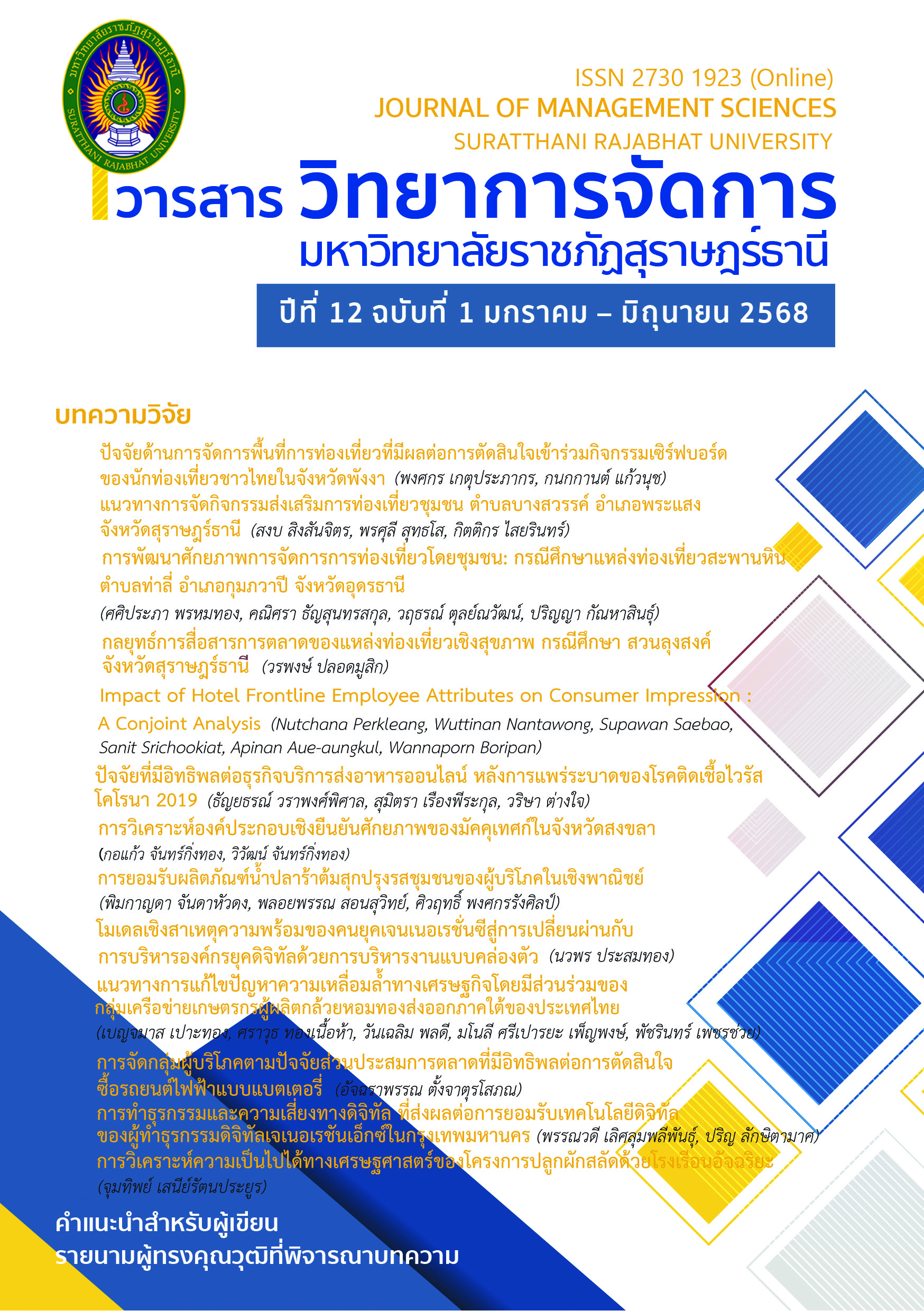
Impact of Hotel Frontline Employee Attributes on Consumer Impression: A Conjoint Analysis
Article Sidebar
Main Article Content
Abstract
The importance of frontline employee service in hotels is considered crucial for creating a strong first impression on customers. This research aims to explore the service characteristics of frontline employees in hotels that influence customers' impressions using Conjoint Analysis. The Conjoint technique is effectively used to understand consumers' complex decision-making by simulating different products or services using combinations of key attributes and assessing them based on consumers' preferences. It is a good technique for eliciting the relative importance of attributes. The study investigates various attributes, including smiling, voice tone, outward appearance, service enthusiasm, and greetings. These variables were combined to create eight different scenarios using Orthogonal Design, which were presented in video clips. Respondents were asked to rate their impression of each scenario on a scale of 1 to 8. Therefore, the survey was conducted on an online platform to incorporate video clips into the questionnaires. The research applied a convenience sampling method to collect data from 400 respondents, with the majority being females aged between 21-30 years, single, and with monthly incomes ranging between 10,001-20,000 baht. The results of the analysis, ranked from highest to lowest influence, showed that the smiling of the front desk staff had the most significant impact on customer satisfaction. Following that were the greetings before and after service, voice tone, outward appearance, and service enthusiasm. However, these characteristics revealed slightly varying relative importance, indicating that each characteristic played a crucial role in creating an overall positive impression. This study has some limitations. For example, while Conjoint Analysis provides valuable insights into the relative importance of factors, it does not determine their absolute importance. This research contributes to previous studies in terms of research methodology and the independent variables considered.
Article Details

This work is licensed under a Creative Commons Attribution-NonCommercial-NoDerivatives 4.0 International License.
References
Baker, J., Grewal, D., & Parasuraman, A. (1994). The influence of store environment on quality inferences and store image. Journal of the academy of marketing science, 22(4), 328-339. https://doi.org/10.1177/0092070394224002.
Baker, J., Levy, M., & Grewal, D. (1992). An experimental approach to making retail store environmental decisions. Journal of retailing, 68(4), 445-460.
Bitner, M.J. (1992), “Servicescapes: the impact of the physical environment surround customers and employees”, Journal of Marketing, 56(2), 57-71. https://doi.org/10.1177/002224299205600205.
Boonhaow, P. (2020, November 25). The benefits of smiling. Health scientist, Faculty of Thai Traditional Medicine, Prince of Songkla University. https://www.ttmed.psu.ac.th/th/blog/268?fbclid=IwAR1MOhoJkucSWay0_oArwhvg20jhpiDezUfu76qvnU_HinZ-wLr2RHOZEI.
Countryman, C. C., & Jang, S. (2006). The effects of atmospheric elements on customer impression: the case of hotel lobbies. International Journal of Contemporary Hospitality Management, 18(7), 534-545. https://doi.org/10.1108/09596110610702968.
Decharin, P. (2021, July 17). How can enthusiastic employees bring success to the organization?. Slow Strategy. https://url.in.th/JobdH.
Easterling, C. R., Leslie, J. E., & Jones, M. A. (1992). Perceived importance and usage of dress codes among organizations that market professional services. Public Personnel Management, 21(2), 211-219. https://doi.org/10.1177/009102609202100208.
Gabbott, M., & Hogg, G. (2001). The role of non-verbal communication in service encounters: A conceptual framework. Journal of Marketing Management, 17(1-2), 5-26. https://doi.org/10.1362/0267257012571401.
Grandey, A.A. & Gabriel, A.S. (2015), “Emotional labor at a crossroads: where do we go from here?”, Annual Review of Organizational Psychology and Organizational Behavior, 2(1), 23-349. https://doi.org/10.1146/annurev-orgpsych-032414-111400.
Hair, J. F., Black, W. C., Babin, B. J., Anderson, R. E., & Tatham, R. L. (2014). Multivariate data analysis (7th ed.). Pearson Education Limited.
Högnäs, S. (2015). The importance of the first impression in hotel customer service. Vaasa University of Applied Sciences.
Itani, O. S., Jaramillo, F., & Paesbrugghe, B. (2020). Between a rock and a hard place: Seizing the opportunity of demanding customers by means of frontline service behaviors. Journal of Retailing and Consumer Services, 53, 101978.
Knutson, B.J. (1988), “Ten laws of customer satisfaction”, Cornell Hotel and Restaurant Administration Quarterly, 29(3), 14-17. https://doi.org/10.1177/001088048802900309.
Lunkam, P. (2022, November 28). The outlook for the hotel industry in Thailand 2022-2024. https://www.krungsri.com/en/research/industry/industry-outlook/services/hotels/io/hotel-2022-2024.
Mattila, A. S., Grandey, A. A., & Fisk, G. M. (2003). The interplay of gender and affective tone in service encounter satisfaction. Journal of Service Research, 6(2), 136-143. https://doi.org/10.1177/1094670503257043.
Mayers, A. (2013). Introduction to Statistics and SPSS in Psychology. Pearson Education.
Nanthapaiboon, J. (2008). Service psychology. Se-ed education.
Nickson, D., Warhurst, C., & Dutton, E. (2005). The importance of attitude and appearance in the service encounter in retail and hospitality. Managing Service Quality: An International Journal, 15(2), 195-208. https://doi.org/10.1108/09604520510585370.
Nwulu, C. S., & Ateke, B. W. (2018). Frontline employee competence development and responsiveness of quick service restaurants. European Journal of Social Sciences Studies, 2(10). 1-18.
Orme, B. K. (2010). Getting started with conjoint analysis: strategies for product design and pricing research (2nd ed.). Research Publisher LLC.
Otterbring, T. (2017). Smile for a while: the effect of employee-displayed smiling on customer affect and satisfaction. Journal of Service Management, 28(2), 284-304. https://doi.org/10.1108/JOSM-11-2015-0372.
Rao, V. R. (2014). Applied Conjoint Analysis. Springer-Verlag.
Rhee, H. T., & Yang, S.-B. (2015). How does hotel attribute importance vary among different travelers? An exploratory case study based on a conjoint analysis. Electronic Markets, 25(3), 211–226. https://doi.org/10.1007/s12525-014-0161-y.
Sawaengsrichara, P. (2019, July 28). Theory of 3 factors to create motivation and enthusiasm at work. 3-Factor Theory [Sirota]. https://drpiyanan.com/2019/07/28/3-factor-theory-sirota/?fbclid=IwAR2j_bzy-pywJqiuCHC3s-ut_NU02zS-wTHSD_Vfl30Rh7SN0-jcThQLvfc.
Sirijanusorn, A. (2021, November 21). The outlook for hotel industry in Thailand 2022-2024. https://www.bangkokbiznews.com/business/972631.
Srichookiat, S., & Jindabot, T. (2018). Salient environmental attributes and their value for small independent grocers. Journal of Consumer Marketing, 35(5), 465-479. https://doi.org/10.1108/JCM-03-2017-2135.
Thai Hotels Association. (2011). Thailand Hotel Standard Foundation. https://www.thaihotels.org/16679475/thailand-hotel-standard-foundation.
Thai Hotels Association. (2024). Hotel Business Operator Sentiment Index. Thai Hotels Association and Bank of Thailand.
