
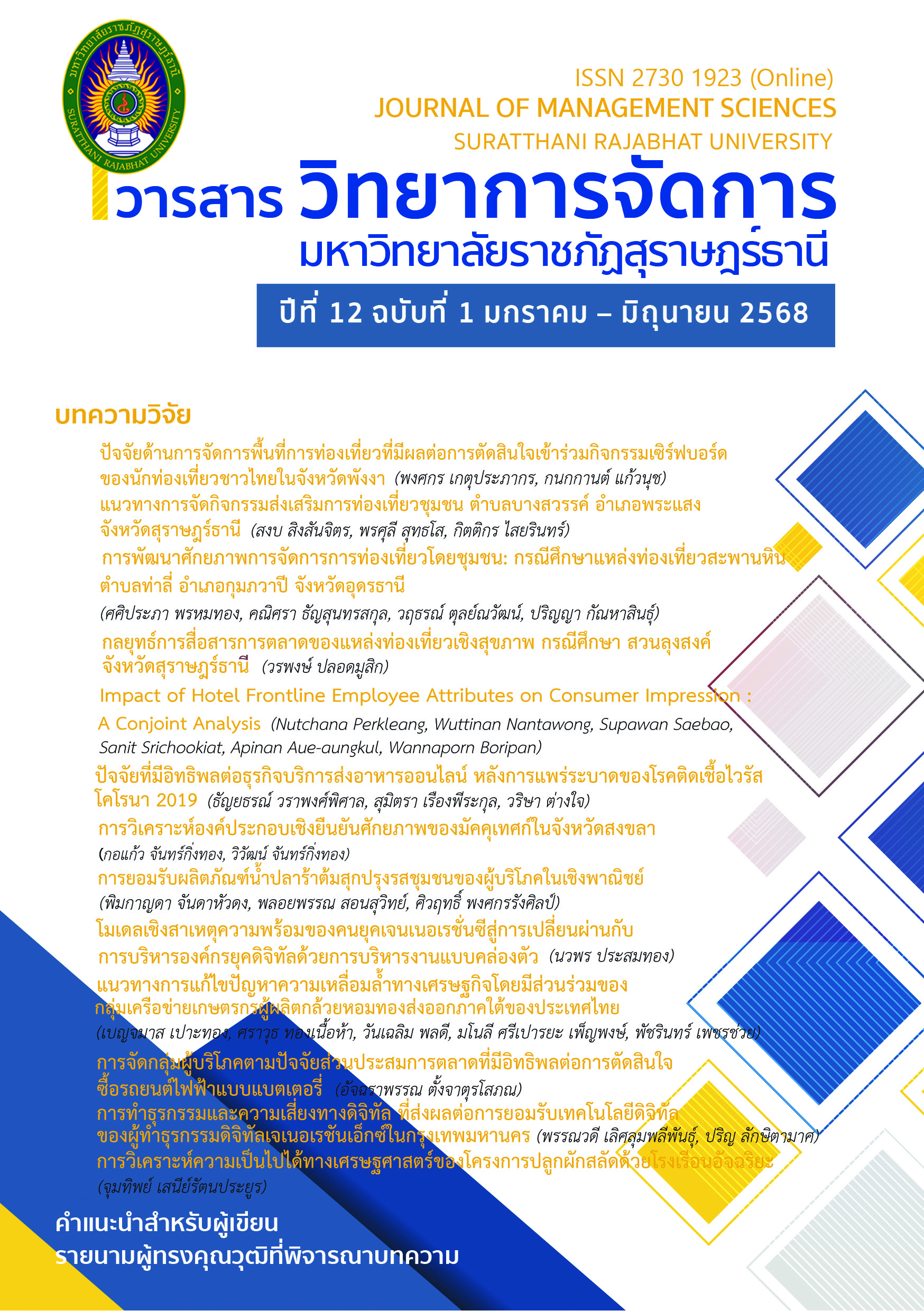
คุณลักษณะพนักงานบริการส่วนหน้าในโรงแรมที่ส่งผลต่อความประทับใจของผู้บริโภค: การวิเคราะห์คอนจอยท์
Article Sidebar
Main Article Content
บทคัดย่อ
การบริการของพนักงานส่วนหน้าในโรงแรม ถือว่ามีความสำคัญมากในการสร้างความประทับใจแรกให้กับลูกค้า การวิจัยนี้มีวัตถุประสงค์เพื่อศึกษาคุณลักษณะของพนักงานบริการส่วนหน้าในโรงแรม ที่ส่งผลต่อความประทับใจของผู้บริโภคด้วยเทคนิคคอนจอยท์ การวิเคราะห์ดังกล่าวถูกใช้ในการทำความเข้าใจกระบวนการตัดสินใจที่ซับซ้อนของผู้บริโภค โดยการจำลองสินค้าหรือบริการตามคุณลักษณะย่อย และประเมินความชอบในแต่ละแบบจำลองดังกล่าว เป็นเทคนิคช่วยค้นหาความสำคัญของคุณลักษณะที่ซ่อนอยู่ในสินค้าหรือบริการได้ดี โดยตัวแปรคุณลักษณะของพนักงานส่วนหน้า ประกอบด้วย รอยยิ้ม น้ำเสียง ความเรียบร้อยของการแต่งกายและบุคลิกภาพภายนอก การกระตือรือร้นในการให้บริการ และการกล่าวทักทาย ข้อคำถามสร้างจากการผสมตัวแปรคุณลักษณะการให้บริการ ออกมาเป็น 8 รูปแบบ ด้วยวิธี Orthogonal Design นำเสนอในรูปแบบคลิปวิดีโอ เมื่อผู้ตอบเห็นตัวแบบ จะต้องให้คะแนนความประทับใจในตัวแบบดังกล่าว จนครบ 8 ตัวแบบ ดังนั้น แบบสอบถามจึงอยู่ในรูปแบบ Online เพื่อให้สามารถบรรจุคลิปวิดีโอ และตอบคำถามได้ งานวิจัยนี้ใช้วิธีการเลือกตัวอย่างตามสะดวก มีจำนวนผู้ตอบแบบสอบถาม 400 คน ส่วนใหญ่เป็นเพศหญิง มีอายุระหว่าง 21-30 ปี สถาพสภาพ โสด รายได้เฉลี่ยต่อเดือนอยู่ระหว่าง 10,001-20,000 บาท ผลการวิเคราะห์อิทธิพลเรียงลำดับจากมากไปน้อย พบว่า รอยยิ้มของพนักงานส่วนหน้ามีอิทธิพลต่อความประทับใจในการให้บริการมากที่สุด รองลงมา คือ การกล่าวทักทายลูกค้าก่อนและหลังบริการ น้ำเสียง การแต่งกาย และความกระตือรือร้นในการให้บริการ อย่างไรก็ตาม คุณลักษณะดังกล่าวมีความสำคัญเชิงสัมพัทธ์ในระดับที่ใกล้เคียงกัน กล่าวคือ แต่ละคุณลักษณะล้วนมีความสำคัญที่จะสร้างความประทับใจทั้งสิ้น การนำผลการวิจัยไปใช้อาจมีข้อจำกัดบางประการ อาทิ เทคนิคคอนจอยท์สามารถหาตอบความสำคัญเชิงเปรียบเทียบระหว่างตัวแปรที่อยู่ในการศึกษาได้ดี แต่ไม่สามารถให้คำตอบความสำคัญเชิงสัมบูรณ์ งานวิจัยนี้แตกต่างจากงานวิจัยในอดีตในเชิงวิธีการวิจัยซึ่งให้ความเสมือนจริงกับผู้ตอบ รวมถึงตัวแปรต้นที่มีความแตกต่างจากงานวิจัยในอดีต
Article Details

อนุญาตภายใต้เงื่อนไข Creative Commons Attribution-NonCommercial-NoDerivatives 4.0 International License.
เอกสารอ้างอิง
Baker, J., Grewal, D., & Parasuraman, A. (1994). The influence of store environment on quality inferences and store image. Journal of the academy of marketing science, 22(4), 328-339. https://doi.org/10.1177/0092070394224002.
Baker, J., Levy, M., & Grewal, D. (1992). An experimental approach to making retail store environmental decisions. Journal of retailing, 68(4), 445-460.
Bitner, M.J. (1992), “Servicescapes: the impact of the physical environment surround customers and employees”, Journal of Marketing, 56(2), 57-71. https://doi.org/10.1177/002224299205600205.
Boonhaow, P. (2020, November 25). The benefits of smiling. Health scientist, Faculty of Thai Traditional Medicine, Prince of Songkla University. https://www.ttmed.psu.ac.th/th/blog/268?fbclid=IwAR1MOhoJkucSWay0_oArwhvg20jhpiDezUfu76qvnU_HinZ-wLr2RHOZEI.
Countryman, C. C., & Jang, S. (2006). The effects of atmospheric elements on customer impression: the case of hotel lobbies. International Journal of Contemporary Hospitality Management, 18(7), 534-545. https://doi.org/10.1108/09596110610702968.
Decharin, P. (2021, July 17). How can enthusiastic employees bring success to the organization?. Slow Strategy. https://url.in.th/JobdH.
Easterling, C. R., Leslie, J. E., & Jones, M. A. (1992). Perceived importance and usage of dress codes among organizations that market professional services. Public Personnel Management, 21(2), 211-219. https://doi.org/10.1177/009102609202100208.
Gabbott, M., & Hogg, G. (2001). The role of non-verbal communication in service encounters: A conceptual framework. Journal of Marketing Management, 17(1-2), 5-26. https://doi.org/10.1362/0267257012571401.
Grandey, A.A. & Gabriel, A.S. (2015), “Emotional labor at a crossroads: where do we go from here?”, Annual Review of Organizational Psychology and Organizational Behavior, 2(1), 23-349. https://doi.org/10.1146/annurev-orgpsych-032414-111400.
Hair, J. F., Black, W. C., Babin, B. J., Anderson, R. E., & Tatham, R. L. (2014). Multivariate data analysis (7th ed.). Pearson Education Limited.
Högnäs, S. (2015). The importance of the first impression in hotel customer service. Vaasa University of Applied Sciences.
Itani, O. S., Jaramillo, F., & Paesbrugghe, B. (2020). Between a rock and a hard place: Seizing the opportunity of demanding customers by means of frontline service behaviors. Journal of Retailing and Consumer Services, 53, 101978.
Knutson, B.J. (1988), “Ten laws of customer satisfaction”, Cornell Hotel and Restaurant Administration Quarterly, 29(3), 14-17. https://doi.org/10.1177/001088048802900309.
Lunkam, P. (2022, November 28). The outlook for the hotel industry in Thailand 2022-2024. https://www.krungsri.com/en/research/industry/industry-outlook/services/hotels/io/hotel-2022-2024.
Mattila, A. S., Grandey, A. A., & Fisk, G. M. (2003). The interplay of gender and affective tone in service encounter satisfaction. Journal of Service Research, 6(2), 136-143. https://doi.org/10.1177/1094670503257043.
Mayers, A. (2013). Introduction to Statistics and SPSS in Psychology. Pearson Education.
Nanthapaiboon, J. (2008). Service psychology. Se-ed education.
Nickson, D., Warhurst, C., & Dutton, E. (2005). The importance of attitude and appearance in the service encounter in retail and hospitality. Managing Service Quality: An International Journal, 15(2), 195-208. https://doi.org/10.1108/09604520510585370.
Nwulu, C. S., & Ateke, B. W. (2018). Frontline employee competence development and responsiveness of quick service restaurants. European Journal of Social Sciences Studies, 2(10). 1-18.
Orme, B. K. (2010). Getting started with conjoint analysis: strategies for product design and pricing research (2nd ed.). Research Publisher LLC.
Otterbring, T. (2017). Smile for a while: the effect of employee-displayed smiling on customer affect and satisfaction. Journal of Service Management, 28(2), 284-304. https://doi.org/10.1108/JOSM-11-2015-0372.
Rao, V. R. (2014). Applied Conjoint Analysis. Springer-Verlag.
Rhee, H. T., & Yang, S.-B. (2015). How does hotel attribute importance vary among different travelers? An exploratory case study based on a conjoint analysis. Electronic Markets, 25(3), 211–226. https://doi.org/10.1007/s12525-014-0161-y.
Sawaengsrichara, P. (2019, July 28). Theory of 3 factors to create motivation and enthusiasm at work. 3-Factor Theory [Sirota]. https://drpiyanan.com/2019/07/28/3-factor-theory-sirota/?fbclid=IwAR2j_bzy-pywJqiuCHC3s-ut_NU02zS-wTHSD_Vfl30Rh7SN0-jcThQLvfc.
Sirijanusorn, A. (2021, November 21). The outlook for hotel industry in Thailand 2022-2024. https://www.bangkokbiznews.com/business/972631.
Srichookiat, S., & Jindabot, T. (2018). Salient environmental attributes and their value for small independent grocers. Journal of Consumer Marketing, 35(5), 465-479. https://doi.org/10.1108/JCM-03-2017-2135.
Thai Hotels Association. (2011). Thailand Hotel Standard Foundation. https://www.thaihotels.org/16679475/thailand-hotel-standard-foundation.
Thai Hotels Association. (2024). Hotel Business Operator Sentiment Index. Thai Hotels Association and Bank of Thailand.
