
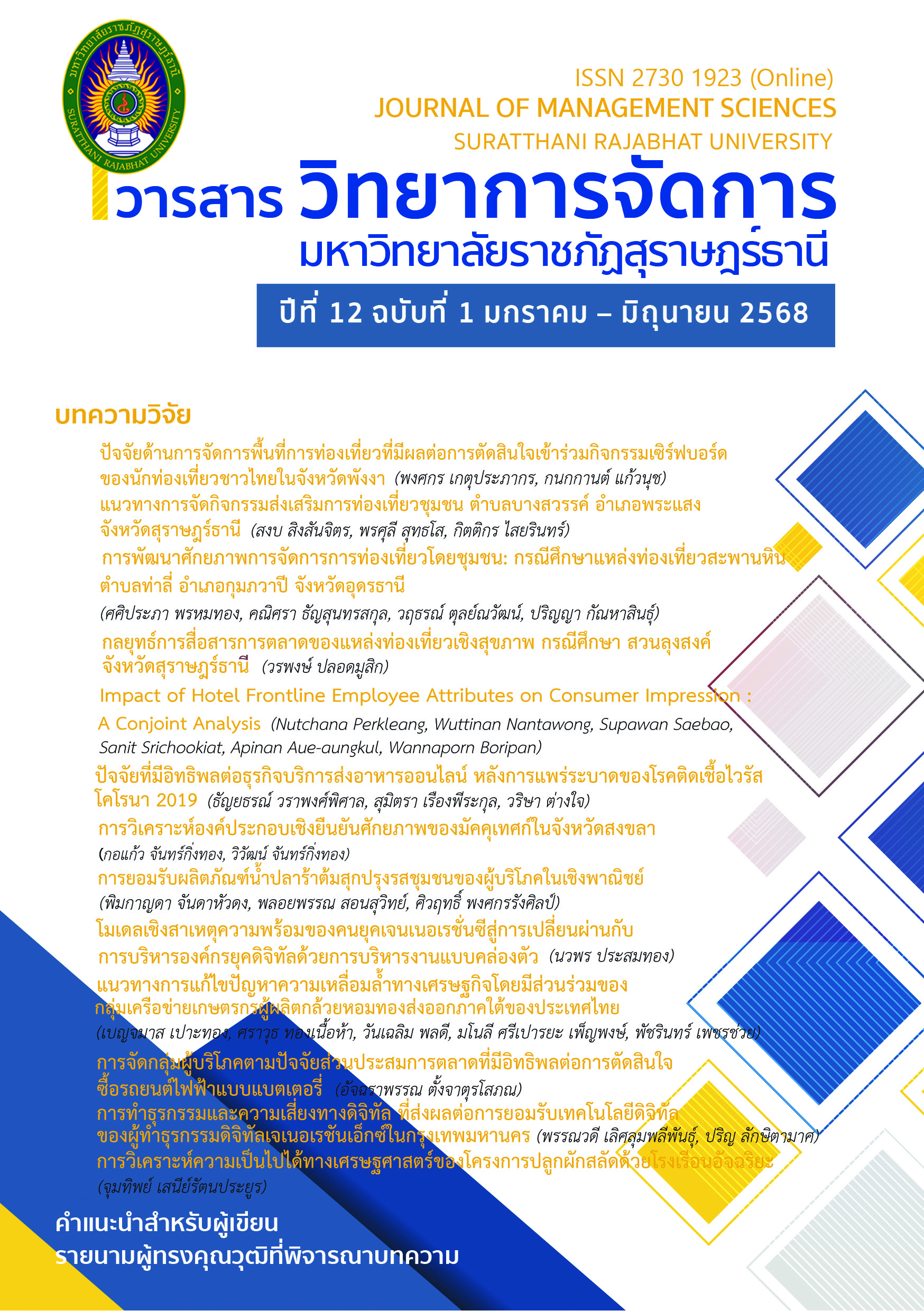
A Causal Model for the Readiness of Generation Z People to Transition to Digital Organizational Management with Agile Management
Article Sidebar
Main Article Content
Abstract
Generation Z plays a crucial role in modern organizational management. This research studied the readiness level of Generation Z individuals, comparing age and educational level with their knowledge and understanding toward the transition to digital-era organizational management through agile management practices, and tested the model consistency of these variables. The population consisted of people aged 13-23 years. The sample size of 400 participants was calculated using the Yamane formula. Cluster random sampling was employed as the sampling method. The research instruments included questionnaires. The statistics used were frequency, percentage, mean, standard deviation, F-test, Scheffe method, and model consistency was checked with SEM. The results of the study are as follows: For H1, the result of the analysis comparing the level of knowledge and understanding of Generation Z people towards the transition to digital organization management with agile management, comparing the age variable using the F-test, showed that the Scheffe pairwise mean test was statistically significant at the .05 level. The difference was found in one aspect, which was the environment aspect, with a value of 0.015. For H2, the results of the comparative analysis of the level of knowledge and understanding of Generation Z people towards the transition to digital organization management with agile management, comparing the education level variable using the F-test showed that the Scheffe pairwise mean test results were different in two aspects: organizational culture with a value of 0.001 and the leadership aspect with a value of 0.015, which were statistically significant at the .05 level. For Hypothesis 3, it was found that the structural equation model developed by the researcher was consistent with the empirical data from the hypotheses set. The p-value was 4.274 and the CMIN was 0.000, while the CMIN/DF was 0, which is less than 2.
Article Details

This work is licensed under a Creative Commons Attribution-NonCommercial-NoDerivatives 4.0 International License.
References
Addecco Group. (2015, March 12). New Organizatuon. https://www.annualreports.com.
Addor, M. L. (2011). Generation Z: What is the future of stakeholder engagement?. Institute for EMERGING ISSUES - NC State University.
Aumnat, W. (2017, December 25). Change Management. https://www.hrcenter.co.th.
Bunyaphitak, P. (2015). Thesis on quality of working life and maintaining organizational commitment of personnel of different ages, a case study of personnel in the Office of the Permanent Secretary, Ministry of Interior [Unpublished master’s thesis]. Chulalongkorn University.
Charoonnimmarn, T. (2023). The innovative strategy of service marketing influence customer decision making on use of hotel business in Chumphon province. Santapol College Academic Journal, 9(1), 106-118.
Damnuthai, K. (2023). Study of digital competence of personnel under the office chief Justice, Region 4. Journal of Roi Kaensarn Academi, 8(2), 193-208.
Denning, S. (2018). The age of agile: how smart companies are transforming the way work gets don. MACOM.
Department of provincial administration. (2023, January 18). Information about Thai people in 2023. https://stat.bora.dopa.go.th/new_stat/webPage/statByAge.php.
Getting smart staff. (2013 September 21). Meet generation Z, Revisited. https://www.gettingsmart.com/2013/09/21/meet-generation-z-2/.
Hadee, W. (2023). “ Components of organizational communication details of university students in the digital age: A study between universities in public centers and public universities”. Journal of Technical Education Development, 35(126), 32-44.
Hair J.F., Black W.C., Babin B.J., Anderson R.E. & Tatham R.L. (2006). Multivariate data analysis (6th ed.). Pearson Prentice Hall.
Hair, J., & Alamer, A. (2022). Partial Least Squares Structural Equation Modeling (PLS-SEM) in second language and education research: Guidelines using an applied example. Research Methods in Applied Linguistics, 1(3), 100027.
Hair, J.F., Black, W.C., Babin, B.J. & Anderson, R.E. (2010). Multivariate Data Analysis (7th ed.). Pearson.
Half, R. (2015, August 18). Generation Z: here’s how to turn your career expectations into realty. https://www.roberthalf.com/us/en/insights/landing-job/generation-z-heres-how-to-turn-your-career-expectations-into-reality.
Hess, T. (2016). Options for formulating a digital transformation strategy. MIS Quarterly Executive, 15(2), 123-139.
Kane, G. C. (2015). Strategy, not technology, drives digital transformation. MIT Sloan Management Review and Deloitte University Press.
Kengkarnchang, K. (2013). Generation Y and a New Challenge in a Human Resources Administration. Journal of Social Sciences and Liberal Arts, 2(1), 17-25.
Kongkaew, J. (2016). Gen Z invades: What type of organizations will be a good match. Bangkok Biz News, 29(10321), 11-12.
Lloyd Baird. (2008). leadership skills. ExpernetBooks.
Luengsrichai, A. & Petchroj, L. (2021). The learning organization in the digital era according to the opinions of personnel under vocational education in Pathumthani Province. Journal of Humanities and Social Sciences Rajapruek University, 7(2), 170-186.
Matt, C., Hess, T., & Benlian, A. (2015). Digital transformation strategies. Business & Information Systems Engineering, 57(5), 339-343.
Miller, J. (2018, October 30). A 16-year-old explains 10 things you need to know about generation Z. https://www.shrm.org/topics-tools/news/hr-magazine/16-year-old-explains-10-things-need-to-know-generation-z.
Morakanyane, R., Grace, A. A., & O'Reilly, P. (2017). Conceptualizing digital transformation in business organizations: A systematic review of literature. In BLED Proceedings (pp.426-444). n.p..
National Science and Technology Development Agency. (2023, July 17). Digital transformation with Digital worker and Digital workforce. https://www.nstda.or.th/.
Ngadkratok, S. (2011, April 23). Structural model analysis techniques. http://rlc.nrct.go.th/.
Numnon, T. (2020). Digital transformation: business strategy for the new era. SP Platt.
Numnon, T. (2023, June 25). Digital transformation in higher education. https://www.bangkokbiznews.com/columnist/1012038.
Office of the Spokesperson, Secretariat of the Prime Minister. (2023). Thailand 4.0. Journal of the Secretariat of the Office of the Prime Minister, 33, 1-44.
Oranop Na Ayutthaya, C. (2022). Inter-generational digital communication and value change toward digital citizenship. National Research Council of Thailand (NRCT).
Orawan, N. (2013, September 11). Change management process and knowledge management. https://www.stou.ac.th/Schools/Shs/booklet/book56_4/km.html.
Osmundsen, K., Iden, J., & Bendik B. (2018). Digital transformation: drivers, success, factors, and implications. In The 12th Mediterranean Conference on Information Systems (MCIS).
Osmundsen, K., Iden, J., & Bendik B. (2018). Digital Transformation: Drivers, Success Factors, and Implications. In MCIS 2018 Proceedings. The 12th Mediterranean Conference on Information Systems (MCIS). https://aisel.aisnet.org/mcis2018/37.
Panthong, S. (2020, July 9-10). Strategies for managing work styles for development into a new era organization. In The 12th National Academic Conference. Nakhon Pathom Rajabhat University.
Phakamach, P., Panjarattanakorn, D, & Onsampant, S. (2023). “Conceptualization and development of digital leadership to drive corporate digital transformation for sustainable success”. International Journal of Educational Communications and Technology (IJECT), 3(2), 30–42.
Philip, K., Hermawan, K., & Iwan, S. (2021). Marketing 5.0: Technology for Humanity. John Wiley & Sons Inc.
Prasatthong, C., Pancharoen, C. (2021). Readiness for change working age people Bangkok in the era of digital Transformation. Suthiparitat Journal, 35(2), 94-111.
Prasomtong, N. (2023). Readiness of Generation Z for the transformation to digital organization management with Agile Management. Nakhonsawan Rajabhat University.
Raengsungnoen, K. (2011). Factor analysis using SPSS and AMOS for research. SE-ED Education.
Rangsimantasiri, P., & Muthitacharoen, P. (2021). Communication strategies under the Agile working concept, Case study: Mirai Department Bank of Ayudhya Public Company Limited. Media and Communication Inquiry, 3(12), 57–71.
Reynolds, R. (2016). Defining, designing for, and measuring “digital literacy” development in learners: A proposed framework. Educational Technology Research & Development, 64(4), 735–762.
Sincharu, T. (2017). Research and statistical data analysis with SPSS and AMOS. Business R&D.
Suwattanawanich, N. (2019). Guidelines for using Agile (Agile) in organizations to be successful of one bank [Unpublished master’s thesis]. Mahidol University.
Thanabadithamcharee, D. (2019, June 14). Digital transformation and enterprise architecture. https://www.sit.kmutt.ac.th/wpcontent/uploads/2019/09/001_DX_Part1_Intro_v1082_DT.pdf.
Thanyarattakul, T., & Wirunhakarun, N. (2018). Digital Transformation Compass. SE-Ed.
Thongsuk, K. (2019). Work efficiency resulting from knowledge and understanding of being a digital organization according to policy digital government case study of the office of the civil service commission. Journal of the dual degree program in public administration and business administration, 2(2), 39-49.
Wanichabancha, K. (2014). SEM structural equation analysis with AMOS. Chula Book Center.
Wilawan, U. (2013). The Study of Change Management of Government’s Secondary School Administrator in The Secondary Educational Area Office 2 [Unpublished master’s thesis]. Srinakharinwirot University.
William, S., Neil, H. (1991), Generations: The History of America’s Future 1584 to 2069. Harper Perennial.
Yusuf, Y. Y., Sarhadi, M. & Gunasekaran, A. (1999). Agile manufacturing: The drivers, concepts and attributes. International Journal of Production Economics, 62, 33-43.
