
Sri Maha Uma Devi's in Sri Lalita Sahasaranama under the Three Dimensions of Studying Folklore
Article Sidebar
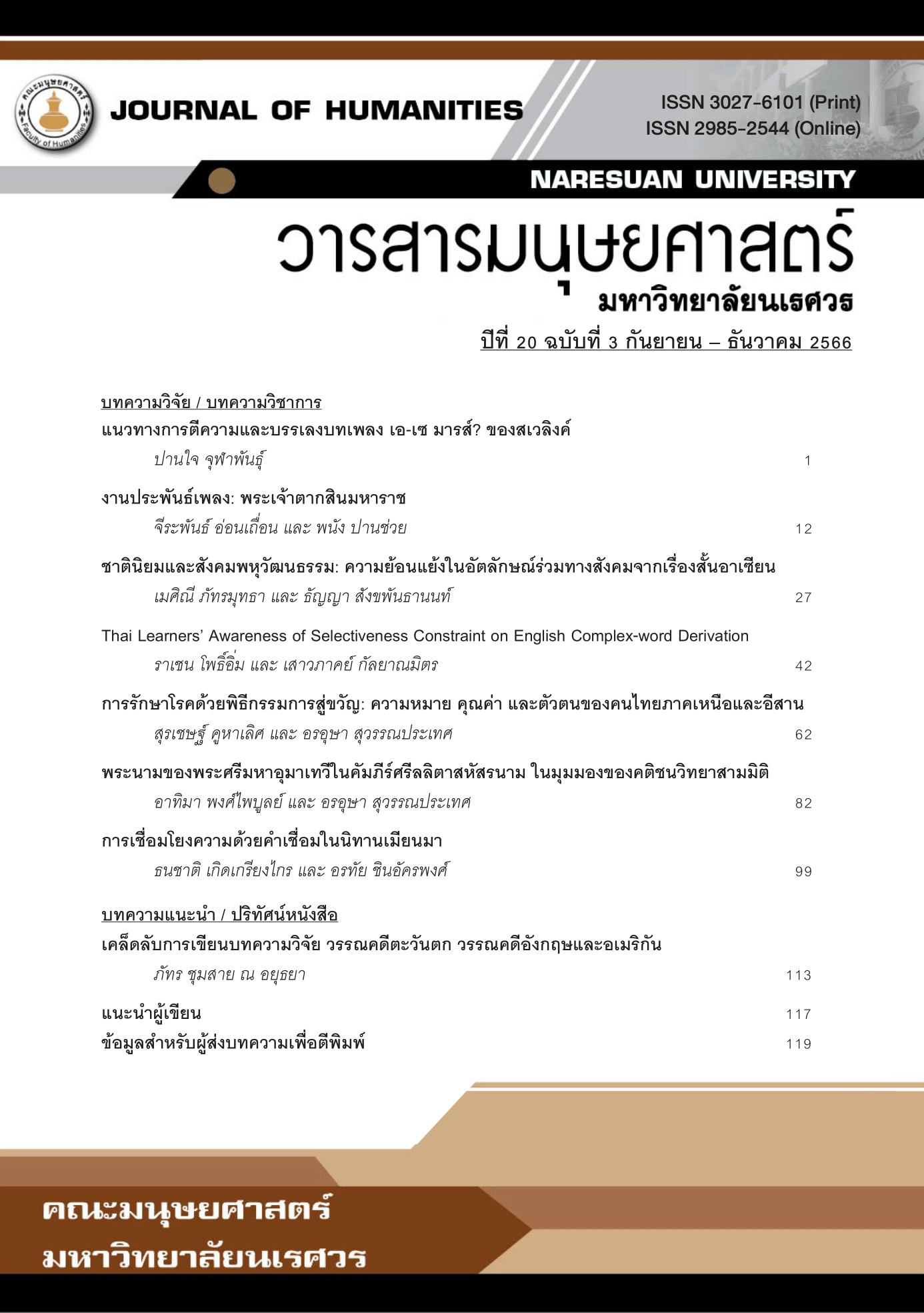
Main Article Content
Abstract
This research article aims to study the address term of a Sri Maha Uma Devi in Sri Lalita Sahasaranama under the three dimensions of studying folklore. It is qualitative research mainly done on the existing document. The result found that Sri Maha Uma Devi has various outstanding characteristics wide ranging from name, appearance and personality. She can appear in many forms in Hindu mythologies. She involves in many events and things at all levels. Thus there are over 1,000 address terms that appear in Sri Lalita Sahasaranama. The name alone has inspired the decipher and collect them in a mantra. It is used in chanting for contemplation, meditation and building mantra power. According to Hindu belief, it can be used as a vehicle for attaining rebellion. In addition, the collection explicitly reveals the true self of Sri Maha Uma Devi, including; the essence of being Maha Devi in both physical and abstract; the role as a wife and Shakti of lord Shiva; the act of mother earth; the relation with the others god; and the personal favorite of Sri Maha Uma Devi.
The studies of the meaning of Sri Maha Uma Devi can link to the idea of the three dimensions in studying folklore: the dimension of individuality, the dimension of social and cultural, and the dimension of myth. It gives a more understanding of the phenomenon of awe Sri Maha Uma Devi. Most of all, every name and tale has provided a lesson learned for life. It has a role in being a restraint and cultivating the power of the mind, having willpower and a straight act to maintain the goodness of the devotee. Overtly, it is a vehicle for the believer to do better for society.
Article Details

This work is licensed under a Creative Commons Attribution-NonCommercial-NoDerivatives 4.0 International License.
ข้อความรู้ใดๆ ตลอดจนข้อคิดเห็นใดๆ เป็นของผู้เขียนแต่ละท่านโดยเฉพาะ คณะมนุษยศาสตร์ มหาวิทยาลัยนเรศวร และกองบรรณาธิการวารสารมนุษยศาสตร์ฯ ไม่จำเป็นต้องเห็นพ้องด้วย
References
กรมศิลปากร. (2558). เทวสตรี: คติพุทธ พราหมณ์ และความเชื่อในประเทศไทย. กรุงเทพฯ: กรมศิลปากร.
กิ่งแก้ว อัตถากร. (2558ก). Pleroma เพลอโรมา. พิษณุโลก: สุรสีห์กราฟฟิค.
กิ่งแก้ว อัตถากร. (2558ข). บางเรื่องจากข้อคิดงานเขียนประกอบการเรียนการสอนวิชาคติชนวิทยาของ กิ่งแก้ว อัตถากร. มปท.
แคทรียา อังทองกำเนิด. (2557). อาร์คีไทพ์อวตาร : ปรากฏการณ์ทางเทพปกรณัมในศาสนาฮินดูและพระพุทธศาสนา (วิทยานิพนธ์ศิลปศาสตรดุษฎีบัณฑิต). พิษณุโลก: มหาวิทยาลัยนเรศวร.
แคมพ์เบลล์ โจเซฟ, และมอยเยอร์ส บิลล์. (2551). พลานุภาพแห่งเทพปกรณัม [The Power of Myth] (บารนี บุญทรง, ผู้แปล) (พิมพ์ครั้งที่ 2). กรุงเทพฯ: อมรินทร์พริ้นติ้งแอนด์พับลิชชิ่ง. (ต้นฉบับพิมพ์ปี ค.ศ. 1991).
ประจักษ์ สายแสง, และเจือง ถิ หั่ง. (2560). ทวิภาวะ. วารสารมนุษยศาสตร์และสังคมศาสตร์ มหาวิทยาลัยราชภัฏสุราษฎร์ธานี, 9(1), 1-36.
ประยูร อุลุชาฎะ [พลูหลวง]. (2530). เทวโลก. กรุงเทพฯ: เมืองโบราณ.
ศุภมาศ เชยศักดิ์. (2552). เทวีมาหาตมยะ : การบูชาสรรเสริญเทวีในวรรณคดีสันสกฤต (วิทยานิพนธ์อักษรศาสตรมหาบัณฑิต). กรุงเทพฯ: จุฬาลงกรณ์มหาวิทยาลัย.
สุภัทรดิศ ดิศสกุล, หม่อมเจ้า. (2547). ศาสนาพราหมณ์ในอาณาจักรขอม. กรุงเทพฯ: มติชน.
อมเรศ ศิริวัฒน์. (2564). เทวีมาหาตมยะ พระเกียรติภูมิอันยิ่งใหญ่แห่งพระเทวี. เชียงใหม่: ซิลค์เวอร์ม.
อรอุษา สุวรรณประเทศ. (2555). กว้างกว่าโลก เหนือจักรวาล ขอบข่ายอันไพศาลของวิชาคติชนวิทยา. วิทยาจารย์, 111(3), 25-28.
อุปนิษัท: คัมภีร์เพื่อความสงบศานติ. (2553). (สวามี ประภาวนันทะ, และเฟดเดอริค แมนเชสเตอร์; กิ่งแก้ว อัตถากร, ผู้แปล). กรุงเทพฯ: อมรินทร์พริ้นติ้งแอนด์พับลิชชิ่ง. (ต้นฉบับพิมพ์ปี ค.ศ. 1957).
ฮักสลีย์ แอลดัส. (2556). ปรัชญาอมตะ. (กิ่งแก้ว อัตถากร, ผู้แปล). กรุงเทพฯ: อมรินทร์พริ้นติ้งแอนด์พับลิชชิ่ง. (ต้นฉบับพิมพ์ปี ค.ศ. 1944, 1945)
Bae, J. H. (2001). In a world of gods and goddesses: The mystic art of indra sharma. San Rafael, CA: Mandala Publishing.
Chinnaiyan, K. M. (2017). Shakti rising: Embracing shadow and light on the goddess path to wholeness. Oakland: Non-Duality Press.
Dehejia, H. (1999). Parvati: Goddess of love. Singapore: Maping.
Dharma, K. (2004). Beauty, power and grace: The many faces of the goddess. San Rafael, CA: Mandala Publishing.
Ellik, E. C. (2015). The shakti coloring book: Goddesses, mandalas, and the power of sacred geometry. Boulder: Sounds True.
Harding, E. U. (1993). Kali: The black goddess of dakshineswar. Berwick: Nicolas – Hays.
Huyler, S. P. (1999). Meeting god: Elements of Hindu devotion. New Haven, CT: Yale University Press.
Menon, T. V. N. (2011). The thousand names of the divine mother: Sri Lalita Sahasranama. (M.N. Namboodiri, Trans.) (9th ed.). Kerala, India: Mata Amritanandamayi Mission Trust. (Original work published 1996).
Zimmer, H. (1992). Myths and symbols in Indian art and cilization. Princeton, NJ: Princeton University Press.
