
Interpretation and Performance Practice of Est-ce Mars? by Sweelinck
Article Sidebar
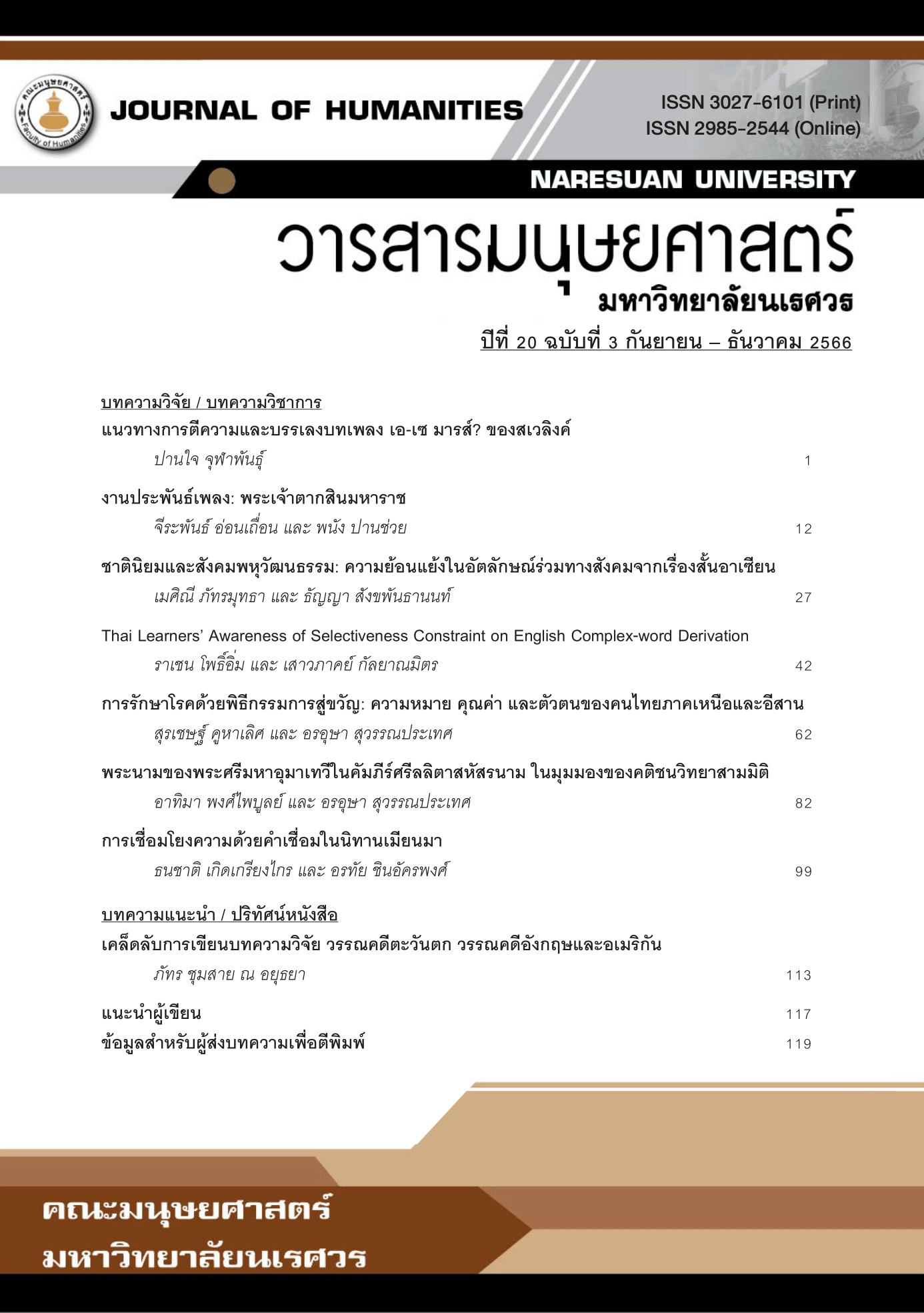
Main Article Content
Abstract
This academic article discusses interpretation and performance practice of Est-ce Mars? by Jan Sweelinck (1562-1621). The composition from the late Renaissance period was designed to perform on a harpsichord rather than a modern piano. Contents in this article include substantial performance practice adjusted for modern piano performance. Pianists can study, explore, and accommodate these ideas with their own discretion and capability.
Article Details

This work is licensed under a Creative Commons Attribution-NonCommercial-NoDerivatives 4.0 International License.
ข้อความรู้ใดๆ ตลอดจนข้อคิดเห็นใดๆ เป็นของผู้เขียนแต่ละท่านโดยเฉพาะ คณะมนุษยศาสตร์ มหาวิทยาลัยนเรศวร และกองบรรณาธิการวารสารมนุษยศาสตร์ฯ ไม่จำเป็นต้องเห็นพ้องด้วย
References
Gillespie, J. (1972). Five centuries of keyboard music: A historical survey of music for harpsichord and piano. New York: Dover.
MIT OpenCourseWare. (2016). Harpsichord demonstration [video]. Retrieved from https://www.youtube.com/watch?v=itLh_yWsOX0
Slonimsky, N. (Ed.). (1991). Baker's biographical dictionary of musicians (8th ed.). New York: Schirmer Books.
Smith, D. J. (1998). Sweelinck’s keyboard music. Early Music, 26(1), 143-145. Retrieved from http://www.jstor.org/stable/3128558
Sweelinck, J. P. (1957). Est-ce Mars. New York: Peters.
Westrop, S. (2003). Performance Note on Jan Sweelinck: Keyboard Music Performed by Christopher Herrick (Organ) for Hyperion Records. Retrieved from https://www.hyperion-records.co.uk/dc.asp?dc=D_CDA67421/2
