
Chinese Cultural Perception in the Chinese Textbook Everyday Chinese
Article Sidebar
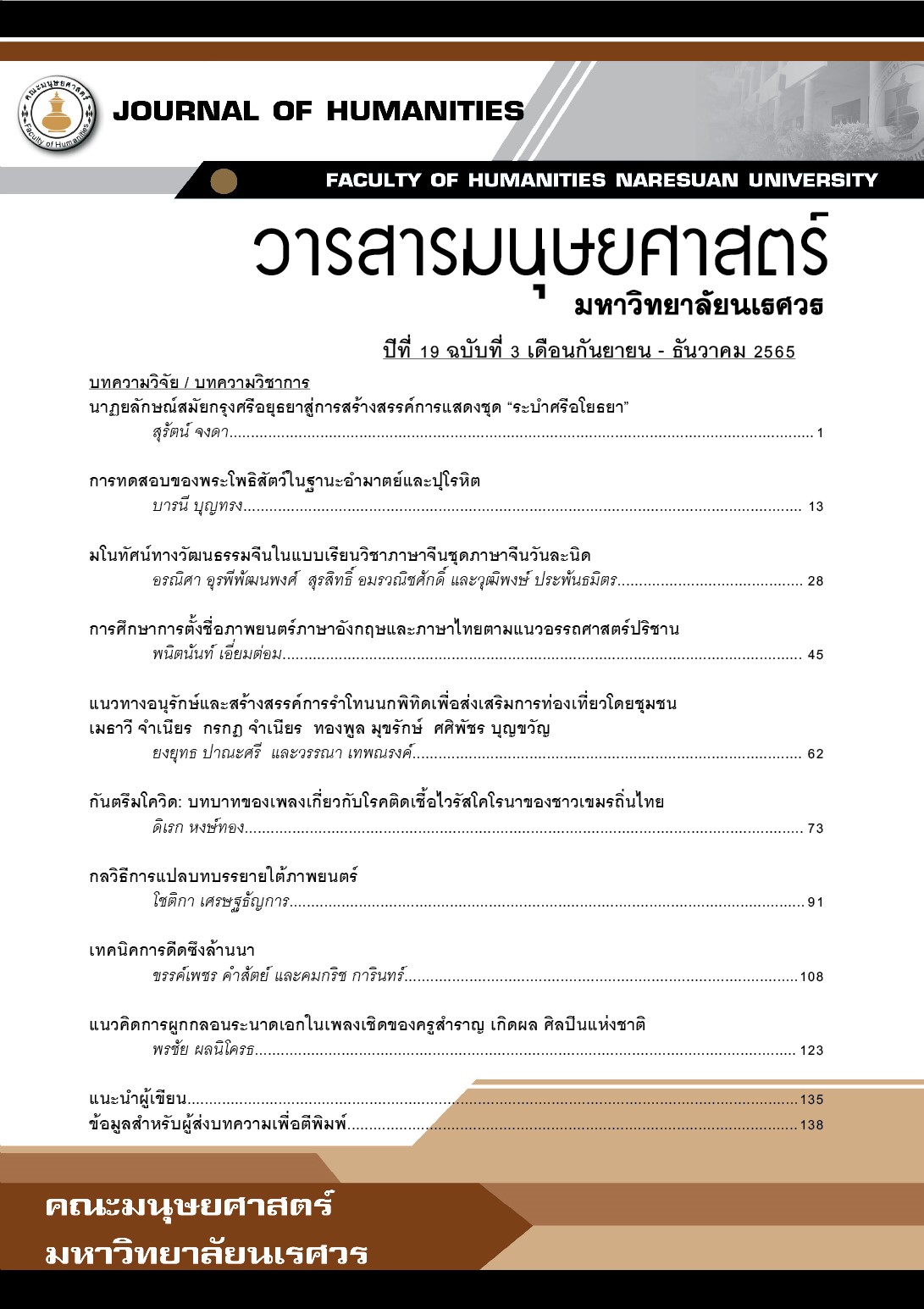
Main Article Content
Abstract
Textbooks are generally viewed as reliable education tool. Besides, they function as communication power tool which create certain kinds of perception to learners’ idea. The purpose of this research is to collect perception of Chinese culture through Chinese textbook, Everyday Chinese, and to analyze the influence over the Thai learners through its contents and texts about Chinese culture’s conceptualization. The result has shown that the Chinese textbook, Everyday Chinese, exposes the perception of Chinese cultural regulations towards the Thai learners in 3 aspects which are the following: achievement culture, informational culture, and behavioral culture. Also, the result reflects that the textbook does not only prioritize academic knowledge about Chinese language, but also subtly consist of soft power as a knowledge base owner giving Chinese culture’s perception towards the Thai learners.
Article Details

This work is licensed under a Creative Commons Attribution-NonCommercial-NoDerivatives 4.0 International License.
ข้อความรู้ใดๆ ตลอดจนข้อคิดเห็นใดๆ เป็นของผู้เขียนแต่ละท่านโดยเฉพาะ คณะมนุษยศาสตร์ มหาวิทยาลัยนเรศวร และกองบรรณาธิการวารสารมนุษยศาสตร์ฯ ไม่จำเป็นต้องเห็นพ้องด้วย
References
กระทรวงศึกษาธิการ. (2556). ตัวชี้วัดและสาระการเรียนรู้ภาษาจีนตามหลักสูตรแกนกลางการศึกษาขั้นพื้นฐาน พุทธศักราช 2551 กลุ่มสาระการเรียนรู้ภาษาต่างประเทศ. กรุงเทพฯ: โรงพิมพ์ สกสค.ลาดพร้าว.
นิธิ เอียวศรีวงศ์. (2557). ชาติไทย เมืองไทย แบบเรียน และอนุสาวรีย์ (พิมพ์ครั้งที่ 3). กรุงเทพฯ: มติชน.
พงศกร เมธีธรรม. (2560). ภาษาอังกฤษ: อำนาจ และการครอบงำ. พิษณุโลก: สำนักพิมพ์มหาวิทยาลัยนเรศวร.
พิมพาพร พึ่งพระ. (2554). การวิเคราะห์เนื้อหาทางภาษาและวัฒนธรรมที่ปรากฏในสื่อการเรียนรู้วิชาภาษาอังกฤษ ชั้นมัธยมศึกษาปีที่ 4 (วิทยานิพนธ์ศิลปศาสตรมหาบัณฑิต). กรุงเทพฯ: บัณฑิตวิทยาลัย มหาวิทยาลัยศรีนครินทรวิโรฒ.
ศรัญญา วาหะรักษ์. (2557). การนำเสนอวัฒนธรรมในหนังสือเรียนภาษาอังกฤษชั้นมัธยมศึกษาตอนปลายและการรับรู้ของครู (วิทยานิพนธ์ศิลปศาสตรมหาบัณฑิต). สงขลา: บัณฑิตวิทยาลัย มหาวิทยาลัยสงขลานครินทร์.
Hammerly, H. (1982). Synthesis in Second Language Teaching: An Introduction to Linguistics. Blaine, WA: Second Language Publications.
Walker, G. (2000). Performed Culture: Learning to Participate in Another Culture. In R. D. Lambert & E. Shohamy (eds), Language Policy and Pedagogy: Essays in Honor of Richard Lambert. Amsterdam: John Benjamins Publishing Company.
Zeng, M. (2019). The Comparison between the Teaching Materials of “Everyday Chinese” and the New HSK Examination Outline (Master’s thesis). Chongqing: Sichuan International Studies University. [in Chinese]
Zhang, J. (2017). Teaching Animation Game Design of “Everyday Chinese”——Textbook for Thailand Middle School (Master’s thesis). Harbin: Harbin Normal University. [in Chinese]
Zheng, Y. (2011). Behavioral Culture in the Chinese Language Classroom (Master’s thesis). Columbus, OH: The Ohio State University.
Zhu, R., & Feng, L. (2016). Everyday Chinese 1. Beijing: Beijing Language and Culture University Press. [in Chinese]
Zhu, R., & Feng, L. (2016). Everyday Chinese 2. Beijing: Beijing Language and Culture University Press. [in Chinese]
Zhu, R., & Feng, L. (2016). Everyday Chinese 3. Beijing: Beijing Language and Culture University Press. [in Chinese]
Zhu, R., & Feng, L. (2016). Everyday Chinese 4. Beijing: Beijing Language and Culture University Press. [in Chinese]
Zhu, R., & Feng, L. (2018). Everyday Chinese 5. Beijing: Beijing Language and Culture University Press. [in Chinese]
Zhu, R., & Feng, L. (2018). Everyday Chinese 6. Beijing: Beijing Language and Culture University Press. [in Chinese]
Zhu, R., & Feng, L. (2019). Everyday Chinese 7. Beijing: Beijing Language and Culture University Press. [in Chinese]
Zhu, R., & Feng, L. (2019). Everyday Chinese 8. Beijing: Beijing Language and Culture University Press. [in Chinese]
