
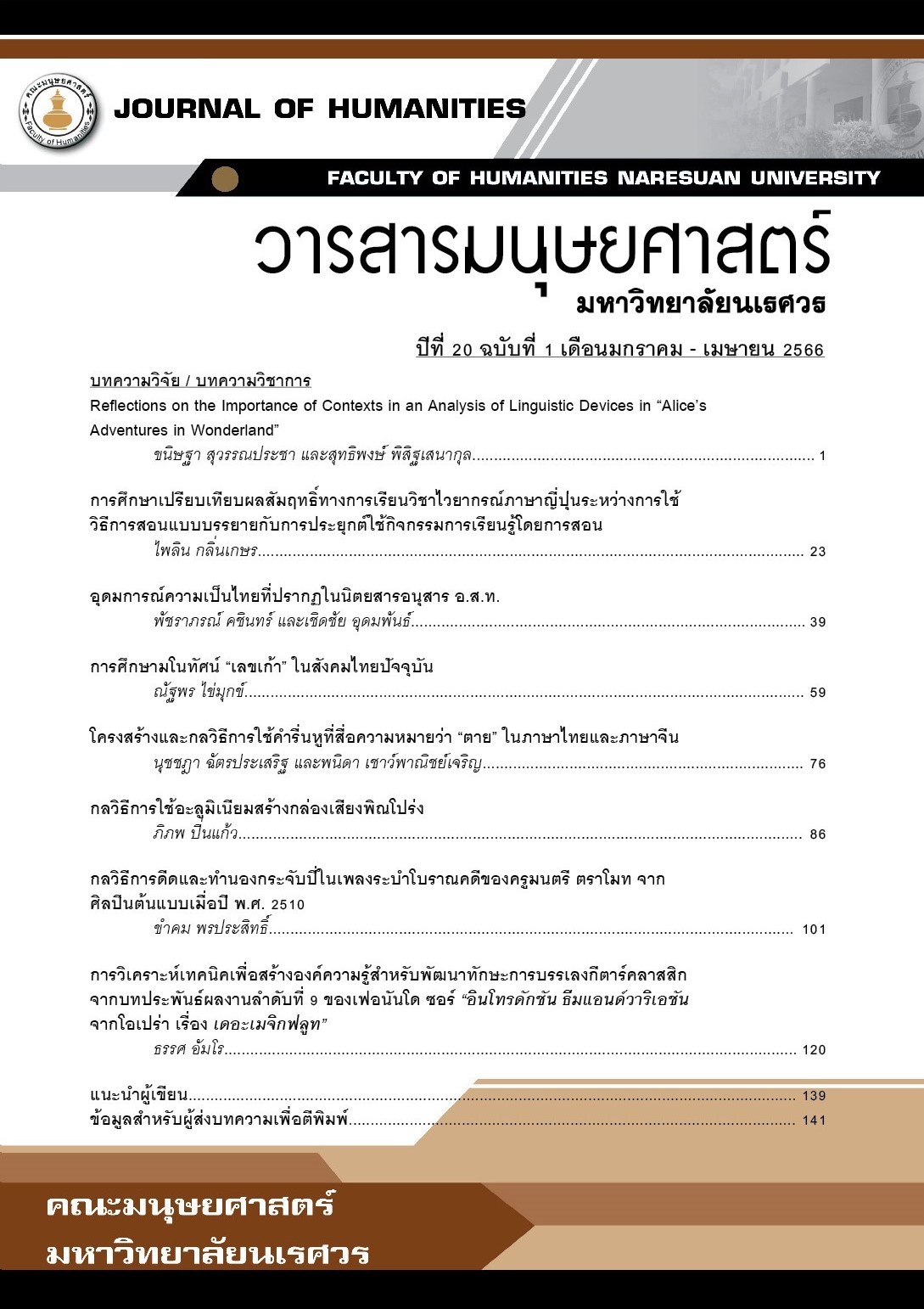
Krachapi Performing Techniques and Melodies for Rabam Borankhadee Music by Kru Montri Tramote's 1967 Original Version
Article Sidebar
Main Article Content
Abstract
This study aims to investigate playing techniques and melodic contours of Krachapi instrument appeared in the archeological dance suite. Comprising five movements, the suite was composed by venerable Montri Tramote and premiered in 1967. Using qualitative research methods. The research finding shows that a Krachapi, having small, medium and large sizes, mainly employs an upward plucking technique to produce the sound of the instrument. While large sizes generally rely on upward techniques, small and medium sizes mainly use downward plucking techniques. Seven plucking techniques are classified: (1) trill on a single note; (2) mordent; (3) glissando; (4) trill on three consecutive notes; (5) acciaccatura; (6) staccato; and (7) pluck and tap technique. While the musical identity of small Krachapi playing techniques is a short trilling technique with an emphasis, a double strike technique on the first and followed by a strike on the second string was mostly found in a large size of Krachapi. It is also found that a large size of Krachapi customarily employs a single pitch triplet and a three-pitch triplet. The exact written melodies can be found in the playing of the small Krachapi well producing sharp and clear tone quality. The medium size frequently uses melodic patterns of zigzag motions, repetitive motions, and a mirroring technique of the previous passage to make new embellished melodies. The emphasis of principal notes and essential pitches to decorate melodic lines with syncopated patterns and strumming two notes in a fifth interval on both strings can be found in large Krachapi’s playing techniques.
Article Details

This work is licensed under a Creative Commons Attribution-NonCommercial-NoDerivatives 4.0 International License.
ข้อความรู้ใดๆ ตลอดจนข้อคิดเห็นใดๆ เป็นของผู้เขียนแต่ละท่านโดยเฉพาะ คณะมนุษยศาสตร์ มหาวิทยาลัยนเรศวร และกองบรรณาธิการวารสารมนุษยศาสตร์ฯ ไม่จำเป็นต้องเห็นพ้องด้วย
References
กรมศิลปากร. (2511). สมุดภาพแสดงเครื่องแต่งกายตามสมัยประวัติศาสตร์และโบราณคดี. พระนคร: ศิวพร.
จีรพล เพชรสม. ข้าราชการบำนาญ วิทยาลัยนาฏศิลป กรมศิลปากร. (21 ตุลาคม 2562). สัมภาษณ์.
เฉลิมศักดิ์ พิกุลศรี. (2530). ดนตรีอินเดีย. ขอนแก่น: มหาวิทยาลัยขอนแก่น.
เชวงศักดิ์ โพธิสมบัติ. ข้าราชการบำนาญ วิทยาลัยนาฏศิลป กรมศิลปากร (25 กันยายน 2561). สัมภาษณ์.
ปกรณ์ รอดช้างเผื่อน. ข้าราชการบำนาญ จุฬาลงกรณ์มหาวิทยาลัย. (2 ตุลาคม 2561). สัมภาษณ์.
ปกรณ์ รอดช้างเผื่อน. ข้าราชการบำนาญ จุฬาลงกรณ์มหาวิทยาลัย. (31 ตุลาคม 2561). สัมภาษณ์.
ปกรณ์ รอดช้างเผื่อน. ข้าราชการบำนาญ จุฬาลงกรณ์มหาวิทยาลัย. (21 พฤศจิกายน 2561). สัมภาษณ์.
ภัทระ คมขำ. (2561). เพลงระบำ. กรุงเทพฯ: จุฬาลงกรณ์มหาวิทยาลัย.
มนตรี ตราโมท. (2505). เครื่องสายไทย. ใน หนังสืออนุสรณ์งานพระราชทานเพลิงศพนายเปกข์ สุขวงศ์ ณ เมรุวัดธาตุทอง วันที่ 30 พฤษภาคม 2505. พระนคร: ห้างหุ้นส่วนจำกัด เกษมสุวรรณ.
มนตรี ตราโมท. (2538). ดุริยสาส์น. ใน หนังสือที่ระลึกงานพระราชทานเพลิงศพนายมนตรี ตราโมท ณ เมรุพลับพลาอิศริยาภรณ์ วัดเทพศิรินทราวาส วันอาทิตย์ที่ 22 ตุลาคม 2538. กรุงเทพฯ: ธนาคารกสิกรไทย จำกัด (มหาชน) สนับสนุนการพิมพ์.
ราชบัณฑิตยสถาน. (2556). พจนานุกรมฉบับราชบัณฑิตยสถาน พ.ศ. 2554. กรุงเทพฯ: นานมีบุ๊คส์พับลิเคชั่นส์.
วราภรณ์ เชิดชู. (2561). เพลงตับ “พิณทุกขนิโรธคามินีปฏิปทา” (วิทยานิพนธ์ศิลปกรรมศาสตรดุษฎีบัณฑิต). กรุงเทพฯ: จุฬาลงกรณ์มหาวิทยาลัย.
สิปปวิชญ์ กิ่งแก้ว. (2558). การปรากฏและการสูญสลายของกระจับปี่เครื่องดนตรีราชสำนักสยาม. วารสารอักษรศาสตร์ มหาวิทยาลัยศิลปากร, 37(1), 145-179.
สำนักมาตรฐานอุดมศึกษา สำนักงานปลัดทบวงมหาวิทยาลัย. (2544). เกณฑ์มาตรฐานดนตรีไทยและการประเมิน พุทธศักราช 2544. กรุงเทพฯ: สำนักงานปลัดทบวงมหาวิทยาลัย.
อรวรรณ บรรจงศิลป, โกวิทย์ ขันธศิริ, สิริชัย ฟักจำรูญ, และปกรณ์ รอดช้างเผื่อน. (2546). ดุริยางคศิลป์ไทย. กรุงเทพฯ: สถาบันไทยคดีศึกษา จุฬาลงกรณ์มหาวิทยาลัย.
Sam, S., Roongrüang, P., & Nyugen, P. (1998). The Khmer people. In T. E. Miller & S. Williams (Eds.), The Garland Encyclopedia of World Music: Volume 4: Southeast Asia (pp.151-217). New York: Routledge.
