
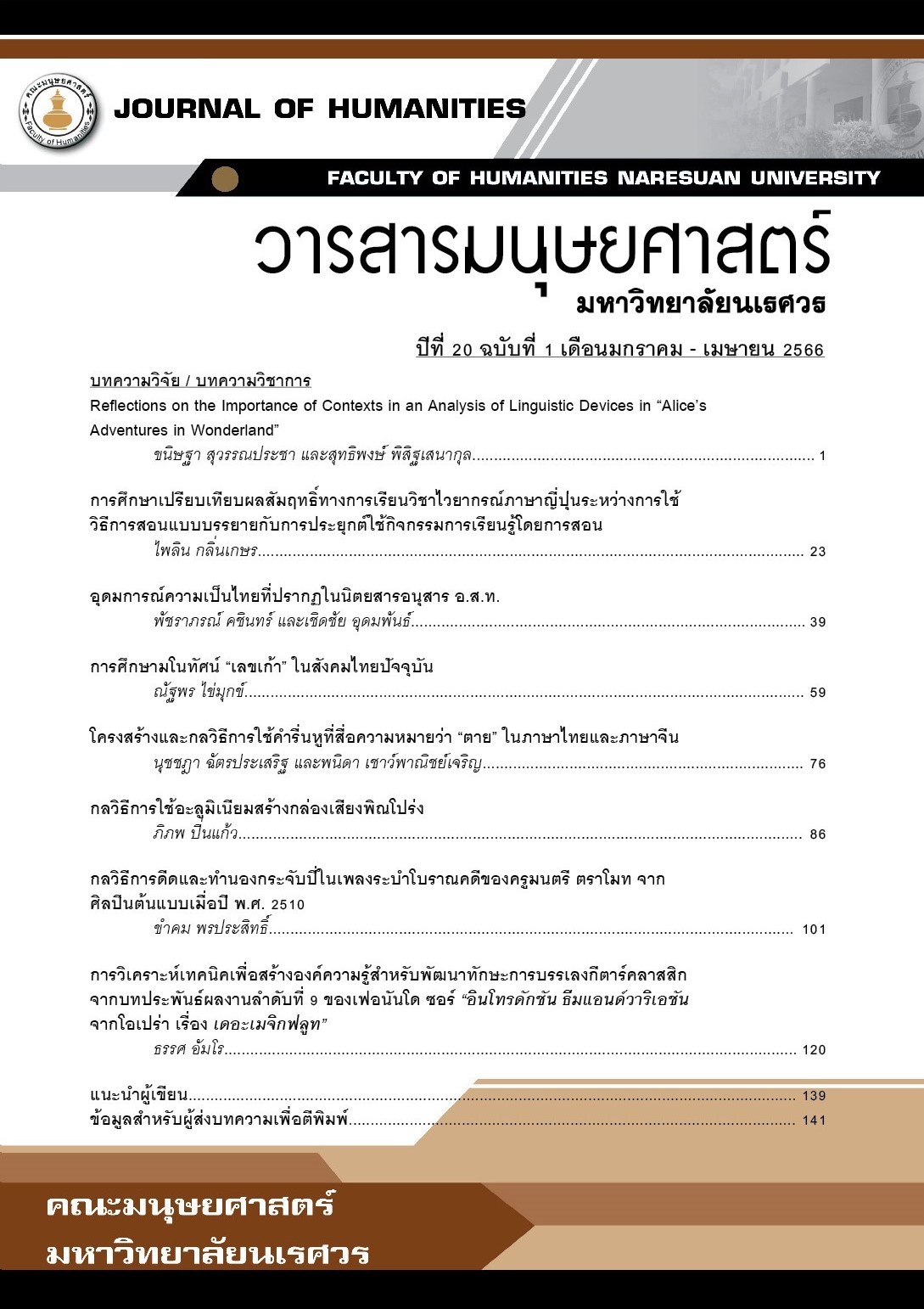
Reflections on the Importance of Contexts in an Analysis of Linguistic Devices in "Alice's Adventures in Wonderland"
Article Sidebar
Main Article Content
Abstract
The research aims to analyze and interpret the linguistic devices in "Alice’s Adventures in Wonderland" by Lewis Carroll, which reflect the importance of contexts. The instrument used are linguistic devices analysis tables focusing on malapropisms and puns. (homonyms, homographs, and homophones). Afterward, three aspects: linguistic and situational context with Systemic Functional Grammar approach of M.A.K. Halliday and cultural context are analyzed for target words, possible meanings, and underlying messages. The findings show 20 malapropisms and 16 puns consisting of 8 homonyms and 8 homophones are used, and the three types of context render effective interpretation of malapropisms and puns, which, consequently, results in a better understanding of the story and the characters’ feelings and thoughts.
Article Details

This work is licensed under a Creative Commons Attribution-NonCommercial-NoDerivatives 4.0 International License.
ข้อความรู้ใดๆ ตลอดจนข้อคิดเห็นใดๆ เป็นของผู้เขียนแต่ละท่านโดยเฉพาะ คณะมนุษยศาสตร์ มหาวิทยาลัยนเรศวร และกองบรรณาธิการวารสารมนุษยศาสตร์ฯ ไม่จำเป็นต้องเห็นพ้องด้วย
References
Ambrosiani, P. (1999). A Russian tail? on the translation of puns in Lewis Carroll’s Alice’s adventure in wonderland. In A. Bengtsson & V. Hancock (Eds.), Humour in language: Textual and linguistics aspects (pp. 30-63). Stockholm: Acta Universitatis Stockholmiensis.
Auerbach, N. (1973). Alice and wonderland: A curious child. Victorian Studies, 17(1), 31-47. Retrieved on January 23, 2021, from http://www.jstor.org/stable/3826513
Brinton, L. J., & Brinton, D. M. (2010). The linguistic structure of modern English. Amsterdam: John Benjamins Publishing Company.
Bulut, T., & Almabrouk, N. (2020). The functions of puns in “Alice’s adventures in wonderland”. The Reading Matrix: An International Online Journal, 20(1), 172-185.
Cambridge University Press. (n.d.). Cambridge Dictionary. Retrieved on January 10, 2020, from https://dictionary.cambridge.org
Carroll, L. (2016). Alice’s adventures in wonderland and through the looking-glass. San Diego: Canterbury Classics.
Chiang, Y. (2013). Nonsense humor: A battlefield for Ludwig Wittgenstein or a playground for Lewis Carroll. HSIUPING Journal of Humanities and Social Sciences, 20, 27-46.
Cook, G. (1994). Discourse and literature: The interplay of form and mind. Oxford: Oxford University Press.
Debrota, C. (2019). Translation strategies in Alice in wonderland's rhymes. Translation Studies: Retrospective and Prospective Views, 12(22), 13-19.
Feng, Z. (2009). Translation and reconstruction of a wonderland: Alice’s adventures in China. Neohelicon, 36, 237–251.
Ferrari, G. (1997). Types of context and their role in multimodal communication. Computational Intelligence, 13(3), 414-426.
Finegan, E. (2008). Language: Its structure and use (5th ed.). Boston, MA: Thomson Wadsworth.
Flescher, J. (1969). The language of nonsense in Alice. Yale French Studies, 43, 128–144. Retrieved from https://doi.org/10.2307/2929641
Fray, D., & Cutler, A. (1997). Malapropisms and the structure of the mental lexicon. Linguistic Inquiry, 8(3), 505-520.
Gee, J. P. (1999). An introduction to discourse analysis: Theory and method. New York: Routledge.
Giorgadze, M. (2014). Linguistic features of pun, its typology and classification. European Scientific Journal, 2, 271-275.
Grice, H. P. (1975). Logic and conversation. In P. Cole & J. L. Morgan (Eds.), Syntax and semantics 3: Speech acts (pp.41-58). New York: Academic Press.
Halliday, M. A. K., & Matthiessen, C. (2013). Halliday's introduction to functional grammar (4th ed.). London: Routledge.
Kaschula, R. H. (2017). Alice in wonderland: Translating to read across African. Journal of African Cultural Studies, 29(3), 276-291. Retrieved from https://doi.org/10.1080/13696815.2016.1160827
Klug, H. W. (2000). The function of linguistic issues in Alice in wonderland and through the looking glass. Retrieved November 1, 2019, from http://klugi.com/wp-content/papers/anglistik /Alice_in_Wonderland.pdf
Knowles, G. (2014). A cultural history of the English language. London: Routledge.
Lakoff, G., & Johnson, M. (1980). Metaphors we live by. Chicago, IL: University of Chicago Press.
Lemos, M. (2009). Language-games in Alice’s adventures in wonderland or: How language operates in Carroll’s text to produce nonsensical meaning in common-sense references. Retrieved December 15, 2019, from https://repositorio-aberto.up.pt/bitstream/10216 /23575/2/marcialemoslanguage000127445.pdf
Matevosyan, A., & Alimyan, M. (2014). Homophonic pun in “Alice in wonderland” in English and Armenian. Armenian Folia Anglistika, 10(1-2), 70–75.
May, L. S. (2007). Wittgenstein’s reflection in Lewis Carroll’s looking-glass. Philosophy and Literature, 31(1), 79-94.
Merriam-Webster. (n.d.). Merriam-Webster dictionary. Retrieved on January 10, 2020, from https://www.merriam-webster.com
Orero-Clavero, M. P. (2002). The translation of nonsense into Spanish with particular reference to Lewis Carroll and Edward Lear supervised by M. Baker. Manchester: University of Manchester Institute of Science and Technology.
Oxford University Press. (n.d.). Oxford Learner’s Dictionary. Retrieved on January 10, 2020, from https://www.oxfordlearnersdictionaries.com
Shires, L. M. (1988). Fantasy, nonsense, parody, and the status of the real: The example of Carroll. Victorian Poetry, 26(3), 267–283. Retrieved January 23, 2021, from http://www.jstor.org/stable /40001965
Song, L. (2010). The role of context in discourse analysis. Journal of Language Teaching and Research, 1(6), 876-879.
Sornsomrit, R. & Kallayanamit, S. (2019). A study of figures of speech in English headlines of western fast food printed advertisements available on google image websites. Journal of Humanities Naresuan University, 16(1), 113–130.
Wagner, D. (2012). The uses of nonsense. Ludwig Wittgenstein reads Lewis Carroll. Wittgenstein-Studien, 3(1), 205-216.
Wittgenstein, L. (1963). Philosophical investigation (G.E.M. Anscombe, Trans). Oxford: Basil Blackwell.
Yule, G. (1996). Pragmatics. Oxford: Oxford University Press.
Zhang, Q. (2017). Creation for fidelity – Zhao Yuanren’s translation of lexical nonsense in Alice’s adventures in wonderland. International Journal of Comparative Literature and Translation Studies, 5(1), 71-79.
