
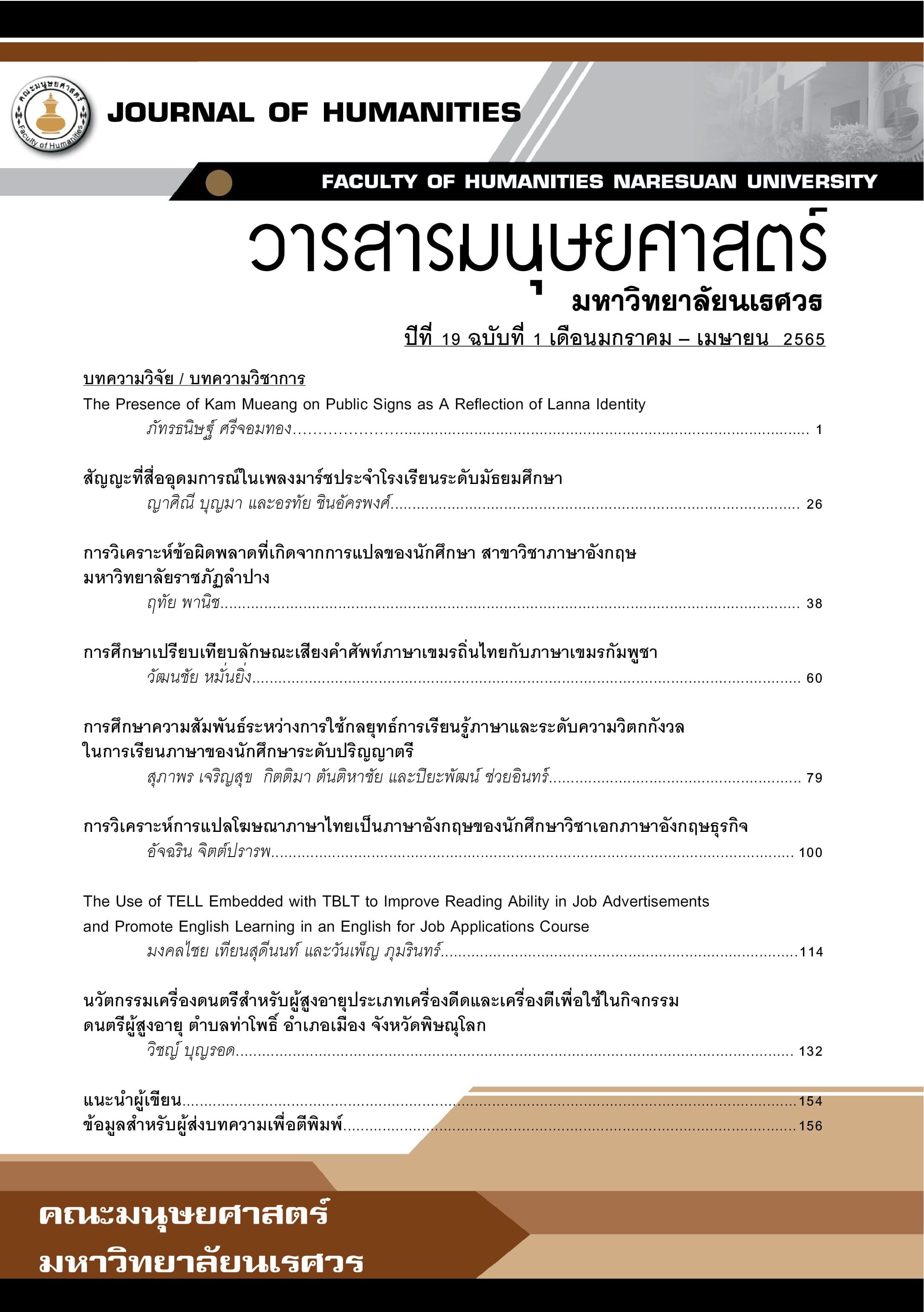
The Use of TELL Embedded with TBLT to Improve Reading Ability in Job Advertisements and Promote English Learning in an English for Job Applications Course
Article Sidebar
Main Article Content
Abstract
The purposes of this study were to investigate the use of Technology–Enhanced Language Learning (TELL) embedded with Task-Based Language Teaching (TBLT) to improve reading ability in job advertisements and promote English learning in an English for Job Applications Course. Participants included 80 undergraduates majoring in General Management from a university in Prathum Thani province. The mixed method of data collection was used by utilizing pre – and post - reading tests for control and experimental groups. A questionnaire and a semi-structured interview were conducted for the experimental group. The findings indicated that there was a statistically significant difference between the control and experimental groups. The majority of students explained that TELL and TBLT could enhance their English learning.
Article Details

This work is licensed under a Creative Commons Attribution-NonCommercial-NoDerivatives 4.0 International License.
ข้อความรู้ใดๆ ตลอดจนข้อคิดเห็นใดๆ เป็นของผู้เขียนแต่ละท่านโดยเฉพาะ คณะมนุษยศาสตร์ มหาวิทยาลัยนเรศวร และกองบรรณาธิการวารสารมนุษยศาสตร์ฯ ไม่จำเป็นต้องเห็นพ้องด้วย
References
Annamalai, N. (2019). The use of web 2.0 technology tools and beyond in enhancing Task Based Language Learning: A case study. The English Teacher, 48(1), 29-44.
Chen, T., & Lin, C. (2018). Enhancing L2 English learning through mobile - assisted TBLT: EFL learners’ perspectives. The Journal of Asia TEFL, 15(2), 453-461.
Chen, S., & Jing, W. (2019). Effects of the Task – Based Language Teaching (TBLT) approach and language assessment on students’ competences in intensive reading course. English Language Teaching, 12(3), 119-138.
Dörnyei, Z. (2001). Teaching and researching motivation. Harlow, England: Longman.
Hourigan, T., & Murray, L. (2010). Using blogs to help language students to develop reflective learning strategies: Towards a pedagogical framework. Austrian Journal of Educational Technology, 26(2), 209-225.
Kendra, C. (2019). The Zone of Proximal Development as defined by Vygotsky. Retrieved 16 December, 2019, from https://www.verywellmind.com/what-is-the-zone-of-proximal-de velopment-2796034
Maley, A. (2016). Principles and procedures in materials development. In M. Azarnoosh et al. (Eds). Issues in materials development. Boston: Sense Publishers.
Meesuk, P. (2020). Educational Research (2nd Ed.). Bangkok: Triple Education.
Nunan, D. (1989). Designing tasks for the communicative classroom. New York: Cambridge University Press.
Nunan, D. (2004). Task-based language teaching. Cambridge: Cambridge University Press.
Office of the Prime Minister. (n.d.). The Twelve National Economic and Social Development Plan (2017-2021). Retrieved 16 December, 2019, from https://www.nesdb.go.th/nesdb_en/ewt _w3c/ewt_dl_link.php?nid=4345
Richards, C. J., & Rogers, S. T. (1999). Approaches and methods in language teaching (2nd Ed.). USA: Cambridge University Press.
Schrooten, W. (2006). TBLT and ICT: Developing and assessing interactive multimedia for Task-Based Language Teaching. In K. van den Branden (Ed.), Task - Based Language Education from theory to practice (pp. 129-150). Cambridge: Cambridge University Press.
Teeler, D., & Gray, P. (2000). How to Use the Internet in ELT. Malaysia: Bluestone Press.
Vacca, L. J., Vacca, T. R., & Gove, K. M. (1995). Reading and Learning to Read. USA: RR Donnelley & Sons Company.
Van den Branden, K. (2006). Task - Based Language Education from theory to practice. Cambridge: Cambridge University Press.
Zhou, Y., & Wei, M. (2018). Strategies in technology - enhanced language learning. Studies in Second Language Learning and Teaching, 8(2), 471-495.
