
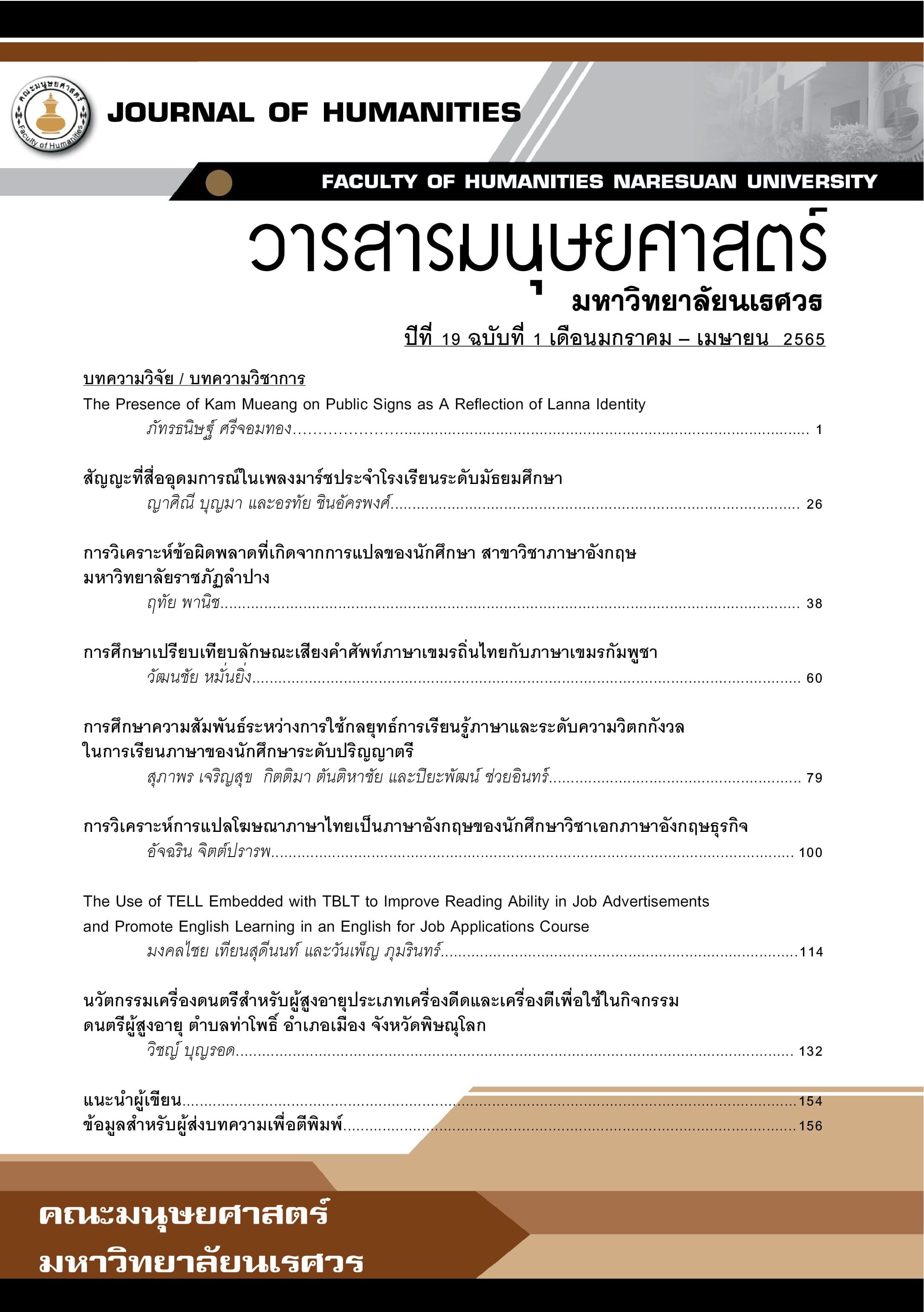
A Study of the Relationship between the Use of Language Learning Strategies and the Level of Language Anxiety among Undergraduate Students
Article Sidebar
Main Article Content
Abstract
The purposes of this study were 1) to examine the frequency use of language learning strategies employed by undergraduate students with high and low language anxiety 2) to examine the use of language learning strategies employed by undergraduate students with high and low language anxiety 3) to find the relationship between the use of language learning strategies and the level of language anxiety of undergraduate students. The participants were 302 fourth year students at Rajamangala University of Technology Srivijaya, Trang Campus. The research instruments used in this study consisted of 1) a questionnaire on language learning strategies developed by Oxford, 1990 (Strategy Inventory for Language Learning; SILL) 2) a questionnaire on foreign language anxiety developed by Horwitz et al., 1986 (Foreign Language Classroom Anxiety Scale; FLCAS) 3) the open-ended questions on language learning strategies and language anxiety. The quantitative data was analyzed by mean, standard deviation, and Pearson product moment correlation. The qualitative data was analyzed by content analysis. The results revealed that 1) students with low language anxiety employed language learning strategies more frequently than students with high language anxiety did. 2) metacognitive strategies were the most used; while social strategies were the least used by students with low language anxiety and metacognitive strategies were the most used; while cognitive strategies were the least used by students with high language anxiety 3) memory, compensation, affective, and social strategies significantly correlated with language anxiety while cognitive, and metacognitive did not significantly correlate with language anxiety.
Article Details

This work is licensed under a Creative Commons Attribution-NonCommercial-NoDerivatives 4.0 International License.
ข้อความรู้ใดๆ ตลอดจนข้อคิดเห็นใดๆ เป็นของผู้เขียนแต่ละท่านโดยเฉพาะ คณะมนุษยศาสตร์ มหาวิทยาลัยนเรศวร และกองบรรณาธิการวารสารมนุษยศาสตร์ฯ ไม่จำเป็นต้องเห็นพ้องด้วย
References
คณะบริหารธุรกิจ. (2555). หลักสูตรบัญชีบัณฑิต (หลักสูตรปรับปรุง พ.ศ. 2555). สงขลา: มหาวิทยาลัยเทคโนโลยีราชมงคลศรีวิชัย.
คณะวิศวกรรมศาสตร์และเทคโนโลยี. (2558). หลักสูตรวิศวกรรมศาสตรบัณฑิต สาขาวิชาวิศวกรรมสารสนเทศและการสื่อสาร (หลักสูตรปรับปรุง พ.ศ. 2558). ตรัง: มหาวิทยาลัยเทคโนโลยีราชมงคลศรีวิชัย.
คณะศิลปศาสตร์. (2555). หลักสูตรศิลปศาสตรบัณฑิต สาขาวิชาการโรงแรมและการท่องเที่ยว (หลักสูตรปรับปรุง พ.ศ. 2555). สงขลา: มหาวิทยาลัยเทคโนโลยีราชมงคลศรีวิชัย.
คณะศิลปศาสตร์. (2555). หลักสูตรศิลปศาสตรบัณฑิต สาขาวิชาภาษาอังกฤษเพื่อการสื่อสารสากล (หลักสูตรปรับปรุง พ.ศ. 2555). สงขลา: มหาวิทยาลัยเทคโนโลยีราชมงคลศรีวิชัย.
ทรงศรี สรณสถาพร. (2560). กลยุทธ์การเรียนรู้ภาษาอังกฤษโดยตรงของผู้เรียนชาวไทยในยุคประเทศไทย 4.0. วารสารวิชาการมหาวิทยาลัยธนบุรี, 11(26), 9-23.
นิรมล รัตนสงเคราะห์, ทรงศรี สรณสถาพร, ยุวดี ถิรธราดล, และกรัณศุภมาศ เอ่งฉ้วน. (2555). กลยุทธ์ที่ใช้ในการเรียนรู้ภาษาของนักศึกษาที่มีความสามารถภาษาอังกฤษระดับสูงและต่ำในหลักสูตรประกาศนียบัตรวิชาชีพครู. วารสารวิชาการศิลปศาสตร์ประยุกต์, 1, 54-65.
ปณิชา นิติสกุลวุฒิ และ ทรงศรี สรณสถาพร. (2557). การใช้กลยุทธ์ในการเรียนรู้ภาษาอังกฤษของนักเรียนที่เข้าร่วมโครงการค่ายอาเซียน. วารสารวิชาการมหาวิทยาลัยธนบุรี, 8(16), 39-54.
ปภังกร กิจทวี, ทรงศรี สรณสถาพร, กรัณศุภมาศ เอ่งฉ้วน, และธนายุส ธนธิติ. (2555). การศึกษาความสัมพันธ์ระหว่างการใช้กลยุทธ์การเรียนรู้ภาษา ระดับความวิตกกังวล และความสามารถในการใช้ภาษาอังกฤษของนักศึกษาปริญญาโท คณะบริหารธุรกิจ. การประชุมเสนอผลงานวิจัยระดับบัณฑิตศึกษา มหาวิทยาลัยสุโขทัยธรรมาธิราช ครั้งที่ 2. 4-5 กันยายน (1-13).
เยาวลักษณ์ ยิ้มอ่อน. (2557). การใช้ภาษาอังกฤษในการประกอบอาชีพของบัณฑิตไทยในเขตกรุงเทพมหานคร. วารสารปัญญาภิวัฒน์, 5(2), 191-204.
วิจารณ์ พานิช. (2555). วิถีสร้างการเรียนรู้เพื่อศิษย์ ในศตวรรษที่ 21. กรุงเทพฯ: มูลนิธิสดศรี-สฤษดิ์วงศ์.
วิทยาลัยการโรงแรมและการท่องเที่ยว. (2560). หลักสูตรบัญชีบัณฑิต (หลักสูตรปรับปรุง พ.ศ. 2560). ตรัง: มหาวิทยาลัยเทคโนโลยีราชมงคลศรีวิชัย.
ศิวนนท์ นิลพาณิชย์. (2560). กลยุทธ์การเรียนรู้ภาษาของนักศึกษามหาวิทยาลัยชั้นปีที่ 1. วารสารวไลยอลงกรณ์ปริทัศน์ (มนุษยศาสตร์และสังคมศาสตร์), 7(2), 1-12.
สุภาพร เจริญสุข และ กิตติมา ตันติหาชัย. (2562). การศึกษารูปแบบของสถานประกอบการ ปัญหาและกลยุทธ์การแก้ปัญหาการสื่อสารภาษาอังกฤษของนักศึกษาฝึกงานระดับมหาวิทยาลัย. วารสารวิทยบริการ มหาวิทยาลัยสงขลานครินทร์, 30(1), 75-88.
สมพร โกมารทัต. (2559). การศึกษาการใช้กลยุทธ์การเรียนภาษาต่างประเทศของนักศึกษาระดับปริญญาตรีในกรุงเทพฯและปริมณฑล. กรุงเทพฯ: มหาวิทยาลัยธุรกิจบัณฑิตย์.
สมพร โกมารทัต. (2562). กลยุทธ์การเรียนภาษาต่างประเทศของผู้เรียนศตวรรษที่ 21. วารสารสุทธิปริทัศน์, 33(105), 187-197.
Anugkakul, G. (2011). A comparative study in language learning strategies of Chinese and Thai students: A case study of Suan Sunandha Rajabhat University. European Journal of Social Sciences, 19(2), 163-174.
Bailey, P., Daley, C. E., & Onwuegbuzie, A. J. (1999). Foreign language anxiety and learning style. Foreign Language Annals, 32, 63-76.
Brown, D. H. (2007). Principles of language learning and teaching. NY: Pearson Education, Inc.
Ellis, R. (2008). The Study of Second Language Acquisition. (2nd ed.). Oxford: Oxford University Press.
Horwitz, E.K., Horwitz, M.B., & Cope, J. (1986). Foreign language classroom anxiety. The Modern Language Journal, 70, 125-132.
Khamkhien, A. (2011). Language learning strategies uses by Thai and Vietnamese university students. MANUSYA: Journal of Humanities, 14(2), 1-23.
Khamkhien, A. (2013). Roles of English as an international language on learning strategies among Japanese and Thai learners. Journal of Teaching and Education, 2(2), 473-483.
Kunasaraphan, K. (2015). English learning strategy and proficiency level of the first year students. Procedia – Social and Behavioral Sciences, 197, 1853-1858.
Lamla-ong, H. (2014). Language learning problems and language learning strategies of MFU students. MFU Connexion: Journal of Humanities and Social Sciences, 3(1), 54-86.
Liu, H. (2013). Effects of Foreign Language Anxiety and Perceived Competence on Learning Strategies Use. International Journal English Linguistics, 3(3), 76-87.
Lucas, I. R., Miraflores, E., & Go, D. (2011). English Language Learning Anxiety among Foreign Language Learners in the Philippines. Philippine ESL Journal, 7, 94-119.
MacIntyre, P. D., & Gardner, R. C. (1991). Methods and results in the study of anxiety and language learning: a review of literature. Language Learning, 41, 85-117.
Matsuda, S., & Gobel, P. (2004). Anxiety and predictors of performance in the foreign language classroom. System, 32, 21-36.
Mingyuan, Z. (2001). Language learning strategies and English language proficiency: An investigation of Chinese ESL students at NUS. Reflections on English Language Teaching, 1, 51-73.
Mohammadi, E., Biria, R., Koosha, M., & Shahsavari, A. (2013). The Relationship between Foreign Language Anxiety and Language Learning Strategies among University Students. Theory and Practice in Language Studies, 3(4), 637-646.
Naeeini, S. K., Maarof, N., & Salehi, H. (2011). Malaysian ESL learners' use of language learning strategies. International Proceedings of Economics Development and Research (IPEDR), 20, 340-344.
Noormohamadi, R. (2009). On the Relationship between Language Learning Strategies and Foreign Language Anxiety. Pan-Pacific Association of Applied Linguistics, 13(1), 39-52.
Nyikos, M., & Oxford, R. (1993). A factor analytic study of language-learning strategy use: Interpretations from information-processing theory and social psychology. The Modern Language Journal, 77, 11-22.
O’Malley, J. M., & Chamot, A. U. (1990). Learning strategies in second language acquisition. Cambridge: Cambridge University Press.
Oxford, R. L. (1990). Language learning strategies: What every teacher should know. NY: Newbury House Harper & Row.
Oxford, R.L., & Ehrman, M.E. (1995). Adults language learning strategies in an intensive foreign language program in the United States. System, 23(3), 359-386.
Oxford, R. L., & Lee, K. R. (2008). Understanding EFL learners? strategy use and strategy awareness. The Asian EFL Journal, 10(1), 7-32.
Pannak, O., & Chiramanee, T. (2011). Language learning strategies used by first year students at Thaksin University, Songkhla campus, Thailand. Proceedings-Factors Affecting English Language Teaching and Learning, 1-12.
Phillips, V. (1990). English as a second language learner strategies of adult Asian students using the strategy inventory for language learning. In L. Dickinson, Autonomy and motivation: A literature review. System, 23(2), 165-174.
Phonhan, P. (2016). Language Learning Strategies of EFL Education Students: A Case Study of Thai Undergraduate Students. Silpakorn University Journal of Social Sciences, Humanities and Arts, 16(2), 115-135.
Rahimi, M., & Katal, M. (2012). Metacognitive strategies awareness and success in learning English as a foreign language: an overview. Procedia-social and Behavioral Sciences, 31, 73-81.
Santikarn, B. (2014). The use of language learning strategies: A case study of undergraduate students in a private university. Journal of Language and Communication, 19(21), 55-72.
Seng, S., & Khleang, S. (2014). Language learning strategy used by Cambodian EFL students. LEARN Journal: Language Education and Acquisition Research Network, 7(1), 58-67.
Tagong, K. (2011). Language learning strategies of Naresuan university international college students. Journal of Education Naresuan University, 13(1), 19-45.
Wenden, A. L., & Rubin, J. (1987). Learner Strategies in Language Learning. New Jersey: Prentice Hall.
Wu, Y. (2008). Language learning strategies used by students at different proficiency levels. The Asian EFL Journal, 10(4), 75-95.
Young, D. J. (1991). Creating a Low-Anxiety Classroom Environment: What Does Language Anxiety Research Suggest? The Modern Language Journal, 75, 426-439.
Zhou, C., & Intaraprasert, C. (2015). Language learning strategies employed by English-major pre-service teachers with different levels of language proficiency. Theory and Practice in Language Studies, 5(5), 919-926.
