
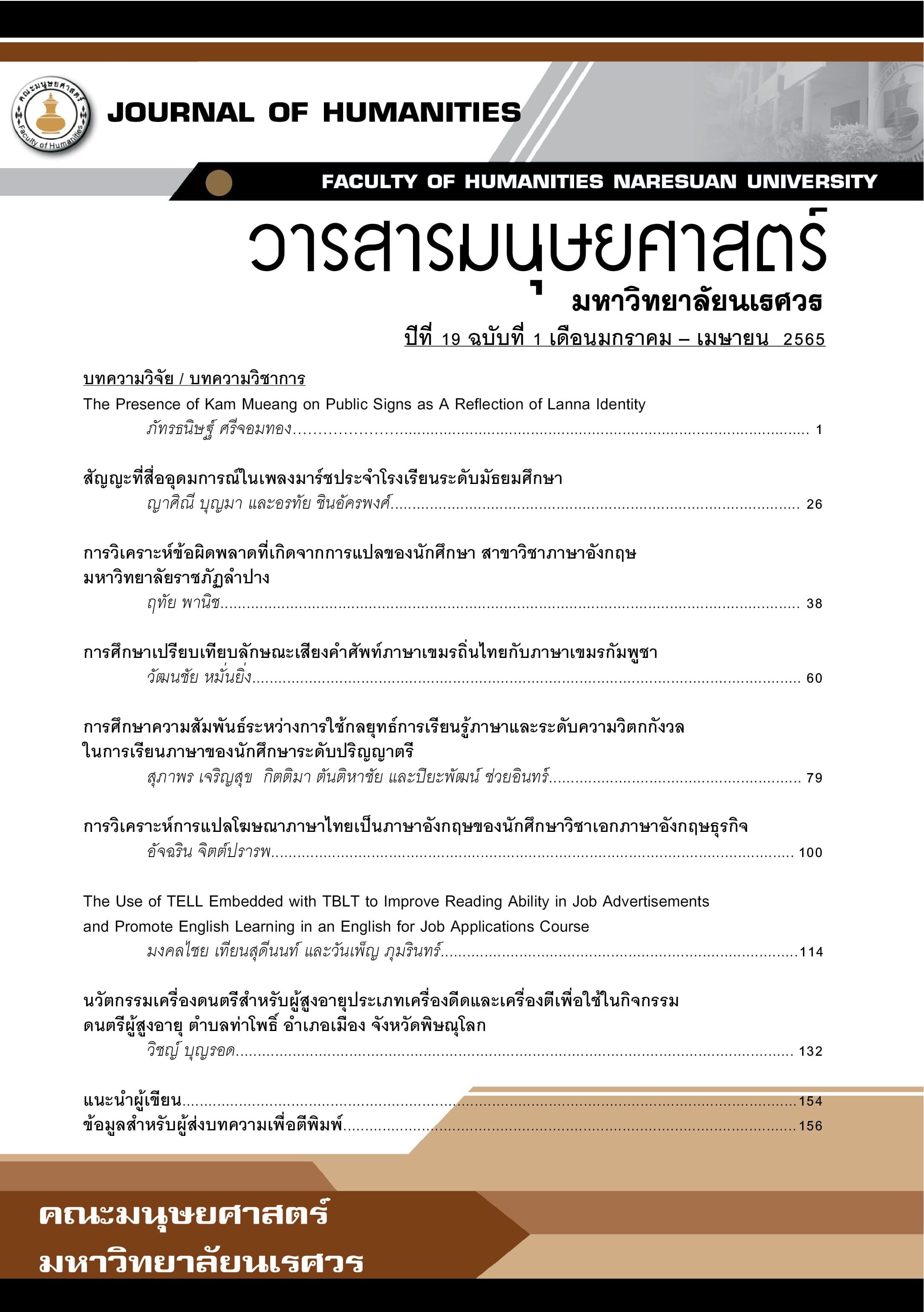
Semiotic Ideologies in Marching Songs of Thai High School
Article Sidebar
Main Article Content
Abstract
The purpose of this research was to study semiotic ideologies in 48 marching songs of Thai high school; both of semiotics (Peirce, 1902) and ideology (van Dijk, 2000, 2006) were adopted in the data analysis. According to data analysis, 6 types of semiotics were found. Color terms, school emblems, flags, blood, religious objects/places and other objects were symbolized in order to convey intended meaning. Besides, it was found 2 main sets of ideologies, including being good and desirable students as well as being proud of their own high schools.
Article Details

This work is licensed under a Creative Commons Attribution-NonCommercial-NoDerivatives 4.0 International License.
ข้อความรู้ใดๆ ตลอดจนข้อคิดเห็นใดๆ เป็นของผู้เขียนแต่ละท่านโดยเฉพาะ คณะมนุษยศาสตร์ มหาวิทยาลัยนเรศวร และกองบรรณาธิการวารสารมนุษยศาสตร์ฯ ไม่จำเป็นต้องเห็นพ้องด้วย
References
กาญจนา แก้วเทพ. (2553). แนวพินิจใหม่ในสื่อสารศึกษา. กรุงเทพฯ: ภาพพิมพ์.
กาญจนา แก้วเทพ. (2555). สื่อเก่า-สื่อใหม่: สัญญะ อัตลักษณ์ อุดมการณ์. กรุงเทพฯ: ภาพพิมพ์.
เกรียงไกร ทองจิตติ. (2560). การกล่อมเกลาทางการเมืองผ่านบทเพลงเพื่อชีวิตช่วงปี พ.ศ. 2516-2519. วารสารมนุษยศาสตร์และสังคมศาสตร์ มหาวิทยาลัยราชพฤกษ์, 3(2), 11-22.
ชัยวัฒน์ หอวรรณภากร. (2544). การสื่อความหมายและอุดมการณ์ในเพลงมหาวิทยาลัย. วิทยานิพนธ์มหาบัณฑิต, สาขาวิชาการวาทวิทยา ภาควิชาวาทวิทยาและการสื่อสารการแสดง คณะนิเทศศาสตร์ จุฬาลงกรณ์มหาวิทยาลัย.
ไชยรัตน์ เจริญสินโอฬาร. (2545). สัญวิทยา, โครงสร้างนิยม, หลังโครงสร้างนิยมกับการศึกษารัฐศาสตร์: Semiology, structuralism, post-structuralism and the study of political science. กรุงเทพฯ: วิภาษา.
ณัฐพร พานโพธิ์ทอง. (2556). วาทกรรมวิเคราะห์เชิงวิพากษ์ตามแนวภาษาศาสตร์ : แนวคิดและการนำมา ศึกษาวาทกรรมในภาษาไทย. กรุงเทพฯ : โครงการการเผยแพร่ผลงานวิชาการ คณะอักษรศาสตร์ จุฬาลงกรณ์มหาวิทยาลัย.
เถกิง พัฒโนภาษ. (2551). สัญศาสตร์ กับ ภาพแทนความ. วารสารวิชาการ คณะสถาปัตยกรรมศาสตร์ จุฬาลงกรณ์มหาวิทยาลัย, 1(1), 35-50.
ทินวัฒน์ สร้อยกุดเรือ. (2561). ภาษากับอุดมการณ์เกียรติภูมิในวาทกรรมเพลงมาร์ชโรงเรียนประจำจังหวัด. วารสารนานาชาติ มหาวิทยาลัยขอนแก่น สาขามนุษยศาสตร์และสังคมศาสตร์, 8(3), 44-65.
ยิ่งลักษณ์ บุญเก็บ. (2552). การใช้เพลงปลุกใจในฐานะสื่อประชาสัมพันธ์ให้คนไทยสำนึกรักชาติของกองทัพบก พ.ศ. 2475-2550. วิทยานิพนธ์ปริญญามหาบัณฑิต, สาขาวิชาการประชาสัมพันธ์ ภาควิชาการประชาสัมพันธ์ คณะนิเทศศาสตร์ จุฬาลงกรณ์มหาวิทยาลัย.
Forney, K. (2003). Study Guide for the Enjoyment of Music. New York, N.Y: W.W. Norton & Company.
Gee, J. P. (2018). Introducing discourse analysis: From grammar to society. London and New York: Routledge.
Jones, R. H. (2012). Discourse analysis : a resource book for students. London and New York: Routledge.
Peirce, C. S. (1902). Logic as semiotic: The theory of signs. Philosophical writings of Peirce, 100-103.
Saussure, F. D. (1959). Course in general linguistics (W. Baskin, Trans.). New York: Philosophical Library.
Simpson, P. (1993). Language, ideology and point of view. London: Routledge.
Strauss, S. G., & Feiz, P. (2014). Discourse analysis: Putting our worlds into words. New York: Routledge.
van Dijk, T. A. (1997). Discourse as Structure and Process. Discourse Studies. A Multidisciplinary Introduction. London; Thousand Oaks, Calif: Sage Publications.
van Dijk, T. A. (2000). Ideology: A multidisciplinary approach. London; Thousand Oaks, Calif: Sage Publications.
van Dijk, T. A. (2006). Ideology and discourse analysis. Journal of Political Ideologies, 11(2), 115-140.
van Dijk, T. A. (2009). Critical discourse studies: A sociocognitive approach. Methods of Critical Discourse Analysis, 2(1), 62-86.
van Dijk, T. A. (2009). Discourse as Structure and Process. Discourse Studies. A Multidisciplinary Introduction. London: Sage Publications.
