
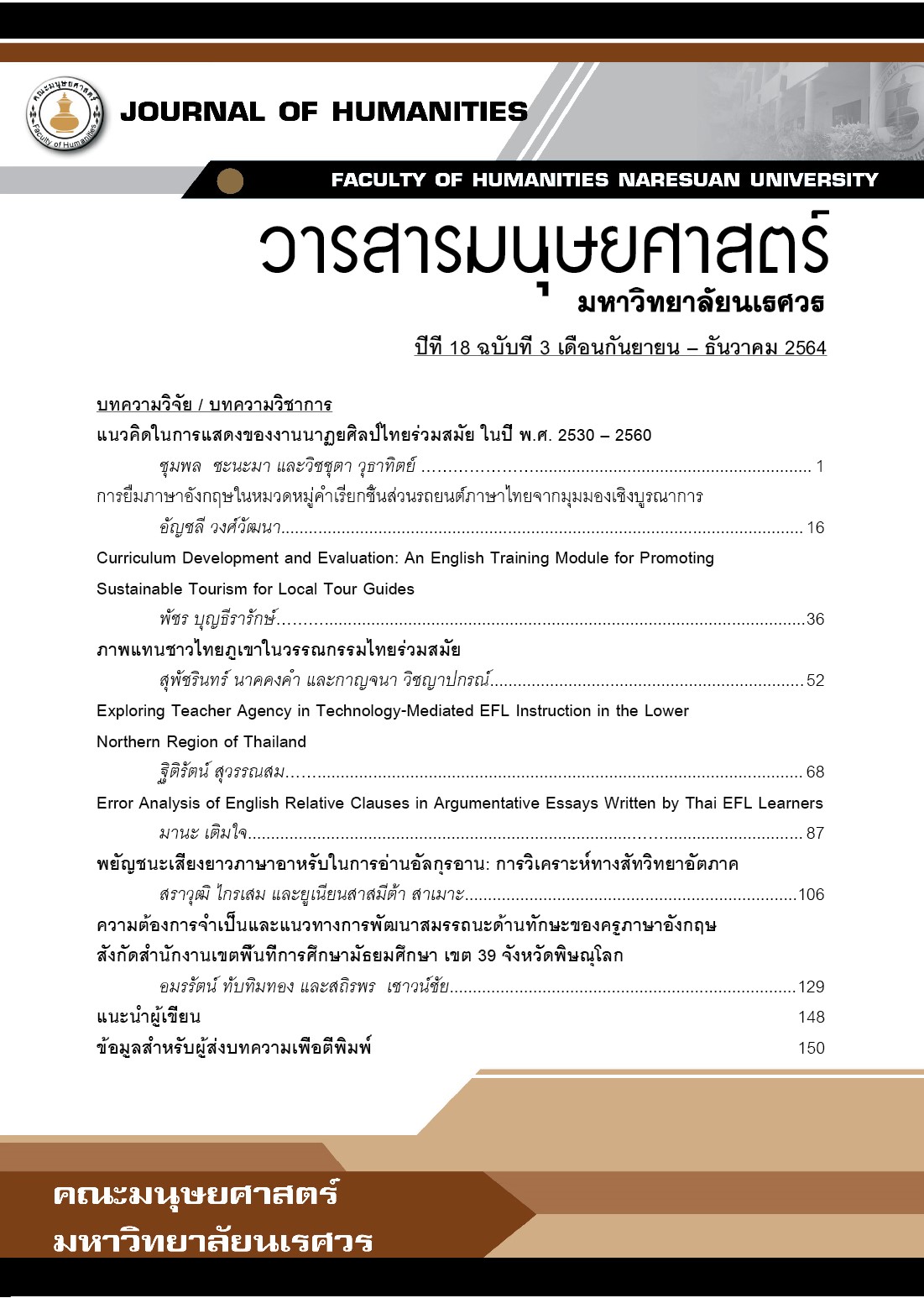
English Borrowing in the Thai Auto-Part-Term Category From an Integrative Point of View
Article Sidebar
Main Article Content
Abstract
This research aimed at the investigation of English language borrowing strategies in the auto-part-term category in Thai and its relevant cognitive aspects, with 1,000 auto-part terms as research data, on the basis of the integration of Translation Theory and Cognitive Linguistics. The results reveal 4 strategical aspects of language borrowing such as importation, loan translation, loan creation and loan idea. Of all the auto-part terms, there are hybrid terms appearing the most, followed by loan-translation, loan-creation, loan-idea and importation terms respectively by far, with the most distribution of loan-translation. The cognitive aspects relevant to the borrowing strategies are that the relation between English language and culture is low resulting in lower problems in the borrowing process which are in accordance with the less number of importation.
Article Details
ข้อความรู้ใดๆ ตลอดจนข้อคิดเห็นใดๆ เป็นของผู้เขียนแต่ละท่านโดยเฉพาะ คณะมนุษยศาสตร์ มหาวิทยาลัยนเรศวร และกองบรรณาธิการวารสารมนุษยศาสตร์ฯ ไม่จำเป็นต้องเห็นพ้องด้วย
References
นัฐยา บุญกองแสน. (2542). การปนภาษาอังกฤษในภาษาไทยกับทัศนคติทางภาษาของบุคคลต่างชั้นอาชีพ. วิทยานิพนธ์อักษรศาสตรมหาบัณฑิต จุฬาลงกรณ์มหาวิทยาลัย.
อัญชลี สิงห์น้อย. (2548). คำนามประสม: ศาสตร์และศิลป์ในการสร้างคำไทย. กรุงเทพมหานคร: สำนักพิมพ์แห่งจุฬาลงกรณ์มหาวิทยาลัย.
อัญชลี สิงห์น้อย. (2548). สากลลักษณ์และเอกลักษณ์ของภาษาและวัฒนธรรม: สิ่งอำนวยและอุปสรรคในการสัมผัสภาษา. วารสารมนุษยศาสตร์ มหาวิทยาลัยนเรศวร, 2(1), 1-14.
อัญชลี สิงห์น้อย วงศ์วัฒนา. (2563). ระบบคำเรียกชิ้นส่วนและอะไหล่รถยนต์ไทยในมุมมองภาษาศาสตร์ ปริชาน. วารสารคณะมนุษยศาสตร์ มหาวิทยาลัยนเรศวร, 17(3), 31-48.
อมรา ประสิทธิ์รัฐสินธุ์. (2547). วิวัฒนาการของการยืมคำและการบัญญัติศัพท์ในสังคมไทย. วารสารอักษรศาสตร์, 33(1), 185–212.
Deignan, Alice and Liz Potter. (2004). A corpus study of metaphors and metonyms in English and Italian. Journal of Pragmatics, 36, 1231–1252.
GivÓn, Talmy. (2001). Syntax I. Amsterdam/Philadelphia, U.S.A: John Benjamins Publishing Company.
Kövecses, Zoltán. (2000). Metaphor and Emotion: Language, Culture, and Body in Human Feeling. Cambridge: Cambridge University Press.
Kövecses, Zoltán. (2002). Metaphor: A Practical Introduction. Oxford: Oxford University Press.
Kövecses, Zoltán. (2005). Metaphor in Culture: Universality and Variation. Cambridge: Cambridge University Press.
Kövecses, Zoltán. (2010). Metaphor: A Practical Introduction. New York: Oxford University Press.
Kövecses, Zoltán. (2015). Where Metaphors Come From: Reconsidering Context in Metaphor. Oxford: Oxford University Press.
Lakoff, George. (1987). Women, Fire, and Dangerous Things: What Categories Reveal about the Mind. Chicago and London: The University of Chicago Press.
Lakoff, George. (1993). “Women, fire, and dangerous things” The importance of Categorization. Chicago: The University of Chicago Press.
Lakoff, George and Mark Johnson. (1980). Metaphor We Live By. Chicago: University of Chicago Press.
Lakoff, George and Mark Johnson. (1999). Philosophy in the Flesh: The Embodied Mind and its Challenge to Western Thought. New York: Basic Books.
Lakoff, George and Mark Turner. (1989). More than Cool Reason: A Field Guide to Poetic Metaphor. Chicago: University of Chicago Press.
Lingladies4loanwords. (2011). Loanword classification tree 3.gif. Retrieved from en.wikipedia.org › wiki › Loanword
Newmark, Peter. (1988). A Textbook of Translation. New York: Prentice Hall.
Ruiz de Mendoza, Francisco José. (2000). The role of mappings and domains in understanding metonymy. In Barcelona, A. (Ed.), Metaphor and Metonymy at the Crossroads. (pp. 109-132). Berlin: Mouton do Gruyter.
Ruiz de Mendoza, Francisco José and Lorena Pérez Hernández. (2001). Metonymy and the grammar: motivation, constraints, and interaction. Language & Communication, 21, 321-357.
Ruiz de Mendoza, Francisco José and Francisco Santibáñez Sáenz. (2003). Content and formal cognitive operations in construing meaning. Rivista di Linguistica, 15(2), 293-320.
Warren, Beatrice. (1999). Aspects of referential metonymy. In Panther, K. U., and Radden, G (Eds.), Metonymy in Language and Thought. (pp. 121–138). Amsterdam: John Benjamins.
Wongwattana, Unchalee S. (Forthcoming). Auto-part terms in Thai: An analysis in cognitive-communicative semantics. Manusya: The Journal of Humanities.
Zakhir, Marouane. (2009). Translation procedures. In Zainurrahman (Ed.), The Theories of Translation: From History to Procedures. (pp. 114-119).
