
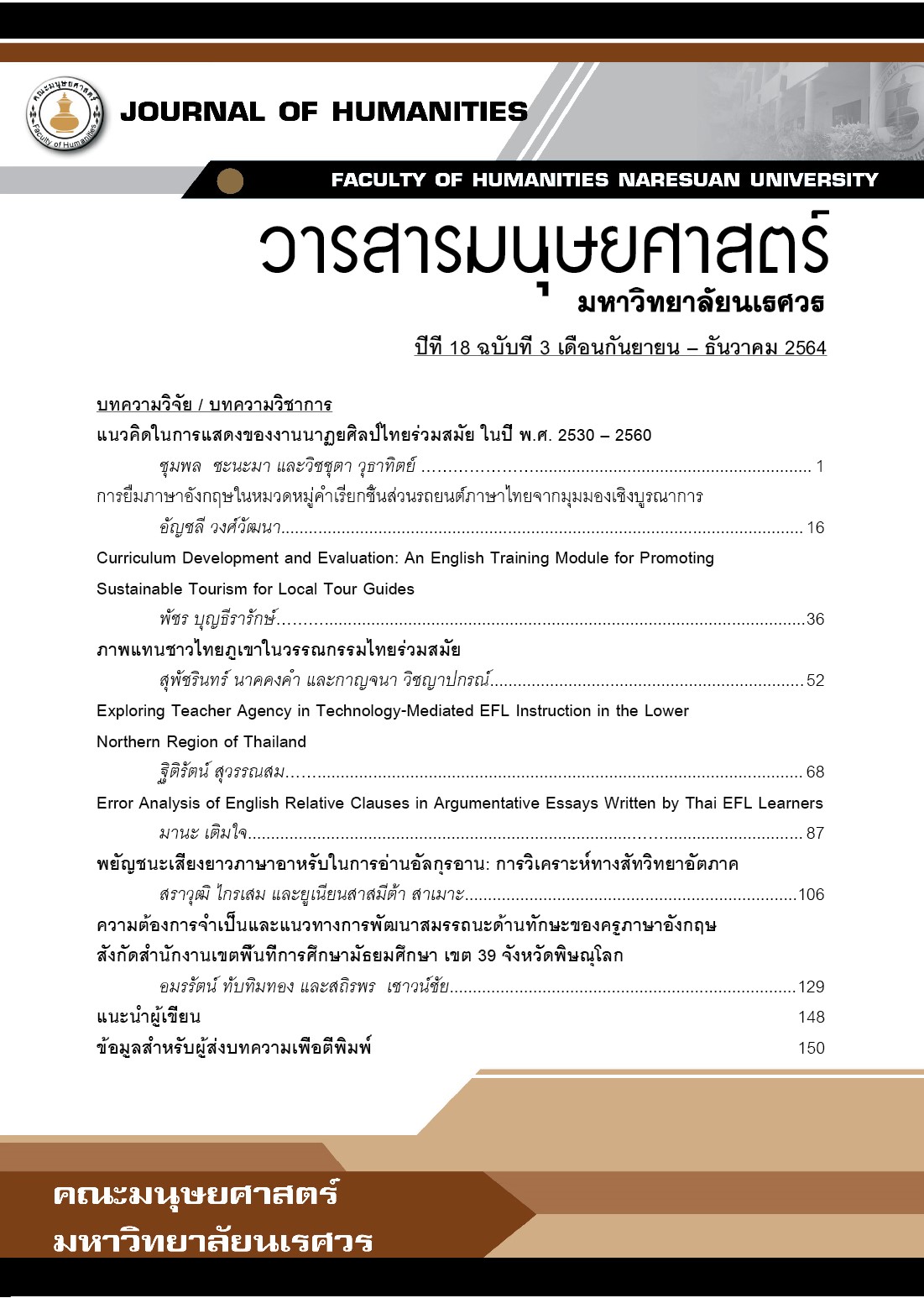
Exploring Teacher Agency in Technology-Mediated EFL Instruction in the Lower Northern Region of Thailand
Article Sidebar
Main Article Content
Abstract
Although ICT technology tools and social networking applications are being applied in Thai EFL classrooms at all levels, teacher agency which includes teachers’ experience, decision, and practice have been underexplored. This paper investigated EFL teachers’ agency in using technology in English language instruction. A questionnaire constructed on the three dimensions of agency was administered to 81 English teachers in primary and secondary schools in the lower northern region of Thailand. The result from the questionnaire revealed that teachers’ agency towards technology-mediated choices is embedded with their concurrent practice yet constrained with external limitations and lack of support. It is also suggested that teachers are likely to welcome technology if it fits into their concurrent pedagogical approaches and supports students’ collaborative and self-directed learning.
Article Details
ข้อความรู้ใดๆ ตลอดจนข้อคิดเห็นใดๆ เป็นของผู้เขียนแต่ละท่านโดยเฉพาะ คณะมนุษยศาสตร์ มหาวิทยาลัยนเรศวร และกองบรรณาธิการวารสารมนุษยศาสตร์ฯ ไม่จำเป็นต้องเห็นพ้องด้วย
References
Beauchamp, C. & Thomas, L. (2009). Understanding teacher identity: An overview of issues in the literature and implications for teacher education. Cambridge Journal of Education, 39(2), 175-189.
Biesta, G., Priestley, M., & Robinson, S. (2015). The role of beliefs in teacher agency. Teachers and Teaching: Theory and Practice, 21(6), 624-640.
Biesta, G., & Tedder, M. (2006). How is agency possible? Towards an ecological understanding of agency-as-achievement (Working Paper 5). Exeter: The Learning Lives Project.
Calvert, L. (2016). Moving from compliance to agency: What teachers need to make professional learning work. Oxford, OH: Learning Forward and NCTAF.
Chigona, A., Chigona, W., & Davids, Z. (2014). Educators’ motivation on integration of ICTs into pedagogy: case of disadvantaged areas. South African Journal of Education, 34(3), 1-8.
Cheng, P.L. (2017). Professional learning community (PLC): Technology integration at a Title I elementary school. Doctoral dissertation, Education Department, San Jose State University. doi: 10.31979/etd.58wj-dk5q.
Chomphuchart, N. (2013). Multiliteracies, technology and English language teaching and learning. University of the Thai Chamber of Commerce Journal, 33(2), 214-228.
Duff, P. A. (2012). Identity, agency, and second language acquisition. In A.Mackey & S.M. Gass (Eds.), Handbook of second language acquisition (pp. 410–426). London: Routledge.
Dweck, C. S. (2008). Mindset: The new psychology of success. Random House Digital, Inc.
Emirbayer, M., & Mische, A. (1998). What is agency? American Journal of Sociology, 103(4), 962 -1023.
Ertmer, P. A. (2005). Teacher pedagogical beliefs: the final frontier in our quest for technology integration? Educational Technology Research and Development, 53(4), 25-39.
Fullan, M. (2001). Changing forces: The sequel. London: Falmer Press.
Gandhi, H.K., & Lynch, R. (2017). A comparative study of teachers’ knowledge of common ICT software, their perceptions towards using ICT and their perceived self-confidence in integrating ICT in their classes according to gender in two international schools in Thailand. Scholar, 8(2), 78-93.
Gil-Flores, J., Rodríguez-Santero, J., & Torres-Gordillo, J. (2017). Factors that explain the use of ICT in secondary-education classrooms: The role of teacher characteristics and school infrastructure. Computers in Human Behavior, 68, 441-449.
Harré, R., & Slocum, N. (2003). Disputes as complex social events. Common Knowledge, 9(1), 100–118.
Hegelheimer, V. (2006a): When the technology course is required. In Levy, M. & Hubbard, P. (Eds.) Teacher education in CALL. Philadelphia: John Benjamins, 117-133.
Hegelheimer, V. (2006b). Helping ESL writers through a multimodal, corpus-based, online grammar resource. CALICO Journal, 24(1), 5-32.
James, P. T. (2008). Academic staff perceptions of ICT and e-learning: A Thai HE case study, The Turkish Online Journal of Educational Technology, 7(4), 36-45.
Johnson, K. E. (2015). Reclaiming the Relevance of L2 Teacher Education. Modern Language Journal, 99, 515-528.
Koehler, M. J., & Mishra, P. (2009). What is technological pedagogical content knowledge? Contemporary Issues in Technology and Teacher Education, 9(1), 60-70.
Kalaja, P., Barcelos, A. M. F., Aro, M., & Ruohotie-Lyhty, M. (2015). Beliefs, agency and identity in foreign language learning and teaching. New York: Springer.
Larson, L.C. (2008). Electronic reading workshop: Beyond books with new literacies and instructional technologies. Journal of Adolescent & Adult Literacy, 52(2), 121-131.
Levin, T., & Wadmany, R. (2008). Teachers’ views on factors affecting effective integration of information technology in the classroom: Developmental scenery. Journal of Technology and Teacher Education, 16(2), 233-263.
Loo, D. B., Trakulkasemsuk, W., & Zilli, P. J. (2017). Examining narratives of conflict and agency: Insights into non-local English teacher identity. The Journal of AsiaTEFL, 14(2), 292-306.
Mahmud, M.M. (2018). Technology and language–what works and what does not: A meta-analysis of blended learning research. The Journal of AsiaTEFL, 15(2), 365-382.
Meirink, J. A., Meijer, P., Verloop, N., & Bergen, T. C. M. (2009). Understanding teacher learning in secondary education: The relations of teacher activities to changed beliefs about teaching and learning. Teaching and Teacher Education, 25, 89–100.
Ngarmpornchai, A., & Adams, J. (2016). Students’ acceptance and readiness for E-learning in Northeastern Thailand. International Journal of Educational Technology in Higher Education, 13, 1-13.
Pilot, A. (2007). The teacher as a crucial factor in curriculum innovation, the case of Utrecht University. In Proceeding of Teaching and Learning according and after Bologna, at the Swiss Federal Institute of Technology (pp.1-19). Zurich, Switzerland.
Priestley, M. (2011). Schools, teachers and curriculum change: A balancing act? Journal of Educational Change, 12, 1-23.
Priestley, M. Biesta, G., & Robinson, S. (2013). Teachers as agents of change: Teacher agency and emerging models of curriculum. In M. Priestley & G. Biesta (Eds), Reinventing the curriculum: New trends in curriculum policy and practice (pp. 187-206). London: Bloomsbury Academic.
Priestley, M., Edwards, R., Priestley, A., & Miller, K. (2012). Teacher agency in curriculum making: Agents of change and spaces for maneuver. Curriculum Inquiry, 42, 191-214.
Ruohotie-Lyhty, M. (2013). Struggling for a professional identity: Two newly qualified language teachers' identity narratives during the first years at work. Teaching and Teacher Education, 30, 120-129.
Rogers, R., & Wetzel, M. M. (2013). Studying agency in literacy teacher education: A layered approach to positive discourse analysis. Critical Inquiry in Language Studies, 10(1), 62-92.
Saowapon, C., Laohajaratsaeng, T., Thammajinda, R., & Singharajwarapan, S. (2001). Education reform and e-learning in Thailand. Retrieved on December 14, 2019, from http://www.oecd.org/education/skills-beyond-school/2428376.pdf
Schulz, R., Isabwe, G.M., & Reichert, F. (2015). Ethical issues of gamified ICT tools for higher education. IEEE Conference on e-Learning e-Management and e-Services (IC3e), 27-31.
Suwannasom, T. & Novio, E.B. (2014). Faculty perceptions of roles in a blended language learning environment. ThaiTESOL Journal, 27(1), 65-82.
Suwannasom, T. & Catane, N. G. (2016). Exploring university students’ attitudes and strategies in a blended English language learning environment. Khon Kaen University International Journal of Humanities & Social Sciences, 6(1), 10-31.
Tanakachane, T. (2005). Factor Affecting ICT Integration into ELT in Nakhon Ratchasima Vocational Education Institutes. Master’s Thesis, Suranaree University of Technology.
van Driel, J., Beijaard, D., & Verloop, N. (2001). Professional development and reform in science education: the role of teachers’ practical knowledge. Journal of Research in Science Teaching, 38, 137-158.
van Lier, L. (2007). Action-based teaching, autonomy, and identity. Innovation in Language Teaching and Learning, 1, 46-65.
Vibulphol, J. (2004). Beliefs about language learning and teaching approaches of pre-service EFL teachers in Thailand, Doctoral dissertation, Oklahoma State University.
York-Barr, J., & Duke, K (2004). What do we know about teacher leadership? Findings from two decades of scholarship. Review of Educational Research, 74(3), 255–316.
Yunus, M. M., Nordin, N., Salehi, H., Embi, M. A., & Salehi, Z. (2014). Future of ICT as a pedagogical tool in ESL teaching and learning. Research Journal of Applied Sciences, Engineering and Technology, 7(4), 764-770.
Zhao, Y., Pugh, K., Sheldon, S., & Byers, J. L. (2002). Conditions for classroom technologyinnovations. Teachers College Record, 104(3), 482-515.
Zhao, Y., & Frank, K. (2003). Factors Affecting Technology Uses in Schools: An Ecological Perspective. American Educational Research Journal, 40(4), 807-840.
