
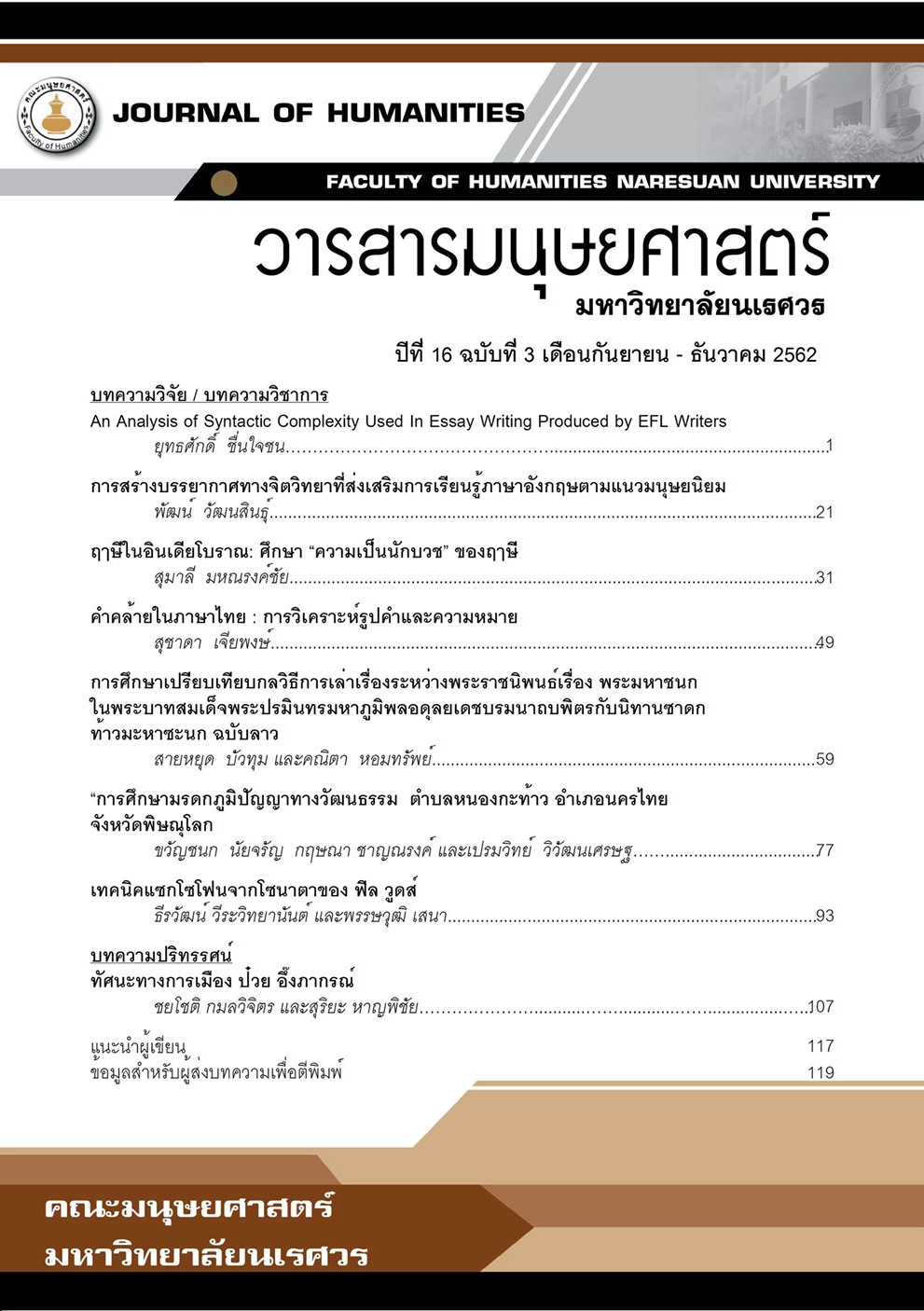
An Analysis of Syntactic Complexity Used in Essay Writing Produced by EFL Writers
Article Sidebar
Main Article Content
Abstract
The purpose of the study was to investigate the syntactic complexity of English essay writing of English learners and the clause types produced by these EFL writers. The participants were 49 third-year English major undergraduate students who enrolled in essay writing course (205223), at Naresuan University, Thailand. They were asked to do an argumentative essay writing test by choosing only one of the three given topics. Then, their essay scripts were collected and analyzed by looking at 1) the ratio of clause per T-unit (C/T), 2) the ratio of dependent clauses per clause (DC/C), and 3) the ratio of dependent clauses per T-units (DC/T). It was found that these syntactic complexity measures are proved to be feasible measures to explore the syntactic complexity of writing learners, and noun clauses were produced the most, followed by adverb clauses and adjective clauses, respectively. This study provides further pedagogical implications and recommendations in response to the findings, particularly for EFL writing instruction at the sentence level.
Article Details

This work is licensed under a Creative Commons Attribution-NonCommercial-NoDerivatives 4.0 International License.
ข้อความรู้ใดๆ ตลอดจนข้อคิดเห็นใดๆ เป็นของผู้เขียนแต่ละท่านโดยเฉพาะ คณะมนุษยศาสตร์ มหาวิทยาลัยนเรศวร และกองบรรณาธิการวารสารมนุษยศาสตร์ฯ ไม่จำเป็นต้องเห็นพ้องด้วย
References
Ai, H., & Lu, X. (2013). A corpus-based comparison of syntactic complexity in NNS and NS university students’ writing. In A. Díaz-Negrillo, N. Ballier & P. Thompson (Eds.), Automatic treatment and analysis of learner corpus data (pp. 249–264). Amsterdam: John Benjamins
Biber, D., & Gray, B. (2016). Grammatical complexity in academic English: Linguistic change in writing. Cambridge: Cambridge University Press.
Biber, D., Gray, B., & Poonpon, K. (2011). Should we use characteristics of conversation to measure grammatical complexity in L2 writing development? TESOL Quarterly, 45, 5-35.
British Council, IDP Education, & University of Cambridge (2018). IELTS task 2: Writing band descriptors (public version). Retrieved January 25, 2018, from https://takeielts.britishcouncil.org/sites/default/files/2018-01/IELTS_task_2_Writing_band_descriptors.pdf
Bulté, B., & Housen, A. (2012). Defining and Operationalising L2 Complexity. In A. Housen, F. Kuiken, & I. Vedder (Eds), Dimensions of L2 performance and proficiency - investigating complexity, accuracy and fluency in SLA (pp. 21-46). Amsterdam: John Benjamins.
Bulté, B., & Housen, A. (2014). Conceptualizing and measuring short-term changes in L2 writing complexity. Journal of Second Language Writing, 26, 42–65. doi:10.1016/j.jslw.2014.09.005
Chuenchaichon, Y. (2011). The development of paragraph writing for EFL writers through the use of a reading into writing method. Ph.D. thesis. University of Reading.
Educational Testing Service (2018). TOEFL iBT Test: Writing independent rubrics. Retrieved January 25, 2018, from https://www.ets.org/s/toefl/pdf/toefl_writing_rubrics.pdf
Hunt, K. (1966). Recent measures in syntactic development. Elementary English, 43, 732-739.
Hyland, K. (2003). Second language writing. Cambridge: Cambridge University Press.
Ji, X. (2009). English development of Chinese EFL student writers from sophomore to senior years. The Journal of Asia TEFL. 6(3), 375-397.
Kim, J. (2014). Predicting L2 writing proficiency using linguistic complexity measures: A corpus-based study. English Teaching, 69(4), 27-51. doi: 10.15858/engtea.69.4.201412.27
Li, Y. (2000). Linguistic characteristics of ESL writing in task-based e-mail activities. System, 28(2), 229-245.
Lu, X. (2010) Automatic analysis of syntactic complexity in second language writing. International Journal of Corpus Linguistics, 15(4), 474 –496. doi: 10.1075/ijcl.15.4.02lu
McWhorter, J. H. (2007). Language interrupted: Signs of non-native acquisition in standard language grammars. New York: Oxford University Press.
Newmeyer, F. J., & Preston, L. B. (2014). Introduction. In F. J. Newmeyer & L. B. Preston (Eds.), Measuring grammatical complexity (pp. 1–13). New York, NY: Oxford University Press.
Ortega, L. (2003). Syntactic complexity measures and their relationship to L2 proficiency: A research synthesis of college-level L2 writing. Applied Linguistics, 24(4), 492-518.
Oshima, A., & Hogue, A. (2006). Writing academic English (4th ed.). White Plains, NY: Pearson Longman.
Pallotti, G. (2015). A simple view of linguistic complexity. Second Language Research, 31(1), 117-134. doi:10.1177/0267658314536435
Polio, C. G. (1997). Measures of linguistic accuracy in second language writing research. Language Learning, 47(1), 101-143.
Seifoori, Z., & Fattahi, J. (2014). The comparison of the method section of applied linguistics articles written by native and Iranian writers in terms of grammatical complexity and clause types. Procedia - Social and Behavioral Sciences, 98, 1698-1705.
Shaw, P., & Ting-Kun Liu, E. (1998). What develops in the development of second-language writing? Applied Linguistics, 19(2), 225-254.
Storch, N. (2009). The impact of studying in a second language (L2) medium university on the development of L2 writing. Journal of Second Language Writing, 18(2), 103-118.
Tai, H. (2015). Writing development in syntactic complexity, accuracy and fluency in a content and language integrated learning class. International Journal of Language and Linguistics, 2(3), 149-156.
Wolfe-Quintero, K., Inagaki, S., & Kim, H.-Y. (1998). Second language development in writing: Measures of fluency, accuracy, and complexity. Honolulu, HI: University of Hawaii Press.
Yang, G. (2015). Grammatical features of structural elaboration and compression common in advanced ESL academic writing. M.A. thesis, Brigham Young University. Retrieved from http://scholarsarchive.byu.edu/cgi/viewcontent.cgi?article=6285&context=etd
