
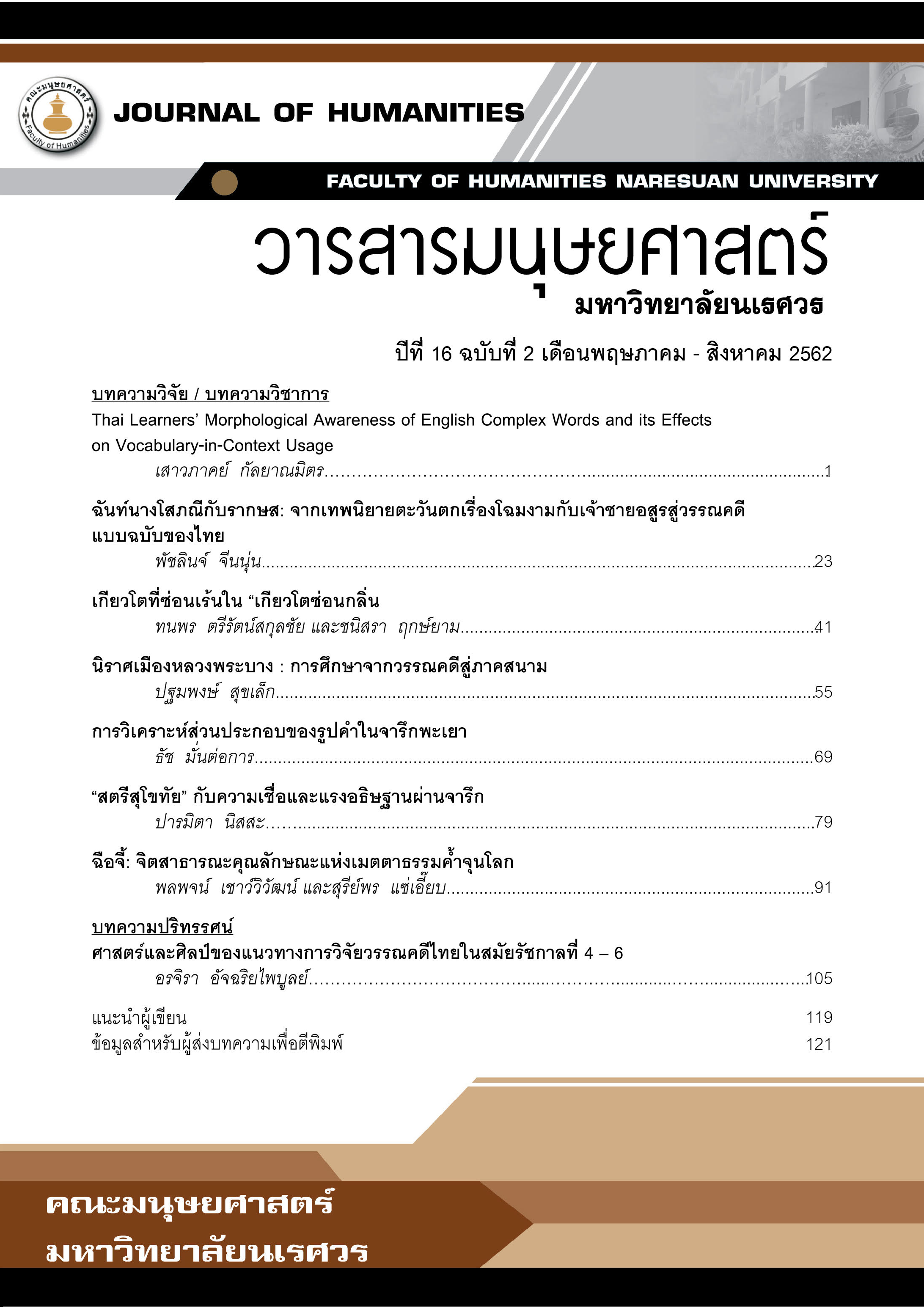
Thai Learners’ Morphological Awareness of English Complex Words and its Effects on Vocabulary-in-Context Usage
Article Sidebar
Main Article Content
Abstract
This research aimed to examine fifty-three Thai learners’ morphological awareness (or MA) of English complex words and to investigate its effects on vocabulary-in-context usage. Four multiple-choice tests were constructed with complex words containing two to five morphemes and free and bound roots and with affixes governed by the selectiveness of derivation constraint. It was found that the increased number of constituent morphemes and the bound roots did not affect the MA. No correlation was found between the awareness of morphemic structures and meanings. The selectiveness constraint was satisfied in some affixes only. Only the awareness of morphemic meanings extended a significant contribution to vocabulary-in-context usage. L1 transfer was not attested, but irregularity of inflection and polysemy of affixes provided a more effective account for Thai learners’ morphological awareness.
Article Details
ข้อความรู้ใดๆ ตลอดจนข้อคิดเห็นใดๆ เป็นของผู้เขียนแต่ละท่านโดยเฉพาะ คณะมนุษยศาสตร์ มหาวิทยาลัยนเรศวร และกองบรรณาธิการวารสารมนุษยศาสตร์ฯ ไม่จำเป็นต้องเห็นพ้องด้วย
References
Akbulut, F. D. (2017). Effects of morphological awareness on second language vocabulary knowledge. Journal of Language and Linguistic Studies, 13(1), 10-26.
Carstairs-McCarthy, A. (2010). An introduction to English morphology: Words and their structure. Edinburgh: Edinburgh University Press.
Deng, T., Shi, J., Dunlap, S., Bi, H., & Chen, B. (2016). Morphological knowledge affects processing of L2 derivational morphology: An event-related potential study. Journal of Neurolinguistics, 37, 47-57.
Dyson, B. (2009). Processability theory and the role of morphology in English as a second language development: A longitudinal study. Second Language Research, 25(3), 355-376.
Ellis, R. (2002). The study of second language acquisition (9th ed.).Oxford: Oxford University Press.
Evans, J. D. (1996). Straightforward statistics for the behavioral sciences. Pacific Grove, CA: Brooks/Cole Publishing.
Flanigan, K., Templeton, S., & Hayes, L. (2012). What’s in a word? Using content vocabulary to generate growth in general academic vocabulary knowledge. Journal of Adolescent & Adult Literacy, 56(2), 132-140.
Fromkin, V., Rodman, R., & Hyams, N. (2017). An introduction to language. MA: Boston.
Gass, S. M.andSelinker, L. (1994). Second language acquisition: An introductory course. New Jersey: Lawrence Erlbaum Associates.
Hashemi, M., & Aziznezhad, M. (2011). Etymology: A word attack strategy for learning the English vocabulary. Social and Behavioral Sciences, 28, 102-106.
Haspelmath, M. & Sims, A. D. (2010). Understanding morphology (2nd ed.). London: Routledge. Hinton, P.R., Brownlow, C., McMurray, I., & Cozens, M. (2004). SPSS explained. London: Routledge
Iwasaki, S. & Ingkaphirom, P. (2005). A reference grammar of Thai. New York: Cambridge University Press.
Jeon, E. H. (2011). Contribution of morphological awareness to second-language reading comprehension. The Modern Language Journal, 95, ii, 217-236.
Karlsson, M. (2015). Advanced students’ L1 (Swedish) and L2 (English) mastery of suffixation. International Journal of English Studies, 15(1), 23-49.
Kraut, R. (2015). The relationship between morphological awareness and morphological decomposition among English language learners. Read Writ, 28, 873-890.
Lardiere, D. (2006). Words and their parts. In R. Fasold & J. Conner-Linton (Eds.), An introduction to language and linguistics (pp.55-96). Cambridge: Cambridge University Press.
Li, M. (2017). The effect of L1 Chinese transfer on L2 English learning: A brief review of the research. Theory and Practice in Language Studies, 7(5), 350-355.
Lieber, R. (2010). Introducing morphology. Cambridge: Cambridge University Press.
Masrai, A. M. (2016). The influence of morphological knowledge on lexical processing and acquisition: The case of Arab EFL learners. Ampersand, 3, 52-60.
Mochizuki, M., & Aizawa, K. (2000). An affix acquisition order for EFL learners: An exploratory study. System, 28, 291-304.
Oz, H. (2014). Morphological awareness and some implications for English language teaching. Social and Behavioral Sciences, 136, 98-103.
Paiman, N., Thai, Y. N., & Yuit, C. M. (2015). Effectiveness of morphemic analysis of Graeco-Latin word parts as a vocabulary learning strategy among ESL learners. 3L: The Southeast Asian Journal of English Language Studies, 21(2), 31-45.
Saville-Troike, M. (2004). Introducing second language acquisition (3rded.). New York: Cambridge University Press.
Solati, A. (2014). Word-formation: A systematic way to enrich power of medical students. Modern Journal of Language Teaching Methods, 4(1), 20-33.
Tahaineh, Y. (2012). The awareness of the English word-formation mechanisms is a necessity to make an autonomous L2 learner in EFL context. Journal of Language Teaching and Research, 3(6), 1105-1113.
Ward, J., & Chuenjundaeng, J. (2009). Suffix knowledge: Acquisition and applications. System, 37, 461-469.
Zhang, D., & Koda, K. (2012). Contribution of morphological awareness and lexical inferencing ability to L2 vocabulary knowledge and reading comprehension among advanced EFL learners: testing direct and indirect effects. Read Writ, 25, 1195-1216.
Zhang, D., & Koda, K. (2013). Morphological awareness and reading comprehension in a foreign language: A study of young Chinese EFL learners. System, 41, 901-913.
Zhang, D., Koda, K., & Sun, X. (2014). Morphological awareness in biliteracy acquisition: A study of young Chinese EFL readers. International Journal of Bilingualism, 18(6), 570-585.
Zhang, Y. & Widyastuti, I. (2010). Acquisition of L2 English Morphology: A family case study. Australian Review of Applied Linguistics, 33(3), 29.1-29.17.
