
Linguistic Strategies Conveying Political Ideologies in Weekly Gag-Cartoon Magazines
Article Sidebar
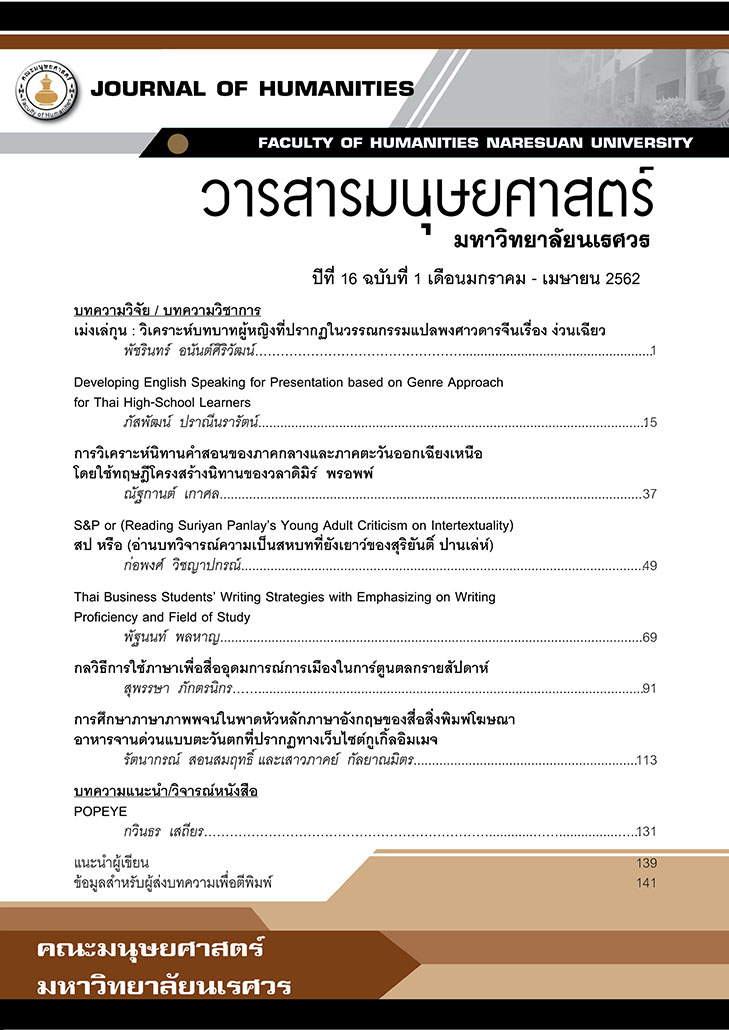
Main Article Content
Abstract
This research aims at studying linguistic strategies which convey political ideologies in weekly gag-cartoon magazine, Kai-Hua-Roh and Maha Sanook, published during 2014-2015, 15 stories; through critical discourse analysis, involved with conception of narratology.
The results revealed that the political ideologies consist of 3 sub-ideologies: a desired government, an undesired government and anti-military government. Various linguistic strategies were manipulated for representing these ideological concepts including the use of intertextuality, presupposition, lexical, sentences, tone of a literary, plot, visual communication, These ideologies involved with political ideologies in Thai society
Article Details
ข้อความรู้ใดๆ ตลอดจนข้อคิดเห็นใดๆ เป็นของผู้เขียนแต่ละท่านโดยเฉพาะ คณะมนุษยศาสตร์ มหาวิทยาลัยนเรศวร และกองบรรณาธิการวารสารมนุษยศาสตร์ฯ ไม่จำเป็นต้องเห็นพ้องด้วย
References
กาญจนา เจริญเกียรติบวร. (2548). การวิเคราะห์วาทกรรมเรื่องตลกภาษาไทย. วิทยานิพนธ์ปริญญาดุษฎีบัณฑิต ภาควิชาภาษาศาสตร์ จุฬาลงกรณ์มหาวิทยาลัย.
ชูศักดิ์ ภัทรกุลวณิชย์. (2545). อ่าน (ไม่) เอาเรื่อง. กรุงเทพฯ: โครงการจัดพิมพ์คบไฟ.
ณัฐพร พานโพธิ์ทอง. (2556). วาทกรรมวิเคราะห์เชิงวิพากษ์ตามแนวภาษาศาสตร์: แนวคิดและการนำมาศึกษาวาทกรรมในภาษาไทย. กรุงเทพฯ: จุฬาลงกรณ์มหาวิทยาลัย.
ทีมข่าวอาชญากรรม. (2556). จ่าเฉย...เดอะซีรีส์: รายงาน. (คมชัดลึกออนไลน์). http://www.komchadluek.net/news/crime/ 170949, 20 กุมภาพันธ์ 2561.
นพพร ประชากุล. (2552). ยอกอักษร ย้อนความคิด เล่ม 1 ว่าด้วยวรรณกรรม. กรุงเทพฯ: อ่าน.
ภาวดี สายสุวรรณ. (2551). ค่านิยมที่สะท้อนในมุขตลกในการ์ตูนช่องของไทย. วารสารดำรงวิชาการ, 9(2), 137-162.
รินคำ. (2559). อุตสาห ‘ขำ’ บก.วิธิต-พิมพ์พิชา อุตสาหจิต. นิตยสารออล, 11(6), 23-29.
ลินิน แสงพัฒนะ. (2557). สัมพันธบทของตัวละครนางเอกในสื่อละครโทรทัศน์ กรณีศึกษาละครโทรทัศน์เรื่องแรงเงา. ปริญญานิเทศศาสตรมหาบัณฑิต คณะนิเทศศาสตร์ สาขาวิชาการสื่อสารเชิงกลยุทธ์ มหาวิทยาลัยกรุงเทพ.
วรพงศ์ ไชยฤกษ์. (2556). วาทกรรมวิเคราะห์เชิงวิพากษ์: มุมมองใหม่ในการวิจัยทางภาษาไทย.วารสารมนุษยศาสตร์สังคมศาสตร์ มหาวิทยาลัยทักษิณ, 8(1), 135-162.
ศิริพร ภักดีผาสุก. (2549). อารมณ์ขันในการ์ตูนการเมืองไทย. วารสารภาษาและวรรณคดีไทย, 23, 86-43.
Eagleton, Terry. (1996). Literary Theory An Introduction. Oxford: Blackwell Publishers.
Fairclough, Norman. (1992). Discourse and social change. Cambridge: Polity.
Fairclough, Norman. (1995). Media Discourse. London: Arnold.
Halliday, Michael. (1978). Language as Social Semiotic. London: Edward Arnold.
_______________. (1994). An Introduction to Functional Grammar, second edition. London: Edward Arnold.
Halmari, Helena. (1999). Discourse of dealth: The Function of the Local Newspaper Coverage of Huntsville, Texas Executions.In J. Verschueren (ed.), Language and Ideology: Selected Papers from the 6th International Pragmatics Conference. Antwerp, International Pragmatics Association, Vol.1, 179-205.
Kayode Samuel, Ariyo. (2017). Satirizing the Nigerian Climate: Multimodal Discourse Analysis of Selected Political Cartoons from TELL Newsmagazine, Asian Research Journal of Arts & Social Sciences, 3(4), 1-10.
van Dijk,Teun A. (1998). Ideology: A Multidisciplinary Approach. London: Sage.
______________. (2006). Discourse and Manipulation. Discourse and Society, 17(2), 359-383.
______________. (2009). Critical Discourse Studies: A Sociocognitive Approach. Cambridge: Cambridge University Press.
Wolfreys, Julian. (2004). Critical Keywords in Literary and Cultural Theory. Hampshire: Palgrave Macmillan.
