
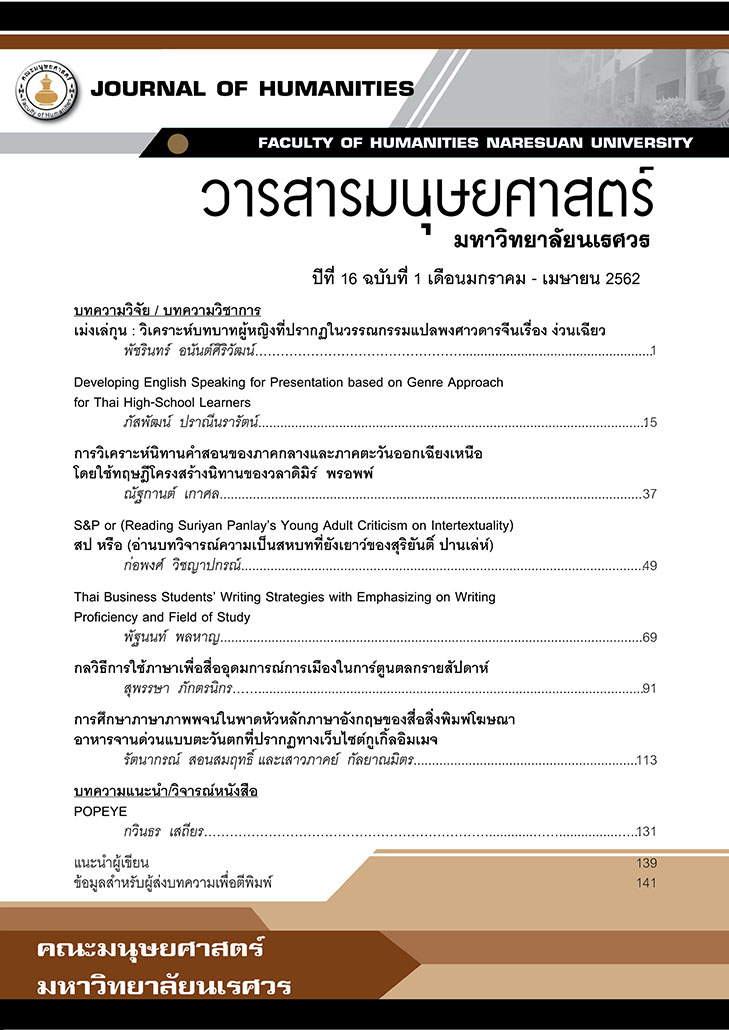
Developing English Speaking for Presentation based on Genre Approach for Thai High-School Learners
Article Sidebar
Main Article Content
Abstract
Owing to the current situation, many English-speaking lessons have problems in linguistic guides to engage Thai adolescent learners to progress speaking ability for presenting factual information. Hence, this research has an objective to develop Thai EFL adolescent learners’ speaking ability at this specific point from speaking lessons designed based on the genre approach (Derewianka 1990). The participants were a small group of Thai high-school students at Satriwithaya School. Two instruments, including: 1) the two new speaking lessons designed based on the genre approach for the practices of presenting factual information (information-report genre), and 2) a video recorder, were applied for the data collection. The findings of this research implied many useful points for developing speaking lessons and pedagogy for Thai EFL adolescent learners.
Article Details
ข้อความรู้ใดๆ ตลอดจนข้อคิดเห็นใดๆ เป็นของผู้เขียนแต่ละท่านโดยเฉพาะ คณะมนุษยศาสตร์ มหาวิทยาลัยนเรศวร และกองบรรณาธิการวารสารมนุษยศาสตร์ฯ ไม่จำเป็นต้องเห็นพ้องด้วย
References
Berendt, E. A. (2009). For Communication and Learning: Research in Spoken and Applied Discourse. Bangkok: Assumption University Press.
Bolton, K. (2008). English in Asia, Asian Englishes, and the Issue of Proficiency. English Today, 94, 24(2), 3-12.
Cheng, A. (2007). Transferring Generic Features and Recontextualizing Genre Awareness: Understanding Writing Performance in the ESP Genre-Based Literacy Framework. English for Specific Purposes, 26(3), 287-307.
Conlon, S. (2009). Chaos in the Classroom. Bangkok: Assumption University Press.
Derewianka, B. (1990). Exploring How Texts Work. NSW: Primary English Teaching Association.
Derewianka, B. and Jones, P. (2012). Teaching Language in Context. Melbourne: Oxford University Press.
Foley, J. A. (2011). Grammar Meaning and Discourse. Bangkok: Assumption University Press.
Gardner, S. and Nesi, H. (2013). A Classification of Genre Families in University Student Writing. Applied Linguistics, 34(1), 25-52.
Johns, A. M. (2003). Genre and ESL/EFL Composition Instruction. In B. Kroll (ed.). Exploring the Dynamics of Second Language Writing. Cambridge: Cambridge University Press. 195-217.
Lewis, M. and McCook, F. (2002). Cultures of Teaching: Voices from Vietnam. ELT Journal, 56(2), 146-153.
Myskow, G. and Gordon, K. (2010). A Focus on Purpose: Using a Genre Approach in an EFL Writing Class. ELT Journal, 64(3), 283-292.
Paran, A. (2012). Language Skills: Questions for Teaching and Learning. ELT Journal. 66(4), 450-458.
Sutinwong, N. (2015). An Analysis of Genre Writing of Thai Adolescent learners found in the Writing of Genre of Recount and Information Reports. Unpublished Master’s Thesis, Assumption University, Bangkok, Thailand.
Thu, A. M. (2009). The Effects of Using a Genre-Based Approach in Teaching English Writing Skills: A Small-Scale Study on Undergraduate Students in Myanmar. Unpublished Master’s Thesis, Assumption University, Bangkok, Thailand.
Tudor, I. (1996). Learner-Centredness as Language Education. Cambridge: Cambridge University Press.
