
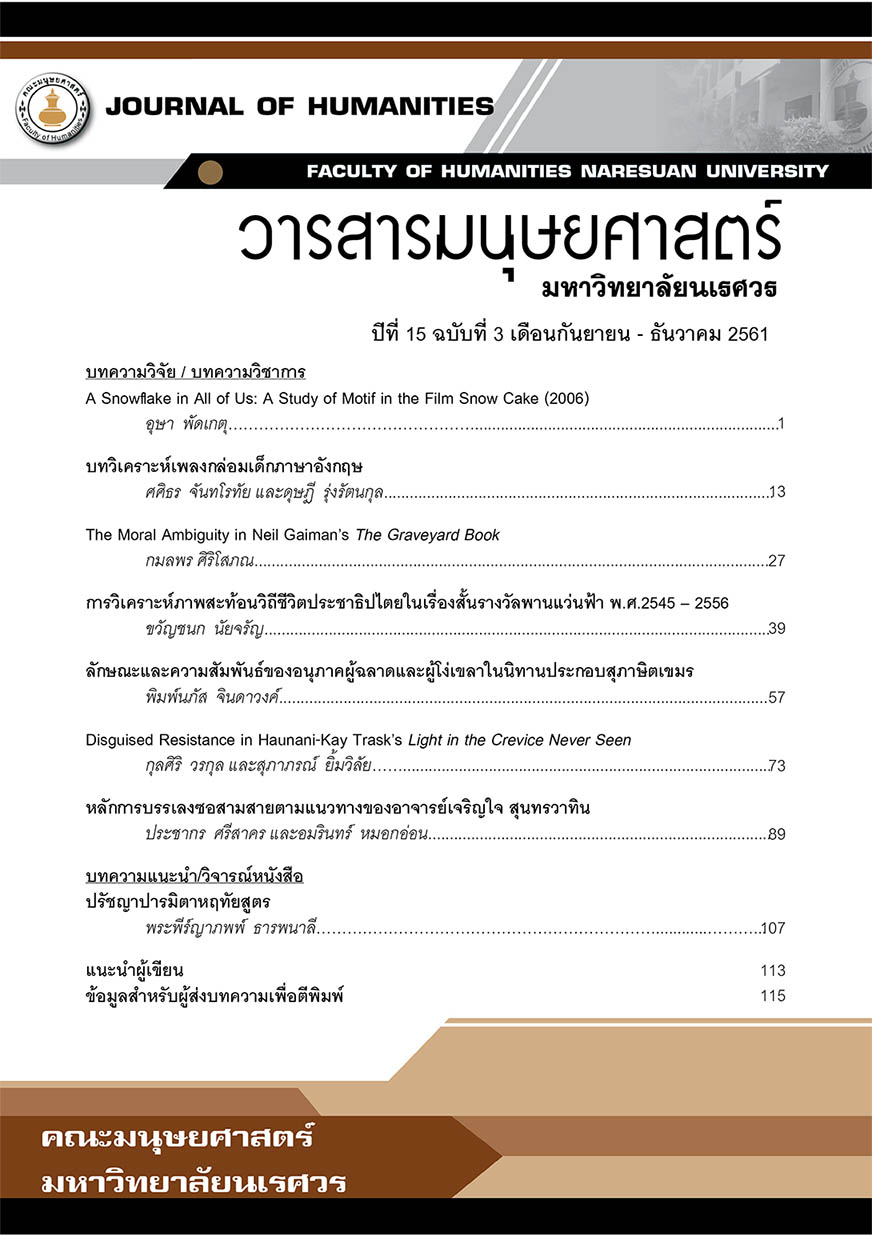
Characteristics and Relationship between the Wise and the Foolish Motifs in Khmer Fable Tales
Article Sidebar
Main Article Content
Abstract
This article aims to examine important characteristics and relationship between “the wise” and “the foolish” motifs in 47 Khmer fable tales. The data were gathered from Prachum rueang tamnan lae nithan phuenban Khamen phakthi 1-9 (ประชุมเรื่องตำนานและนิทานพื้นบ้านเขมร ภาคที่ 1-9) and Motif-Index of Folk Literature by Stith Thompson’s method was used for comparison analysis. The result shows that the wise and the foolish characters in Khmer fable tales have both universal and distinctive characteristics. The wise, considered from their distinctive characteristics, are weak and small animals, inferior men, fathers-in-law, kings, widows and God Indra; whereas the foolish are Buddhist monks, elder brothers-in-law, fathers-in-law, young men, little girls, thieves, parents, ghosts, giants, noble men and tree guardian spirits. Both human and animal characters represent each type of Khmer folks and reflect Khmer socio-cultural ways. Furthermore, the study reveals five types of relationship: 1) conflict between bigger and smaller animals 2) conflict between man and animal 3) conflict between men and/or man and supernatural being 4) friendship between man and animal 5) friendship between men. These relationships show how the Khmer common men release their stressed getting from the governors’ and/or the superiors deeds. It educates social members to realize how significant of cleverness, kinds of friends, mate selection and proper relation between the rulers and the subordinates, as well. It also reflects the Khmer ways of lives and governance system.
Article Details
ข้อความรู้ใดๆ ตลอดจนข้อคิดเห็นใดๆ เป็นของผู้เขียนแต่ละท่านโดยเฉพาะ คณะมนุษยศาสตร์ มหาวิทยาลัยนเรศวร และกองบรรณาธิการวารสารมนุษยศาสตร์ฯ ไม่จำเป็นต้องเห็นพ้องด้วย
