
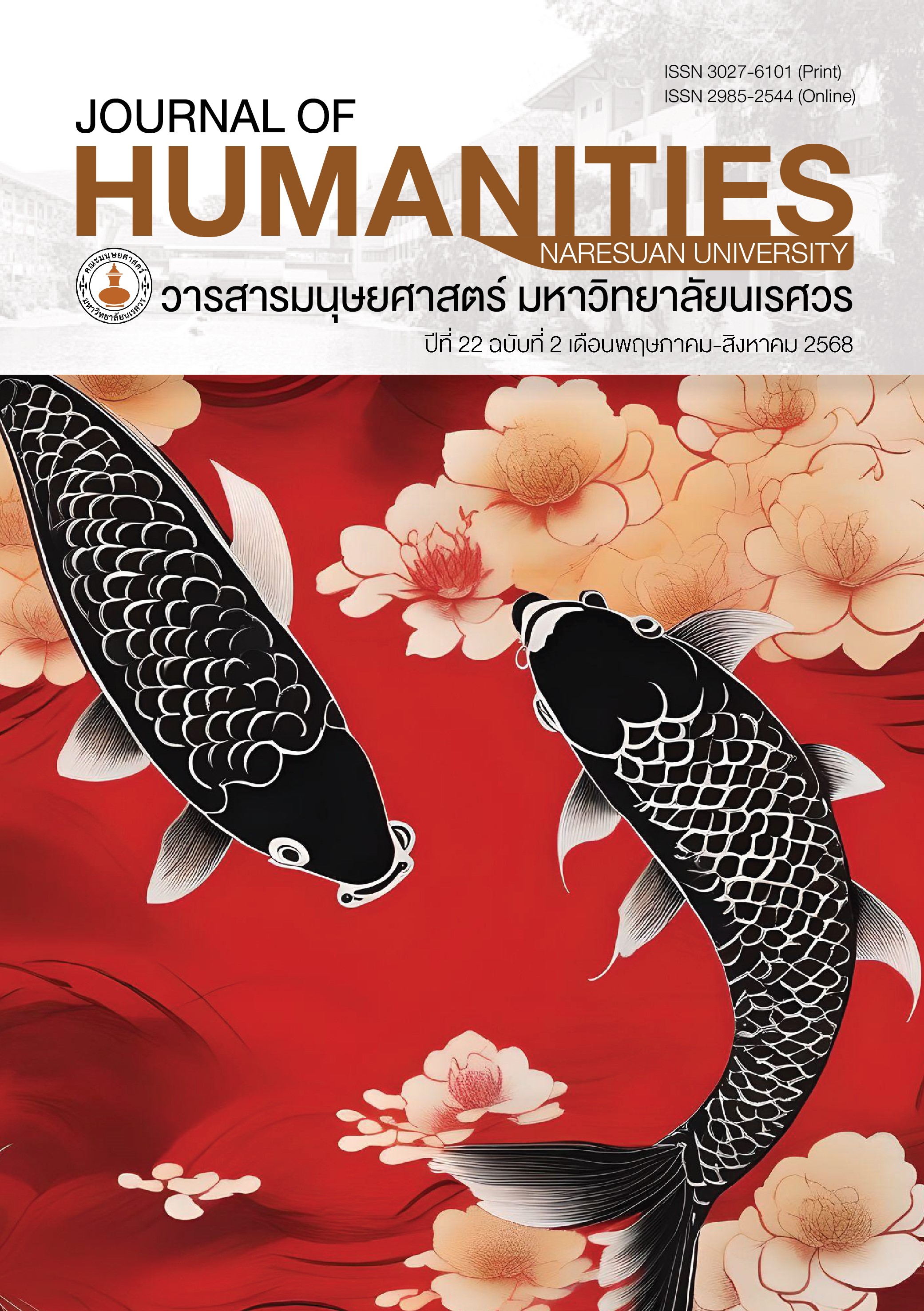
ความหมายและบทบาทของลวดลายปลาในวัฒนธรรมจีน
Article Sidebar
Main Article Content
บทคัดย่อ
บทความวิชาการเรื่องนี้มุ่งเน้นศึกษาความหมายและบทบาทของลวดลายปลาในวัฒนธรรมจีนโดยสังเขป นำเสนอเนื้อหา 3 ประเด็น ได้แก่ 1. ความหมายและความเป็นมาของลวดลายปลา 2. ลวดลายปลาในยุคก่อนประวัติศาสตร์จีน-ยุคประวัติศาสตร์จีน 3. บทบาทของลวดลายปลาที่ปรากฏตามสิ่งของเครื่องใช้ หรือสถานที่ต่าง ๆ ซึ่งพบได้อย่างชัดเจนตามหลักฐานทางโบราณคดี เช่น ตราสัญลักษณ์ประจำตัวรูปปลาในสมัยราชวงศ์ถัง แท่นฝนหมึกลายปลาในสมัยราชวงศ์ซ่ง รูปแบบและรูปลักษณ์ของลวดลายปลาเปลี่ยนแปลงไปตามยุคสมัย ตามเหตุปัจจัยที่แตกต่างกัน แต่ยังคงมีความหมายในด้านดีเป็นสิริมงคล สะท้อนวิถีชีวิตความผูกพันระหว่างชาวจีนกับปลาที่มีมาแต่ในอดีต การประยุกต์ใช้ปลาในฐานะรูปและลวดลายปลาจึงอยู่คู่ชาวจีนมาอย่างยาวนาน และมีความหลากหลาย จนกระทั่งสามารถพัฒนาไปเป็นลวดลายปลาที่มีเอกลักษณ์ และได้กลายเป็นส่วนหนึ่งของวัฒนธรรมจีนในปัจจุบัน
Article Details

อนุญาตภายใต้เงื่อนไข Creative Commons Attribution-NonCommercial-NoDerivatives 4.0 International License.
ข้อความรู้ใด ๆ ตลอดจนข้อคิดเห็นใด ๆ เป็นของผู้เขียนแต่ละท่านโดยเฉพาะ คณะมนุษยศาสตร์ มหาวิทยาลัยนเรศวร และกองบรรณาธิการวารสารมนุษยศาสตร์ฯ ไม่จำเป็นต้องเห็นพ้องด้วย
เอกสารอ้างอิง
Chen, Y., Zhong, W., & Liang, W. (2021). Tracing the origin and artistic characteristics of flying fish pattern in Ming dynasty. Fashion Guide Journal, 10(6), 32-37. https://shorturl.at/58tuk
Cheng, J., & Jiang, J. (2019). Shi Jing annotation (3rd ed.). Zhonghua Book Company.
Dulyasucharit, T. (2002). Sanyalak mongkhon chin suepsan chit-winyan banphachon [Auspicious Chinese symbols spiritual and ancestral spirit transmission]. Sangsan books.
Gao, S. (2017). Study on characteristics of large wood in Liaoning Qing dynasty [Unpublished Master's thesis]. Shenyang Jianzhu University.
Guanfu Museum. (2020, 18 February). Hóng mù lǐ shí miàn shuāng yú wén xiù dūn qīng zhōng qī [Rosewood marble cushion with double fish pattern, mid-Qing dynasty] [Image]. http://www.guanfumuseum.org.cn/view.php?cid=543&sid=4
Hu, J. (2016). How to comfort parting - the hairpin as a token. In M. Wang (Ed.), Master's gate 13 (pp. 164-172). Guangxi Fine Arts Publishing House.
Ingkhawet, Y. (1989). Wiwattanakan kawinipon: Suejing chuchue [Evolution of Chinese poetry: Shi Jing: Chu Ci]. Sathirakoses-Nagapradipa Foundation.
Ji, R. (2019). Research on the application of Feiyu robe in the Ming dynasty [Unpublished Master’s thesis]. Beijing Institute of Fashion Technology.
Jia, X. (2020). History of Chinese clothing. Donghua University Press.
Jiang, L. (2017). Study of pre-Qin dynasty jade decorative art [Unpublished Doctoral dissertation]. Shanxi University.
Jin, J. (2022). Application and innovative design of traditional fish pattern in Guochao clothing [Master's thesis]. Qingdao University. [In Chinese]
Jingzhou Museum. (n.d.). Qī mù cǎi huì sān yú wén ěr bēi [Lacquer wood cup with three fish patterns] [Image]. http://jzmsm.org/news-353.html
Lai, F. (2006). Fish line decorations in Chinese traditional folk life form. Packaging Engineering Journal, 27(4), 1-3. https://shorturl.at/hYD3A
Liu, H. (2019). Study on the inheritance and development of ceramic fish pattern [Master's thesis]. Jingdezhen Ceramic University. [In Chinese]
Liu, L. (2022). Research on decoration design of fish pattern in Zibo fish plate from the perspective of folk art [Master's thesis]. Jingdezhen Ceramic University. [In Chinese]
Liu, Q., Liu, J., Shen, Y., Zhang, X., & Zhang, L. (2012). Chinese auspicious painting illustration. Baihua Literature and Art Publishing House.
National Museum of China. (n.d.). Rén miàn yú wén cǎi táo pén [Painted pottery basin with human face and fish pattern] [Image]. https://www.chnmuseum.cn/zp/zpml/kgfjp/202008/t20200824_247218.shtml
Ning, B., Liu, S., & He, L. (2017). Metaphor image and historical evolution of Chinese ancient fish culture. Chinese Fisheries Economics Journal, 35(4), 93-99. https://qikan.cqvip.com/Qikan/Article/Detail?id=673820628&from=Qikan_Article_Detail
Pan, G. (2009). History of Chinese architecture (sixth edition). China Architecture & Building Press.
Shen, C., & Wang, X. (2004). History of Chinese clothing. Shaanxi Normal University General Publishing House.
Shu, W. (2012). Auspicious designs of China: Chinese-English bilingual (Chinese red). Huangshan Publishing House.
The Palace Museum. (n.d.). Wǔ cǎi yú zǎo wén gài guàn [Colorful fish and algae pattern lidded jar] [Image]. https://www.dpm.org.cn/collection/ceramic/227384.html
Wang, X. (2008). Research on official clothing of the Ming dynasty. Journal of Gugong Studies. 5(1), 180-216. https://shorturl.at/OJHNh
Zhang, H. (2018). Bead embroidery art design. Tsinghua University Press.
Zhang, Y. (2022). An iconographic study of fish-dragon stilts shaped sparrows in Chinese architectural components. Interior Architecture of China, 242(14), 102-104. https://shorturl.at/XGZu1
Zheng, J. (2011). Folk auspicious patterns: Continued. Beijing Arts and Crafts Press.
Zhou, X. (2012). Poet tamnan thetsakan chin [Revealing the legend of Chinese festivals] (T. Sikkhakoson, Trans). Matichon. (Original work published 2009)
Zhou, X., & Gao, C. (1994). A grand view of ancient Chinese clothing. Chongqing Publishing House.
