
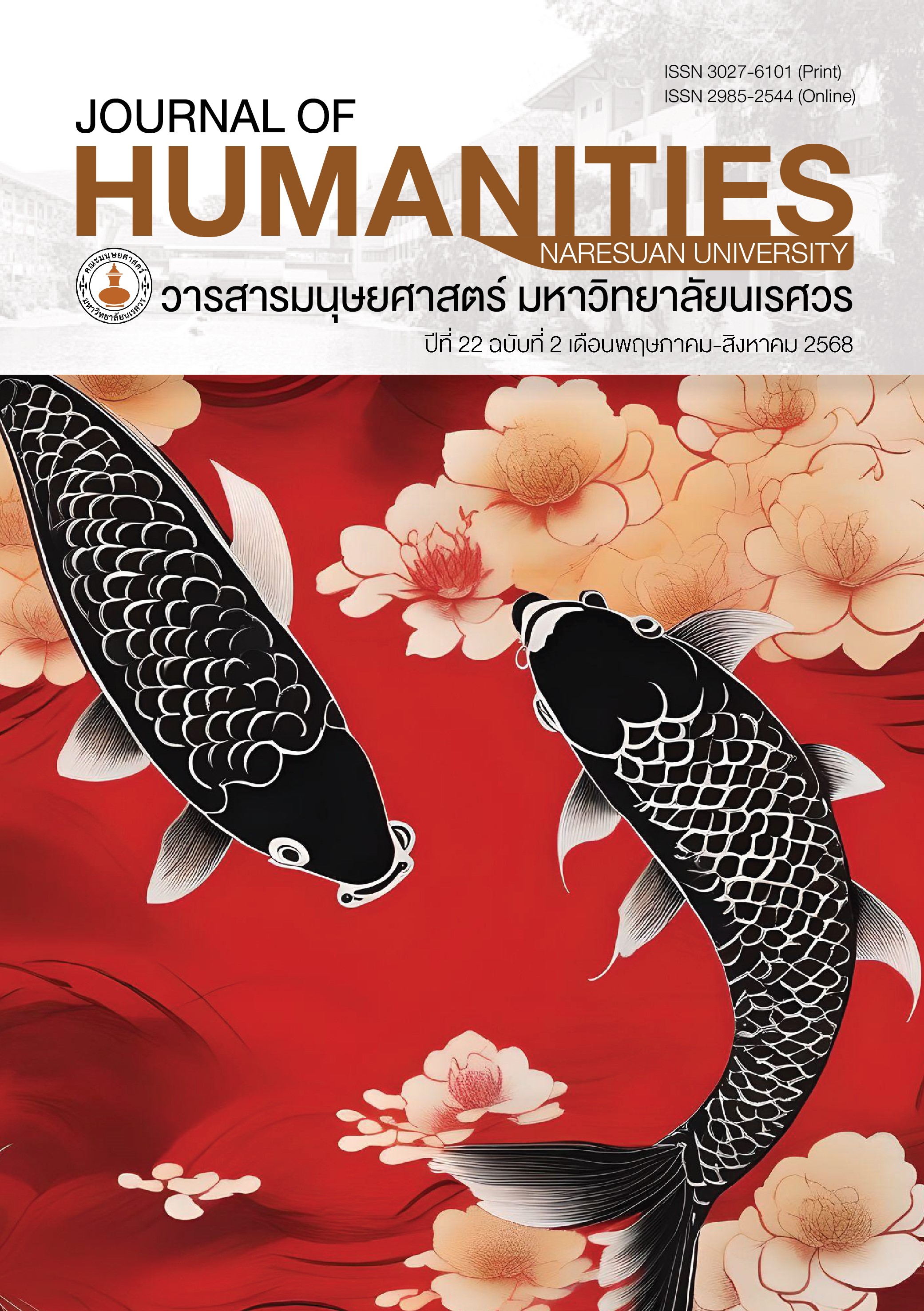
Meanings and Roles of Fish Patterns in Chinese Culture
Article Sidebar
Main Article Content
Abstract
This academic article aimed to study meanings and roles of fish patterns in Chinese culture in brief. There are 3 issues presented: 1) meanings and history of fish patterns 2) fish patterns in the prehistoric–historical periods of China and 3) roles of fish patterns on utensils or places, which of them were obvious archeological evidence such as the Tang Dynasty’s fish symbol or the Song Dynasty’s ink stone and so on. Fish patterns and appearances have changed over time, depending on different factors. However, the positive meaning of fish has still remained in terms of auspiciousness. Fish has reflected the Chinese ways of life and the relationship between Chinese people and fish which has existed since the past. Fish has been applied as images and patterns for a long period of time by Chinese people. There are so various patterns that they can be developed into unique ones and have become part of the modern Chinese culture.
Article Details

This work is licensed under a Creative Commons Attribution-NonCommercial-NoDerivatives 4.0 International License.
ข้อความรู้ใดๆ ตลอดจนข้อคิดเห็นใดๆ เป็นของผู้เขียนแต่ละท่านโดยเฉพาะ คณะมนุษยศาสตร์ มหาวิทยาลัยนเรศวร และกองบรรณาธิการวารสารมนุษยศาสตร์ฯ ไม่จำเป็นต้องเห็นพ้องด้วย
References
Chen, Y., Zhong, W., & Liang, W. (2021). Tracing the origin and artistic characteristics of flying fish pattern in Ming dynasty. Fashion Guide Journal, 10(6), 32-37. https://shorturl.at/58tuk
Cheng, J., & Jiang, J. (2019). Shi Jing annotation (3rd ed.). Zhonghua Book Company.
Dulyasucharit, T. (2002). Sanyalak mongkhon chin suepsan chit-winyan banphachon [Auspicious Chinese symbols spiritual and ancestral spirit transmission]. Sangsan books.
Gao, S. (2017). Study on characteristics of large wood in Liaoning Qing dynasty [Unpublished Master's thesis]. Shenyang Jianzhu University.
Guanfu Museum. (2020, 18 February). Hóng mù lǐ shí miàn shuāng yú wén xiù dūn qīng zhōng qī [Rosewood marble cushion with double fish pattern, mid-Qing dynasty] [Image]. http://www.guanfumuseum.org.cn/view.php?cid=543&sid=4
Hu, J. (2016). How to comfort parting - the hairpin as a token. In M. Wang (Ed.), Master's gate 13 (pp. 164-172). Guangxi Fine Arts Publishing House.
Ingkhawet, Y. (1989). Wiwattanakan kawinipon: Suejing chuchue [Evolution of Chinese poetry: Shi Jing: Chu Ci]. Sathirakoses-Nagapradipa Foundation.
Ji, R. (2019). Research on the application of Feiyu robe in the Ming dynasty [Unpublished Master’s thesis]. Beijing Institute of Fashion Technology.
Jia, X. (2020). History of Chinese clothing. Donghua University Press.
Jiang, L. (2017). Study of pre-Qin dynasty jade decorative art [Unpublished Doctoral dissertation]. Shanxi University.
Jin, J. (2022). Application and innovative design of traditional fish pattern in Guochao clothing [Master's thesis]. Qingdao University. [In Chinese]
Jingzhou Museum. (n.d.). Qī mù cǎi huì sān yú wén ěr bēi [Lacquer wood cup with three fish patterns] [Image]. http://jzmsm.org/news-353.html
Lai, F. (2006). Fish line decorations in Chinese traditional folk life form. Packaging Engineering Journal, 27(4), 1-3. https://shorturl.at/hYD3A
Liu, H. (2019). Study on the inheritance and development of ceramic fish pattern [Master's thesis]. Jingdezhen Ceramic University. [In Chinese]
Liu, L. (2022). Research on decoration design of fish pattern in Zibo fish plate from the perspective of folk art [Master's thesis]. Jingdezhen Ceramic University. [In Chinese]
Liu, Q., Liu, J., Shen, Y., Zhang, X., & Zhang, L. (2012). Chinese auspicious painting illustration. Baihua Literature and Art Publishing House.
National Museum of China. (n.d.). Rén miàn yú wén cǎi táo pén [Painted pottery basin with human face and fish pattern] [Image]. https://www.chnmuseum.cn/zp/zpml/kgfjp/202008/t20200824_247218.shtml
Ning, B., Liu, S., & He, L. (2017). Metaphor image and historical evolution of Chinese ancient fish culture. Chinese Fisheries Economics Journal, 35(4), 93-99. https://qikan.cqvip.com/Qikan/Article/Detail?id=673820628&from=Qikan_Article_Detail
Pan, G. (2009). History of Chinese architecture (sixth edition). China Architecture & Building Press.
Shen, C., & Wang, X. (2004). History of Chinese clothing. Shaanxi Normal University General Publishing House.
Shu, W. (2012). Auspicious designs of China: Chinese-English bilingual (Chinese red). Huangshan Publishing House.
The Palace Museum. (n.d.). Wǔ cǎi yú zǎo wén gài guàn [Colorful fish and algae pattern lidded jar] [Image]. https://www.dpm.org.cn/collection/ceramic/227384.html
Wang, X. (2008). Research on official clothing of the Ming dynasty. Journal of Gugong Studies. 5(1), 180-216. https://shorturl.at/OJHNh
Zhang, H. (2018). Bead embroidery art design. Tsinghua University Press.
Zhang, Y. (2022). An iconographic study of fish-dragon stilts shaped sparrows in Chinese architectural components. Interior Architecture of China, 242(14), 102-104. https://shorturl.at/XGZu1
Zheng, J. (2011). Folk auspicious patterns: Continued. Beijing Arts and Crafts Press.
Zhou, X. (2012). Poet tamnan thetsakan chin [Revealing the legend of Chinese festivals] (T. Sikkhakoson, Trans). Matichon. (Original work published 2009)
Zhou, X., & Gao, C. (1994). A grand view of ancient Chinese clothing. Chongqing Publishing House.
