
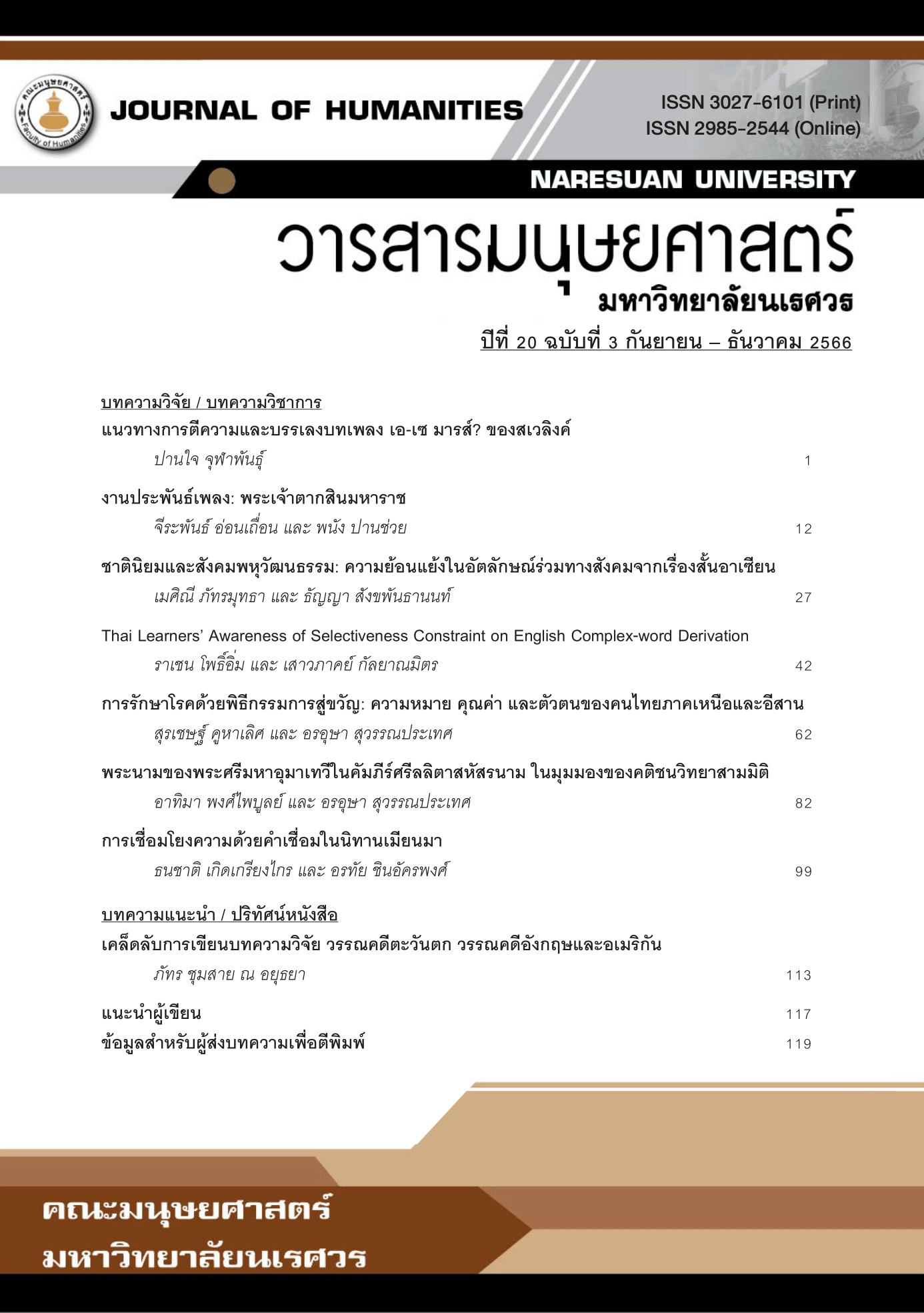
การตระหนักรู้เรื่องข้อบังคับการเลือกใช้ชนิดของคำในการสร้างคำผสานภาษาอังกฤษของผู้เรียนชาวไทย
Article Sidebar
Main Article Content
บทคัดย่อ
งานวิจัยนี้ศึกษาระดับการตระหนักรู้เรื่องข้อบังคับการเลือกใช้ชนิดของคำในการสร้างคำผสานภาษาอังกฤษของผู้เรียนชาวไทย 59 คน และความสัมพันธ์ระหว่างระดับการตระหนักรู้กับระดับความรู้ความสามารถโดยทั่วไปด้านภาษาอังกฤษ เครื่องมือคือแบบทดสอบปรนัย 4 ตัวเลือก จำนวน 60 ข้อ มีอุปสรรคและปัจจัยชนิดไม่กำกวม 10 ตัว และชนิดที่ให้ความหมายหลายนัย 10 คู่ เกรดเฉลี่ยวิชาภาษาอังกฤษและคะแนนสอบมาตรฐาน CEPT ใช้เป็นค่าระดับความรู้ทั่วไปด้านภาษาอังกฤษ พบว่ากลุ่มตัวอย่างตระหนักรู้เรื่องดังกล่าวในระดับพอใช้ และประสบผลสำเร็จมากกว่าในการสร้างคำด้วยตัวอุปสรรคและปัจจัยชนิดไม่กำกวม และพบความสัมพันธ์ที่สอดคล้องตามกันกับระดับความรู้ด้านภาษาอังกฤษ โดยระดับค่า CEFR ของคำศัพท์มีผลต่อความสำเร็จหรือล้มเหลวในการเรียนรู้ข้อบังคับการเลือกใช้ชนิดของคำในการสร้างคำผสาน
Article Details

อนุญาตภายใต้เงื่อนไข Creative Commons Attribution-NonCommercial-NoDerivatives 4.0 International License.
ข้อความรู้ใด ๆ ตลอดจนข้อคิดเห็นใด ๆ เป็นของผู้เขียนแต่ละท่านโดยเฉพาะ คณะมนุษยศาสตร์ มหาวิทยาลัยนเรศวร และกองบรรณาธิการวารสารมนุษยศาสตร์ฯ ไม่จำเป็นต้องเห็นพ้องด้วย
เอกสารอ้างอิง
Balpho, W. (2000). English syntax I (Unpublished manuscript). Bangkok: Dhonburi Rajabhat University.
Cambridge University Press. (n.d.). International language standards. Retrieved December 31, 2020, from https://www.cambridgeenglish.org/exams-and-tests/cefr/
Deng, T., Shi, J., Dunlap, S., Bi, H., & Chen, B. (2016). Morphological knowledge affects processing of L2 derivational morphology: An event-related potential study. Journal of Neurolinguistics, 37, 47-57.
Ellis, R. (1994). The study of second language acquisition. Oxford: Oxford University Press.
Ellis, R. (2002). The study of second language acquisition (9th ed.). Oxford: Oxford University Press.
Gass, S. M., & Selinker, L. (1994). Second language acquisition: An introductory course. New Jersey: Lawrence Erlbaum Associates.
Iwasaki, S., & Ingkaphirom, P. (2005). A reference grammar of Thai. New York: Cambridge University Press.
Kallayanamit, S. (2019). Thai learners’ morphological awareness of English complex words and its effects on vocabulary-in-context usage. Journal of Humanities Naresuan University, 16(2), 1-22.
Karlsson, M. (2015). Advanced students’ L1 (Swedish) and L2 (English) mastery of suffixation. International Journal of English Studies, 15(1), 23-49.
Lardiere, D. (2006). Words and their parts. In R. Fasold & J. Conner-Linton (Eds.), An introduction to language and linguistics (pp. 55-96). Cambridge: Cambridge University Press.
Masrai, A. M. (2016). The influence of morphological knowledge on lexical processing and acquisition: The case of Arab EFL learners. Ampersand, 3, 52-60.
Pasquarella, A., Chen X., Lam, K., & Luo, Y. C. (2013). Cross-language transfer of morphological awareness in Chinese–English bilinguals. Journal of Research in Reading, 34(1), 23-42.
Saville-Troike, M. (2004). Introducing second language acquisition (3rd ed.). New York: Cambridge University Press.
Ward, J., & Chuenjundaeng, J. (2009). Suffix knowledge: Acquisition and applications. System, 37, 461-469.
Zhang, D. (2013). Linguistic distance effect on cross-linguistic transfer of morphological awareness. Applied Psycholinguistics, 34(5), 917-942.
Zhang, D., Koda, K., & Sun, X. (2014). Morphological awareness in biliteracy acquisition: A study of young Chinese EFL readers. International Journal of Bilingualism, 18(6), 570-585.
