
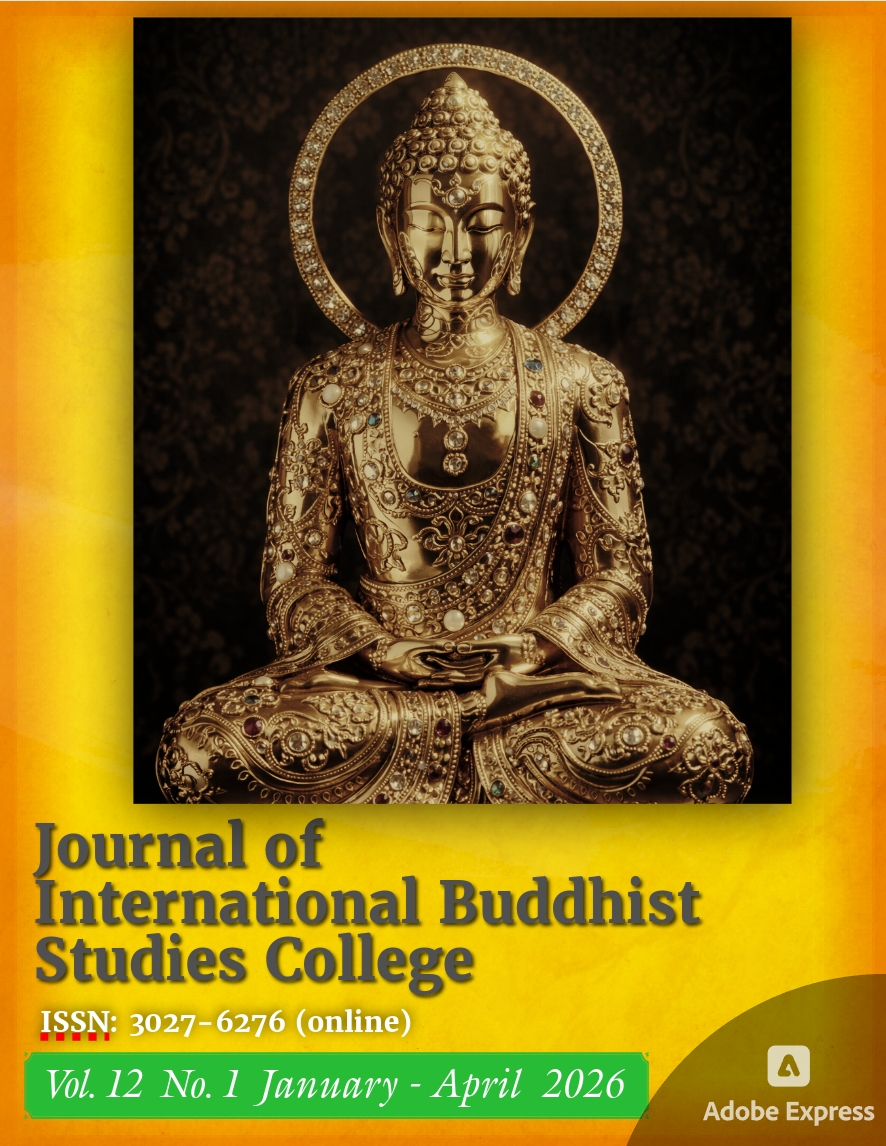
The Concept of Gratitude to the Buddha (Buddhānussati) and the Science of Gratitude
Article Sidebar
Main Article Content
Abstract
This article examines Buddhānussati (recollection of the Buddha) as a contemplative form of gratitude and proposes an interdisciplinary framework for interpreting its personal and social significance. Rather than treating Buddhānussati as a merely devotional act, the article argues that it functions as a disciplined recollective practice through which attention, emotion, and ethical orientation are reshaped by sustained reflection on the Buddha’s qualities. Drawing on selected Pāli sources and modern scholarship on gratitude, the discussion shows that Buddhist texts associate recollection of the Buddha with confidence, joy, tranquility, and concentration, while contemporary psychological and neuroscientific studies link gratitude with well-being, prosociality, and neural activity related to valuation, moral cognition, and emotion regulation. At the personal level, Buddhānussati may support emotional balance, resilience, ethical self-regulation, and reduced self-centered rumination. At the social level, it may foster humility, compassion, the expression of gratitude, and relational harmony within families, classrooms, and religious communities. The article argues, however, that scientific findings should not be used to reduce Buddhist soteriology to neurobiology, nor should speculative claims be treated as established evidence. The most defensible conclusion is that contemporary gratitude research can illuminate selected psychological and social dimensions of Buddhānussati, while Buddhist sources provide the deeper ethical and liberative framework within which the practice should be understood. Future research should employ philologically grounded textual study and culturally sensitive empirical designs to examine individual and communal forms of Buddhānussati more rigorously.
Article Details

This work is licensed under a Creative Commons Attribution-NonCommercial-NoDerivatives 4.0 International License.
The Journal of TCI is licensed under a Creative Commons Attribution-NonCommercial-NoDerivatives 4.0 International (CC BY-NC-ND 4.0) licence unless otherwise stated. Please read our Policies page for more information on Open Access, copyright and permissions.
References
Algoe, S. B. (2012). Find, remind, and bind: The functions of gratitude in everyday relationships. Social and Personality Psychology Compass, 6(6), 455–469. https://doi.org/10.1111/j.1751-9004.2012.00439.x
Algoe, S. B., Fredrickson, B. L., & Gable, S. L. (2013). The social functions of the emotion of gratitude via expression. Emotion, 13(4), 605–609. https://doi.org/10.1037/a0032701
Bhikkhu Bodhi. (Trans.). (2012). The numerical discourses of the Buddha: A translation of the Aṅguttara Nikāya. Wisdom Publications.
Boggiss, A. L., Consedine, N. S., Brenton-Peters, J. M., Hofman, P. L., & Serlachius, A. S. (2020). A systematic review of gratitude interventions: Effects on physical health and health behaviors. Journal of Psychosomatic Research, 135, 110165. https://doi.org/10.1016/j. jpsychores.2020.110165
Buddhaghosa. (2010). The path of purification (Visuddhimagga) (Bhikkhu Ñāṇamoli, Trans.). Buddhist Publication Society. (Original work published ca. 5th century CE)
Diniz, G., Korkes, L., Tristão, L. S., Pelegrini, R., Bellodi, P. L., & Bernardo, W. M. (2023). The effects of gratitude interventions: Systematic review and meta-analysis. einstein (São Paulo), 21, eRW0371. https://doi.org/ 10.31744/einstein_journal/2023RW0371
Fox, G. R., Kaplan, J., Damasio, H., & Damasio, A. (2015). Neural correlates of gratitude. Frontiers in Psychology, 6, 1491. https://doi.org/10.3389/ fpsyg.2015.01491
Grant, A. M., & Gino, F. (2010). A little thanks goes a long way: Explaining why gratitude expressions motivate prosocial behavior. Journal of Personality and Social Psychology, 98(6), 946–955. https://doi.org/10.1037/ a0017935
Hazlett, L. I., Moieni, M., Irwin, M. R., Haltom, K. E. B., Jevtic, I., Meyer, M. L., Breen, E. C., Cole, S. W., & Eisenberger, N. I. (2021). Exploring neural mechanisms of the health benefits of gratitude in women: A randomized controlled trial. Brain, Behavior, and Immunity, 95, 444–453. https://doi.org/10.1016/j.bbi.2021.04.019
Kini, P., Wong, J., McInnis, S., Gabana, N., & Brown, J. W. (2016). The effects of gratitude expression on neural activity. NeuroImage, 128, 1–10. https://doi.org/10.1016/j.neuroimage.2015.12.040
Wood, A. M., Froh, J. J., & Geraghty, A. W. A. (2010). Gratitude and well-being: A review and theoretical integration. Clinical Psychology Review, 30(7), 890–905. https://doi.org/10.1016/j.cpr.2010.03.005
