ความสัมพันธ์ระหว่างการตรวจเชื้อจากเสมหะไม่ครบและความสำเร็จ ในการรักษาวัณโรคปอด
Article Sidebar
Main Article Content
บทคัดย่อ
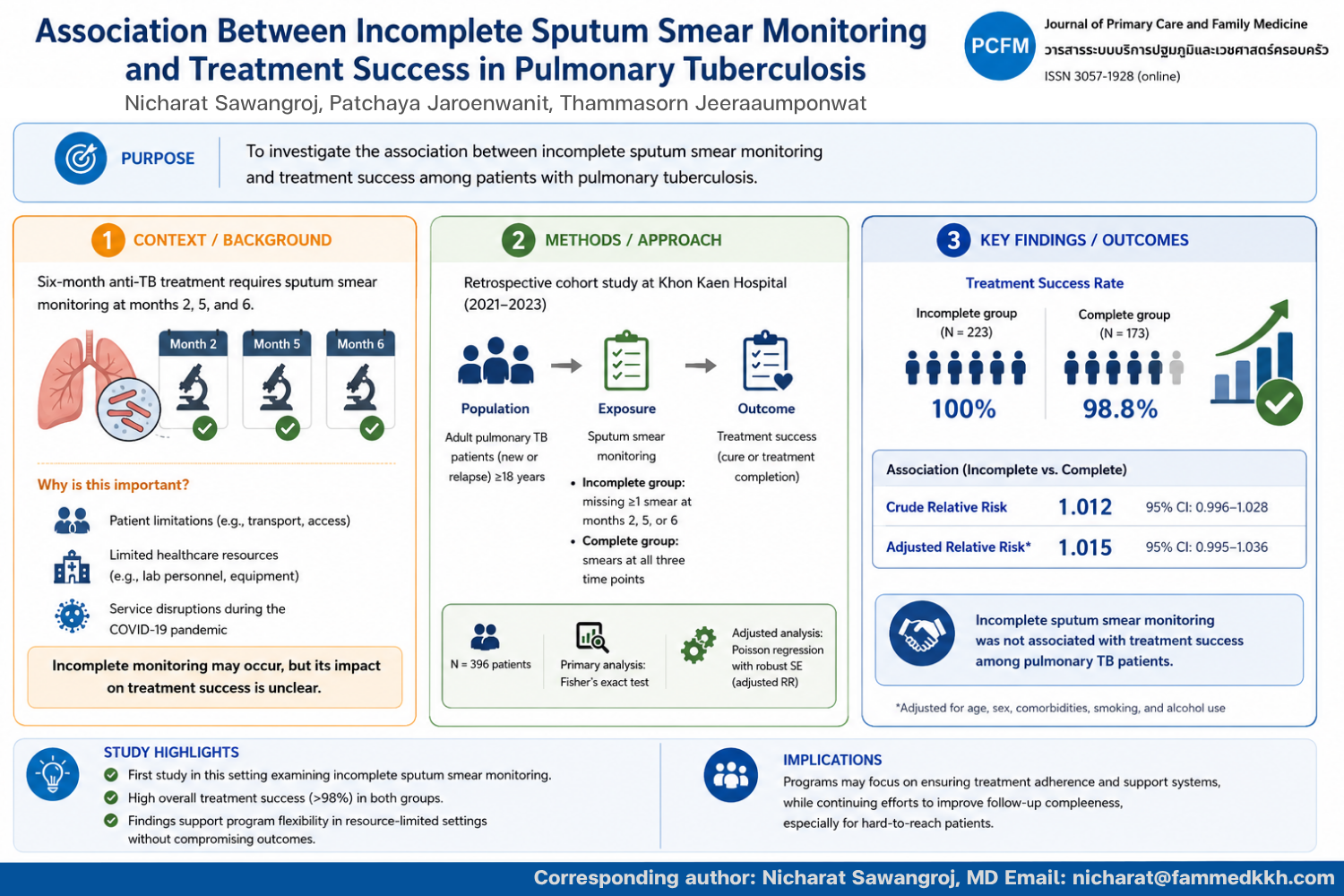
ที่มา: การรักษาวัณโรคปอดในปัจจุบัน รักษาด้วยยาเป็นเวลา 6 เดือน ร่วมกับการตรวจติดตามเสมหะในเดือนที่ 2 5 และ 6 อย่างไรก็ตาม ผู้ป่วยบางรายไม่สามารถมาตรวจติดตามครบทั้งสามครั้ง เนื่องจากข้อจำกัดของผู้ป่วย ทรัพยากรทางระบบสุขภาพที่จำกัด และการหยุดชะงักของบริการระหว่างการระบาดของโรคโควิด-19 เราจึงทำการศึกษาความสัมพันธ์ของการติดตามตรวจเสมหะไม่ครบตามเกณฑ์กับอัตราความสำเร็จในการรักษาผู้ป่วยวัณโรคปอด
แบบวิจัย: Retrospective cohort study
วัสดุและวิธีการ: ใช้ข้อมูลจากเวชระเบียนของผู้ป่วยวัณโรคปอดรายใหม่หรือกลับเป็นซ้ำ ที่เข้ารับการรักษาที่โรงพยาบาลขอนแก่น ระหว่างปี พ.ศ. 2564-2566 ผู้ป่วยถูกจัดเป็นสองกลุ่มตามการติดตามตรวจเสมหะ ได้แก่ กลุ่มไม่ครบ (ขาดการตรวจอย่างน้อยหนึ่งครั้งในเดือนที่ 2, 5 หรือ 6) และกลุ่มครบ (ตรวจครบทั้งสามครั้ง) ผลลัพธ์หลักคืออัตราการรักษาสำเร็จ ซึ่งหมายถึงผู้ที่รักษาหายหรือรักษาครบ โดยได้ทำการวิเคราะห์แบบปัจจัยเดียวด้วย Fisher’s exact test และใช้ Poisson regression ที่ปรับค่าเบี่ยงเบนมาตรฐาน (robust SE) เพื่อคำนวณ adjusted relative risk (aRR) โดยควบคุมตัวแปรกวน
ผลการศึกษา: จากเวชระเบียนผู้ป่วย 396 คน มี 223 คน อยู่ในกลุ่มที่ตรวจเสมหะไม่ครบ และ 173 คนในกลุ่มที่ตรวจครบ อัตราการรักษาสำเร็จในกลุ่มที่ตรวจไม่ครบคือ ร้อยละ 100 และในกลุ่มที่ตรวจครบคือ ร้อยละ 98.8 โดยมีค่า relative risk เท่ากับ 1.012 (95%CI: 0.996-1.028) นอกจากนี้ผลการวิเคราะห์โดยใช้ poisson regression ที่ควบคุมอายุ เพศ โรคร่วม การสูบบุหรี่ และการดื่มแอลกอฮอล์ ยังคงให้ผลไปในทิศทางเดียวกัน โดยมี aRR เท่ากับ 1.015 (95%CI: 0.995-1.036)
สรุป: การติดตามตรวจเสมหะไม่ครบตามเกณฑ์ไม่สัมพันธ์กับอัตราความสำเร็จในการรักษาผู้ป่วยวัณโรคปอด
คำสำคัญ: วัณโรคปอด การติดตามตรวจเสมหะ ความสำเร็จในการรักษา
Downloads
Article Details

อนุญาตภายใต้เงื่อนไข Creative Commons Attribution-NonCommercial-NoDerivatives 4.0 International License.
เนื้อหาและข้อมูลในบทความที่ลงตีพิมพ์ในวารสาร PCFM ถือเป็นข้อคิดเห็นและความรับผิดชอบของผู้เขียนบทความโดยตรง ซึ่งกองบรรณาธิการวารสารไม่จำเป็นต้องเห็นด้วยหรือร่วมรับผิดชอบใด ๆ
บทความ ข้อมูล เนื้อหา รูปภาพ ฯลฯ ที่ได้รับการตีพิมพ์ลงในวารสาร PCFM ถือเป็นลิขสิทธิ์ของวารสาร PCFM หากบุคคลหรือหน่วยงานใดต้องการนำทั้งหมดหรือส่วนหนึ่งส่วนใดไปเผยแพร่ต่อหรือเพื่อกระทำการใด ๆ จะต้องได้รับอนุญาตเป็นลายลักษณ์อักษรจากวารสาร PCFM ก่อนเท่านั้น
เอกสารอ้างอิง
Global tuberculosis report 2023. Geneva: World Health Organization; 2023.
WHO operational handbook on tuberculosis. Module 4: Treatment – drug-susceptible tuberculosis treatment. Geneva: World Health Organization; 2022.
WHO global lists of high burden countries for TB, multidrug/rifampicin-resistant TB (MDR/RR-TB) and TB/HIV, 2021–2025. Geneva: World Health Organization; 2021.
Division of Tuberculosis, Department of Disease Control, Ministry of Public Health. Thailand operational plan: To end tuberculosis, phase 2 (2023–2027). Bangkok: Aksorn Graphic and Design Publishing House; 2023.
Division of Tuberculosis, Department of Disease Control, Ministry of Public Health. Division of Tuberculosis. National Tuberculosis Control Programme Guideline, Thailand 2021. Bangkok: Aksorn Graphic and Design Publishing House; 2021.
Alene KA, Wangdi K, Clements ACA. Impact of the COVID-19 pandemic on tuberculosis control: an overview. Trop Med Infect Dis. 2020;5:123.
Chaves Torres NM, Quijano Rodríguez JJ, Porras Andrade PS, Arriaga MB, Netto EM. Factors predictive of the success of tuberculosis treatment: a systematic review with meta-analysis. PLoS One. 2019;14(12):e0226507. PubMed .
Satyanarayana S, Nagaraja SB, Kelamane S, Jaju J, Chadha SS, Chander K, et al. Did successfully treated pulmonary tuberculosis patients undergo all follow-up sputum smear examinations? Public Health Action. 2011;1:27-9.
Nakaggwa P, Odeke R, Kirenga BJ, Bloss E. Incomplete sputum smear microscopy monitoring among smear-positive tuberculosis patients in Uganda. Int J Tuberc Lung Dis. 2016;20:594–9.
Izudi J, Tamwesigire IK, Bajunirwe F. Does completion of sputum smear monitoring have an effect on treatment success and cure rate among adult tuberculosis patients in rural Eastern Uganda? A propensity score-matched analysis. PLoS One. 2019;14(12):e0226919. PubMed
Charoensakulchai S, Lertpheantum C, Aksornpusitpong C, Trakulsuk P, Sakboonyarat B, Rangsin R, et al. Six-year trend and risk factors of unsuccessful pulmonary tuberculosis treatment outcomes in Thai community hospital. BMC Res Notes. 2021;14(1):89. PubMed
Ralph AP, Ardian M, Wiguna A, Maguire GP, Becker NG, Drogumuller G, et al. A simple, valid, numerical score for grading chest X-ray severity in adult smear-positive pulmonary tuberculosis. Thorax. 2010;65:863–9.
Thiel BA, Bark CM, Nakibali JG, van der Kuyp F, Johnson JL. Reader variability and validation of the Timika X-ray score during treatment of pulmonary tuberculosis. Int J Tuberc Lung Dis. 2016;20:1358–63.
Chakraborthy A, Shivananjaiah AJ, Ramaswamy S, Chikkavenkatappa N. Chest X-ray score (Timika score): a useful adjunct to predict treatment outcome in tuberculosis. Adv Respir Med. 2018;86:205–10.
Ngamjarus C, Pattanittum P. n4Studies [mobile application]. Version 2.2. Bangkok: App Store; 2023. Available from: https://apps.apple.com/th/app/n4studies/id680516901
The jamovi project. jamovi [computer software]. Version 2.4. 2023. Available from: https://www.jamovi.org
Posit Team. RStudio: Integrated Development Environment for R [computer software]. Version 2024.12.1+563 (“Kousa Dogwood”). 2025. Available from: https://posit.co
Horne DJ, Royce SE, Gooze L, Narita M, Hopewell PC, Nahid P, et al. Sputum monitoring during tuberculosis treatment for predicting outcome: systematic review and meta-analysis. Lancet Infect Dis. 2010;10:387–94.
