
Association Between Incomplete Sputum Smear Monitoring and Treatment Success in Pulmonary Tuberculosis
Article Sidebar
Main Article Content
Abstract
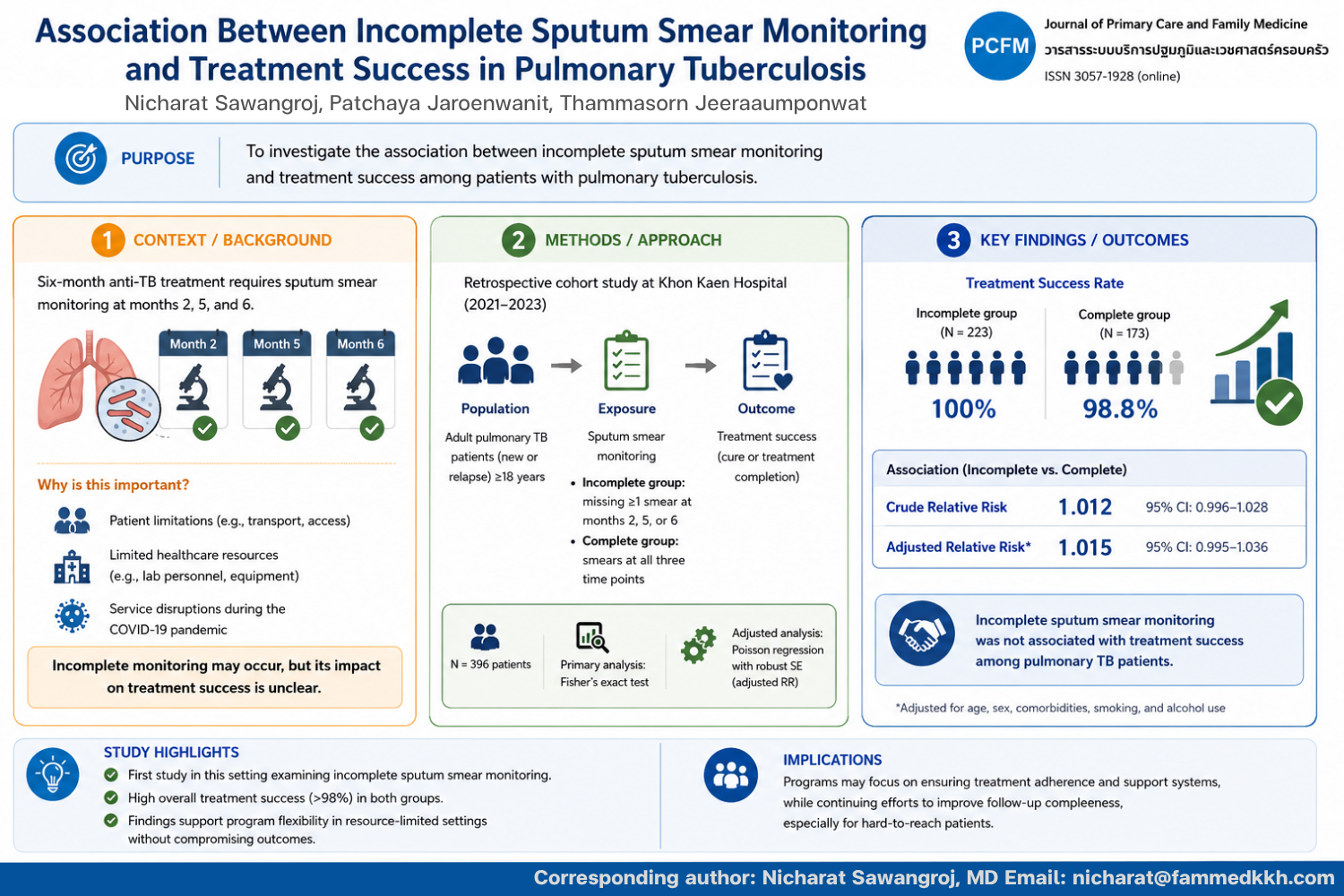
Background: The six-month treatment regimen for pulmonary tuberculosis (TB) includes sputum monitoring at months two, five, and six. However, due to patient limitations, healthcare resource constraints, and service disruptions during the COVID-19 pandemic, some patients were unable to complete all three follow-ups. This study aimed to investigate the association between incomplete sputum smear monitoring and treatment success among patients with pulmonary TB.
Design: Retrospective cohort study
Methods: The medical records were analyzed for new or relapsed cases of adult pulmonary TB patients treated at Khon Kaen Hospital between 2021 and 2023. Patients were categorized into two groups: the incomplete monitoring group (missing ≥ one smear at months two, five, or six), and the complete group (smears at all three points). The primary outcome was treatment success, defined as cure or treatment completion. Crude analysis was performed using Fisher’s exact test. Poisson regression with robust standard errors was used to estimate adjusted relative risk (aRR).
Results: Of 396 patients, 223 were in the incomplete group and 173 in the complete group. The treatment success rate was 100% in the incomplete group and 98.8% in the complete group. The crude relative risk was 1.012 (95% CI: 0.996-1.028). After adjustment for age, sex, comorbidities, smoking, and alcohol use, the association remained in the same direction, with an aRR of 1.015 (95% CI: 0.995-1.036).
Conclusions: Incomplete sputum smear monitoring was not associated with the treatment success rate among pulmonary TB patients.
Keywords: pulmonary tuberculosis, sputum smear monitoring, treatment success
Downloads
Article Details

This work is licensed under a Creative Commons Attribution-NonCommercial-NoDerivatives 4.0 International License.
The content and information in articles published in the PCFM journal are solely the opinions and responsibilities of the authors. The journal's editorial board does not necessarily agree with or share any responsibility for them.
All articles, information, content, images, etc., published in the PCFM journal are the copyright of the PCFM journal. If any individual or organization wishes to reproduce, distribute, or use any part or the entirety of the content, they must obtain written permission from the PCFM journal beforehand.
References
Global tuberculosis report 2023. Geneva: World Health Organization; 2023.
WHO operational handbook on tuberculosis. Module 4: Treatment – drug-susceptible tuberculosis treatment. Geneva: World Health Organization; 2022.
WHO global lists of high burden countries for TB, multidrug/rifampicin-resistant TB (MDR/RR-TB) and TB/HIV, 2021–2025. Geneva: World Health Organization; 2021.
Division of Tuberculosis, Department of Disease Control, Ministry of Public Health. Thailand operational plan: To end tuberculosis, phase 2 (2023–2027). Bangkok: Aksorn Graphic and Design Publishing House; 2023.
Division of Tuberculosis, Department of Disease Control, Ministry of Public Health. Division of Tuberculosis. National Tuberculosis Control Programme Guideline, Thailand 2021. Bangkok: Aksorn Graphic and Design Publishing House; 2021.
Alene KA, Wangdi K, Clements ACA. Impact of the COVID-19 pandemic on tuberculosis control: an overview. Trop Med Infect Dis. 2020;5:123.
Chaves Torres NM, Quijano Rodríguez JJ, Porras Andrade PS, Arriaga MB, Netto EM. Factors predictive of the success of tuberculosis treatment: a systematic review with meta-analysis. PLoS One. 2019;14(12):e0226507. PubMed .
Satyanarayana S, Nagaraja SB, Kelamane S, Jaju J, Chadha SS, Chander K, et al. Did successfully treated pulmonary tuberculosis patients undergo all follow-up sputum smear examinations? Public Health Action. 2011;1:27-9.
Nakaggwa P, Odeke R, Kirenga BJ, Bloss E. Incomplete sputum smear microscopy monitoring among smear-positive tuberculosis patients in Uganda. Int J Tuberc Lung Dis. 2016;20:594–9.
Izudi J, Tamwesigire IK, Bajunirwe F. Does completion of sputum smear monitoring have an effect on treatment success and cure rate among adult tuberculosis patients in rural Eastern Uganda? A propensity score-matched analysis. PLoS One. 2019;14(12):e0226919. PubMed
Charoensakulchai S, Lertpheantum C, Aksornpusitpong C, Trakulsuk P, Sakboonyarat B, Rangsin R, et al. Six-year trend and risk factors of unsuccessful pulmonary tuberculosis treatment outcomes in Thai community hospital. BMC Res Notes. 2021;14(1):89. PubMed
Ralph AP, Ardian M, Wiguna A, Maguire GP, Becker NG, Drogumuller G, et al. A simple, valid, numerical score for grading chest X-ray severity in adult smear-positive pulmonary tuberculosis. Thorax. 2010;65:863–9.
Thiel BA, Bark CM, Nakibali JG, van der Kuyp F, Johnson JL. Reader variability and validation of the Timika X-ray score during treatment of pulmonary tuberculosis. Int J Tuberc Lung Dis. 2016;20:1358–63.
Chakraborthy A, Shivananjaiah AJ, Ramaswamy S, Chikkavenkatappa N. Chest X-ray score (Timika score): a useful adjunct to predict treatment outcome in tuberculosis. Adv Respir Med. 2018;86:205–10.
Ngamjarus C, Pattanittum P. n4Studies [mobile application]. Version 2.2. Bangkok: App Store; 2023. Available from: https://apps.apple.com/th/app/n4studies/id680516901
The jamovi project. jamovi [computer software]. Version 2.4. 2023. Available from: https://www.jamovi.org
Posit Team. RStudio: Integrated Development Environment for R [computer software]. Version 2024.12.1+563 (“Kousa Dogwood”). 2025. Available from: https://posit.co
Horne DJ, Royce SE, Gooze L, Narita M, Hopewell PC, Nahid P, et al. Sputum monitoring during tuberculosis treatment for predicting outcome: systematic review and meta-analysis. Lancet Infect Dis. 2010;10:387–94.
